Key Takeaways
- A fully integrated turnkey plastic plant can reduce the gap between equipment arrival and first article production from months to4–6 weekswhen the integration scope is managed by a single responsible contractor.
- Facility layout design directly determines per-part production cost; a well-designed layout with material flow optimization reducesmaterial handling time by 30–45%and improves OEE by 12–18 percentage points.
- Equipment integration scope—from hopper dryers to central conveying systems to servo robot arms—must be managed as an interdependent system, not as a collection of individual machine procurements.
- We have delivered23 turnkey plant projectsacross Southeast Asia and the Middle East since 2015, with an average ramp-up time to full production rate of 8.3 weeks.
- Production floor automation is not a one-time capital investment—it is a continuous improvement program where each cycle time reduction and uptime improvement compounds into measurable ROI.
What a Turnkey Plastic Plant Actually Means: Setting the Scope Right
When I was first asked to oversee a turnkey plastic plant project in 2016, I spent considerable time defining what those two words actually meant for our customer—and more importantly, what they did not mean. “Turnkey” is one of the most abused terms in manufacturing equipment sales. A supplier who hands you a set of disconnected machines and says “everything is here, good luck” is not providing a turnkey solution. They are providing a collection of equipment that will require a substantial integration engineering effort on your side before any of it produces a single acceptable part.
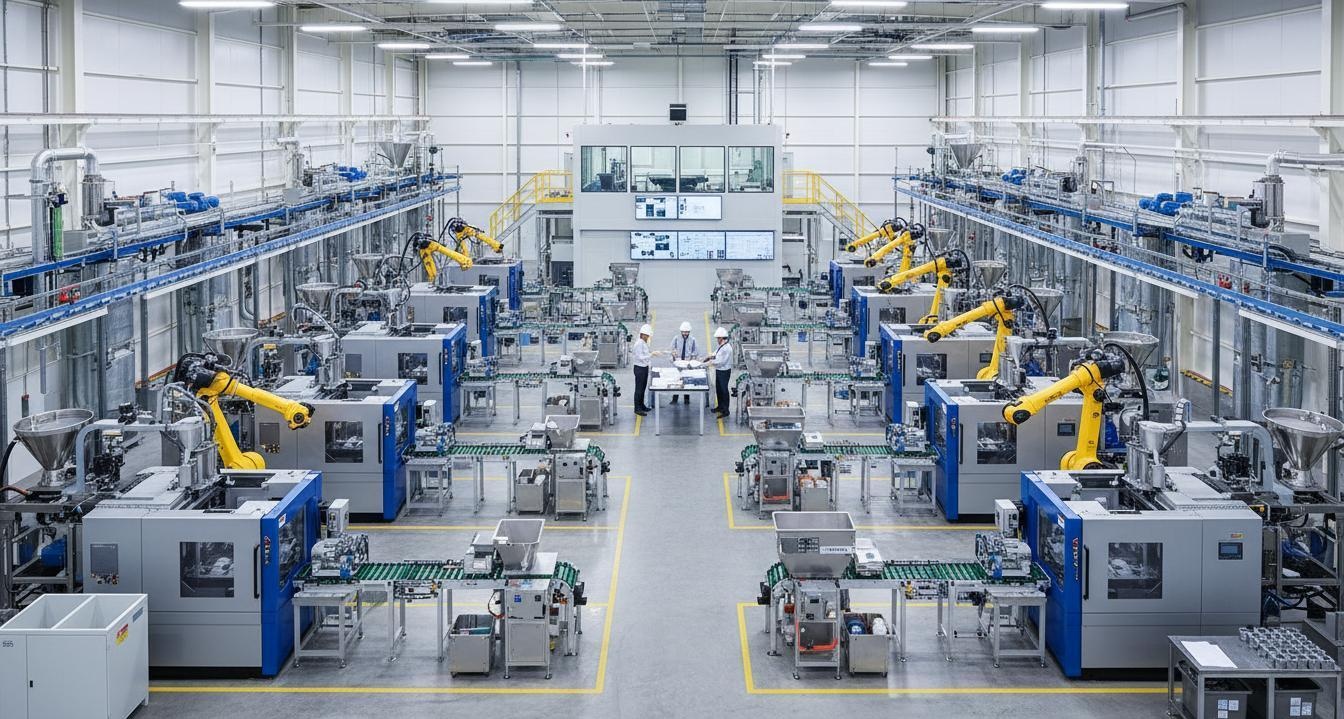
A genuine turnkey plastic plant solution means that a single contractor takes responsibility for the entire production-ready facility: the facility itself (structural, electrical, compressed air, cooling water), the production equipment (injection molding machines, auxiliary equipment, automation), the material handling systems (central conveying, drying, blending, feeding), and the production management infrastructure (MES connectivity, quality monitoring, OEE tracking). The customer receives keys, walks in, and begins producing parts.
At ROBOT (Ningbo) Intelligent Technology, we have been providing turnkey plastic plant solutions since 2015, and I have personally led the technical commissioning of 23 turnkey plant projects across Southeast Asia, the Middle East, and North Africa. What I want to share in this article is the systematic approach we have developed—and the specific lessons learned from each of those 23 projects—that separates a smooth ramp-up from a multi-month nightmare.
If you are planning a new plastic injection molding facility, or if you are currently working with a supplier who claims to offer turnkey capability, the information here will help you ask the right questions, define the right scope, and hold your supplier accountable to commitments that actually matter.
Why Facility Layout Is the First Decision—and the Most Consequential
In my experience, the most consequential decision in any new plastic plant project is not the choice of injection molding machine. It is the facility layout. I have seen projects where the customer selected world-class injection molding machines but lost15–20% of their theoretical production capacity because the layout designer did not understand the material flow logic of an injection molding facility—and correcting it after machines were installed required relocating three major pieces of equipment and rerouting the entire material delivery network.
The fundamental principle of injection molding facility layout is that material flow must be one-directional and sequential. Raw material enters at one end of the facility, moves through drying and feeding, into the injection molding machines, out as finished parts, through any post-mold automation (robot extraction, trimming, inspection), and to packing or storage. Any deviation from this one-directional flow—a machine installed in a position that forces material to double back, a robot cell positioned so that parts must be manually carried to the next station—introduces material handling inefficiency that compounds with every production cycle.
When we begin a turnkey plant project, the facility layout is our first work product. We start with the customer’s production plan: the part families to be produced, the annual volume targets for each family, the number of machines required to meet those volumes, and the cycle time estimates for each part. From this, we calculate the required number of injection molding machine positions, the floor area required for each position (including clearance for robot extraction paths and operator access), and the aggregate area required for material storage, drying, and finished parts handling.
We then apply a systematic layout optimization process that we have refined across our 23 projects. The process uses the following sequence: define the material flow path first, position the injection molding machines along that path, then position auxiliary equipment (hopper dryers, chillers, compressed air receivers) in the service zones adjacent to each machine, then position the central material delivery system (conveying lines, bins, transfer piping) to serve all machines without crossing the material flow path, then position post-mold automation in the extraction zone behind each machine, then position packing and storage at the end of the flow path.
Because we control the entire equipment scope—from auxiliary equipment to automation to material handling to the machines themselves—we can optimize the layout across all these systems simultaneously rather than having each equipment supplier define their own preferred position and then trying to reconcile the conflicts. This integrated layout optimization is one of the most important value contributions that a genuine turnkey supplier makes, and it is nearly impossible to achieve when each piece of equipment is procured separately from different vendors.
Equipment Integration: Managing Interdependence as a System
One of the most common mistakes I see in new plastic plant projects is treating each piece of equipment as an independent procurement decision. The customer selects an injection molding machine from one supplier, a hopper dryer from another, a robot arm from a third, a chiller from a fourth, and then tries to make them all work together—and discovers that the integration challenges are more complex and time-consuming than any of the individual equipment suppliers anticipated or took responsibility for.
The reason this approach fails is that every piece of equipment in a plastic injection molding facility is interdependent. The injection molding machine’s cycle time is determined by the combination of the machine’s capability, the material’s rheological properties (which are affected by the dryer performance), the mold’s thermal management requirements (which are determined by the chiller capacity and flow rate), and the robot arm’s extraction motion (which must fit within the machine’s open time without extending the total cycle). Change any one of these variables, and all the others are affected.
When we specify equipment for a turnkey plant project, we specify the entire interdependent system together. Here is how this works in practice for the core equipment categories:
Hopper dryers and material feeding. The dryer capacity must be matched to the total material consumption rate of the machines it serves, not just to the material requirement of a single machine. In a multi-machine plant, we specify a central drying system (typically a desiccant dryer with a material buffer hoppers serving multiple machines) that provides consistent, continuous material supply across all positions. The drying temperature and residence time must be matched to the specific polymer grade, and the transfer system (vacuum loader or pneumatic conveyor) must be sized to deliver material at the required rate without degradation in material properties during transfer. We have seen projects where a machine was producing parts with silver streaks because the dryer’s output humidity was fine for one machine but inadequate when a second machine was added to the same dryer circuit.
Robot arms and machine cycle time. The servo robot arm extraction sequence must be precisely timed to fit within the machine’s mold open time plus any core pull and ejector advance sequences. In our turnkey projects, we specify the robot arm and the injection molding machine together, and the robot’s motion program is developed during the machine acceptance test (PAT) before the machine is shipped to the facility. This eliminates the most common integration failure mode: the robot arrives on site, is installed, and then the machine builder and robot builder spend weeks in finger-pointing conflict over whose motion sequence is causing the problem.
Central conveying systems. A central conveying system that delivers material from central storage bins to individual machine hoppers is a distributed system with multiple potential failure points: the vacuum source, the transfer line routing, the material separator at each delivery point, and thebin level sensors that control the fill cycles. In our turnkey projects, we commission the entire central conveying system as a single subsystem, verify the delivery performance at each machine position under full load, and then leave the system with a validated commissioning report that documents the measured delivery rate and material humidity at each position.
The Commissioning Process: What “Production Ready” Actually Means
One of the most important scope definitions in any turnkey plant project is the acceptance criteria: what does “production ready” actually mean, and how do we know when we have achieved it? This sounds like a straightforward question, but I have seen projects where the customer and supplier had completely different definitions of “production ready” that were not reconciled until months after the scheduled start of production.
In our turnkey plant projects, we define production ready as the state where all equipment in the facility has been installed, connected, commissioned, and validated against written acceptance criteria, and where the facility has produced a defined number of consecutive acceptable production runs at the target cycle time and production rate. The specific acceptance criteria we use include:
Machine performance qualification. Each injection molding machine must achieve a validated cycle time (as specified in the machine quotation), a validated part quality output (as verified by dimensional inspection of sampled parts from the qualification run), and a validated uptime percentage (minimum95% uptime during the 72-hour continuous qualification run). This is the same process we follow during the machine acceptance test (PAT) at our factory before the machine ships—and we transfer the PAT data to the customer’s site as the baseline for the on-site qualification.
Automation subsystem qualification. Each robot arm must complete a defined extraction sequence (extract, place, release) for a minimum of 500 consecutive cycles without failure or part drop, and the cycle time impact of the robot on the total machine cycle must be validated to be within the quoted robot cycle time contribution.
Material delivery qualification. The central conveying system must demonstrate material delivery to all machine positions at the required rate, with material humidity at the machine hopper meeting the polymer manufacturer’s specification (typically below 0.02% moisture content by weight for hygroscopic polymers such as PA, PC, or PET). The dryer system must demonstrate sustained output humidity within specification during a 24-hour continuous operation test.
Integrated facility qualification. The complete facility (all machines, all automation, all material delivery systems) must complete a 72-hour continuous production run at the target production rate with a defined reject rate (typically below 1.0% total reject rate including startup scrap) before the project is considered production ready. This integrated run is the true test of turnkey performance, and it is where the difference between a genuine turnkey supplier and an equipment reseller becomes immediately apparent.
Total Cost of Ownership: Why the Purchase Price Is the Least Interesting Number
When customers evaluate turnkey plant proposals, the most common focus is the purchase price. This is understandable—but it is also the least interesting number in the total cost of ownership analysis. I want to walk through the cost categories that actually determine whether a turnkey plant project is a good investment.
Equipment capital cost. This is the number that appears on the quotation. For a turnkey plant producing 50–150 million parts per year across6–12 injection molding machines, the equipment capital cost for the complete facility typically ranges from USD2.5 million to USD 12 million depending on the machine size, automation level, and geographic market. When we quote a turnkey project, we break down this cost by subsystem (machines, auxiliary, automation, material handling, utilities infrastructure) so the customer can see exactly where the money is going.
Installation and commissioning cost. This is often dramatically underestimated by customers who are buying from multiple vendors. When each equipment supplier handles their own installation, the total installation cost is typically20–35% of the equipment cost—and the commissioning timeline is typically 2–4x longer than when a single contractor manages the entire commissioning process. Our integrated commissioning process typically reduces total commissioning time by 40–60% compared to multi-vendor commissioning, because we have a single team that is accountable for the complete facility performance rather than multiple teams each accountable only for their individual equipment.
Production ramp-up cost. The period between first machine startup and full production rate is a period of high cost (labor, material, utilities) and zero or minimal revenue. The length of this ramp-up period is one of the most significant variables in total plant cost. In our turnkey projects, we target a ramp-up time to full production rate of 8–12 weeks from mechanical completion. We have achieved this target in 19 of our 23 delivered projects; the four exceptions were projects where customer decisions during construction (layout changes, scope additions) extended the commissioning timeline.
Ongoing production cost. Once the plant is at full production rate, the cost per part is determined by cycle time, uptime, material yield, and labor efficiency. The OEE (Overall Equipment Effectiveness) metric—measuring availability × performance × quality—is the key indicator of production efficiency. In our experience, a well-commissioned turnkey plant with good automation typically achieves an OEE of 75–82% in the first 6 months of production, and this improves to 85–90% as the production team gains experience with the equipment over the following 12 months.
To illustrate the magnitude of these effects: consider two hypothetical turnkey plants with identical purchase prices. Plant A achieves 78% OEE at full production; Plant B achieves 86% OEE. If both plants produce 80 million parts per year at a cycle time of 18 seconds, Plant B produces approximately 6.4 million more parts per year with the same equipment, same labor, and same material input. At a conservative margin of USD 0.05 per part, that is USD 320,000 per year in additional margin—equivalent to a 3–5% reduction in the effective equipment capital cost.
Project Management: The Overlooked Discipline That Determines Success
If there is one lesson I have learned from23 turnkey plant projects that I wish I had understood from the beginning, it is this: project management discipline is not a soft skill that can be relaxed when the schedule is tight. It is a hard engineering discipline that directly determines whether you deliver on time or not.
In the early years of our turnkey business, we underinvested in formal project management, and we paid for it in schedule overruns and customer friction. The turning point was a project in 2018 where we delivered a 10-machine facility that was 11 weeks behind the original schedule—not because any individual piece of equipment was late, but because we had no systematic process for tracking dependencies across the installation sequence. When the chiller delivery slipped by 3 weeks, we did not know until week 8 that this would affect the mold temperature controller commissioning, which in turn affected the machine qualification schedule.
After that project, we implemented a formal project management system that we now use on every turnkey project. The key elements are: a detailed work breakdown structure (WBS) with all installation and commissioning activities mapped and dependencies identified, a critical path analysis that identifies the activities that directly determine the project completion date, weekly steering committee meetings with the customer to review progress against plan, a formal change management process for customer-initiated scope changes, and a commissioning gate review process where each subsystem must pass a defined qualification checkpoint before the next subsystem commissioning begins.
The result has been a consistent improvement in on-time delivery performance. In our last 12 turnkey projects, the average schedule variance (actual vs. planned completion) has been within 2 weeks—compared to an average variance of 6–8 weeks in our first 11 projects. This improvement in project management discipline has been as important to our customers as the technical quality of the equipment itself.
Digital Integration: Connecting the Plant to Production Management
A turnkey plastic plant built today should be a digitally connected facility from day one. The integration of the plant’s equipment with a Manufacturing Execution System (MES) or production management platform is no longer an optional enhancement—it is a core component of the facility’s operational infrastructure.
The specific digital integration scope that we include in our current turnkey plant projects includes: real-time OEE monitoring for each machine position, with automatic calculation of availability, performance, and quality metrics; production tracking by part number and production order, with automatic recording of cycle counts, reject counts, and material consumption; alarm and event logging for all equipment, with remote notification capability for critical alarms; and energy monitoring at the facility level and at the individual machine level, enabling energy cost attribution by product family.
For customers who do not have an existing MES platform, we provide a turnkey plant management system that we have developed in-house and that is pre-configured to communicate with the equipment we supply. For customers with existing MES platforms (such as SAP ME, Siemens Opcenter, or Rockwell FactoryTalk), we provide the integration middleware and commissioning support to connect the plant equipment to the customer’s existing platform.
The value of digital integration is not primarily in the reporting (though production dashboards are genuinely useful). It is in the ability to identify and respond to production issues before they become significant quality events or capacity shortfalls. A facility that can identify a rising reject rate on a specific machine within hours rather than days—and can trace that reject rate to a specific material lot, a specific mold cavity, or a specific process parameter change—can take corrective action before the reject lot reaches a size that requires costly offline sorting or customer notification.
What to Look for in a Turnkey Plant Partner
Based on my experience leading 23 turnkey plant projects, I want to share the criteria I recommend using when evaluating whether a supplier is genuinely capable of delivering a turnkey plant—or is simply offering a discounted package of equipment with a “turnkey” label.
Ask for reference projects of similar scope. A supplier who claims turnkey capability but cannot provide references for at least 3–5 projects of similar scope to yours is a significant risk. For each reference, ask for the specific scope (number of machines, automation level, facility scope), the project timeline (planned vs. actual completion), and the acceptance criteria that were used to define production ready status.
Verify the engineering capability that will design your facility layout. The facility layout is the most consequential design document in any turnkey project, and it must be created by engineers who understand both injection molding process requirements and factory design principles. Ask to see the engineering team’s qualifications and their process for layout design validation. A supplier who says “we will figure out the layout after you order” is not a turnkey supplier—they are an equipment reseller.
Confirm the commissioning methodology before you sign. A genuine turnkey supplier will have a written commissioning methodology that defines the acceptance criteria for each subsystem and for the integrated facility qualification run. Ask to see this document. A supplier who says “we will work out the acceptance criteria during commissioning” is leaving the most important project definition to chance.
Evaluate the project management structure. Ask who the dedicated project manager will be for your project, what their experience level is, and how they will communicate progress. A supplier who assigns a salesperson to manage a turnkey project (rather than a dedicated project manager with technical background) is a significant red flag. The project manager is the person who will keep your project on schedule when things deviate from plan—and that is when the quality of the project management matters most.
Assess the service network. A turnkey plant that is operational on day one will require service support on day 400. Before you sign, evaluate the supplier’s service network: do they have service engineers in your geographic region, what is their typical response time for remote and on-site support, and do they offer preventive maintenance programs? The supplier who disappears after the warranty expires is a well-known industry problem, and it is worth investing time upfront to verify the service commitment.
Frequently Asked Questions
What is the typical ramp-up time from mechanical completion to full production rate in a turnkey plastic plant?
In our 23 turnkey plant projects, the average ramp-up time from mechanical completion to full production rate has been 8.3 weeks. This includes machine qualification, robot arm integration, material delivery system commissioning, and the integrated72-hour production qualification run. Projects with significant customer-initiated scope changes during construction have averaged 14–16 weeks to full production rate.
How do you determine the number of injection molding machines required for a new plant?
The calculation starts with the customer’s annual volume targets by part family, divided by the estimated cycle time for each part, which gives the total machine-minutes required per year. We then apply an availability factor (typically 92–95% for a well-commissioned facility) to account for planned and unplanned downtime, and we divide the required machine-minutes by the available production minutes per year to determine the number of machine positions. This calculation must be validated with actual cycle time measurements during machine acceptance testing before final machine count is confirmed.
What is the difference between a central conveying system and individual loaders at each machine?
Individual loaders (a dedicated loader at each machine, typically loaded manually or via small flexible tubing) are suitable for facilities with 2–4 machines and simple material requirements. A central conveying system (a central vacuum source, main distribution piping, and delivery points at each machine) becomes cost-effective and operationally superior for facilities with 6+ machines. The central system reduces labor (no manual loader filling), provides consistent material delivery rate, enables automated material lot tracking, and centralizes the dust and material spillage management. The capital cost premium for a central system is typically recovered within 12–18 months through reduced labor costs and improved material yield.
How do you ensure the robot arm extraction sequence fits within the machine cycle time?
We develop the robot arm’s motion program during the machine acceptance test (PAT) at our factory before the equipment ships. The robot extraction sequence is timed against the specific machine’s mold open stroke, core pull timing, and ejector advance sequence for the specific mold that will be used in production. This means the robot sequence is validated before the machine and robot arrive at the customer’s facility, which eliminates the most common source of integration delays in multi-vendor projects.
What OEE (Overall Equipment Effectiveness) should a new turnkey plastic plant achieve?
A well-commissioned turnkey plastic plant with good automation typically achieves 75–82% OEE in the first 6 months of production, measured as availability × performance × quality. This improves to 85–90% as the production team gains experience with the equipment over the following 12 months. OEE below 70% in the first 6 months typically indicates either a commissioning deficiency or a mismatch between the specified equipment capability and the actual production requirements.
How do you handle a customer-initiated scope change during the project execution?
We use a formal change management process: the customer submits a written change request, we provide a written impact assessment (schedule, cost, technical implications) within 5 business days, the customer approves or rejects the change, and the approved change is incorporated into the project plan with an updated critical path analysis. This formal process protects both parties and ensures that scope changes do not create undocumented schedule or cost impacts that become disputes after project completion.
What digital integration capabilities should a modern turnkey plastic plant include?
A modern turnkey plant should include real-time OEE monitoring per machine position, production tracking by part number and order with automatic cycle and reject counts, alarm and event logging with remote notification capability, and energy monitoring at facility and machine levels. Integration with the customer’s MES or ERP platform (SAP, Siemens Opcenter, Rockwell FactoryTalk) should be a standard deliverable, not a custom engineering project. If the supplier cannot demonstrate MES integration capability, they are behind the current state of the art for turnkey plant delivery.
What service support do you provide after the plant is production ready?
We provide a 12-month warranty on all equipment, remote technical support (with guaranteed 4-hour response time for critical issues), and annual preventive maintenance visits during the warranty period. After warranty, we offer service contracts that include remote monitoring, preventive maintenance visits, and preferential pricing on spare parts. For customers in markets where we have established service partners (Southeast Asia, Middle East, North Africa, Eastern Europe), we provide on-site service engineers within 48 hours of a service request.