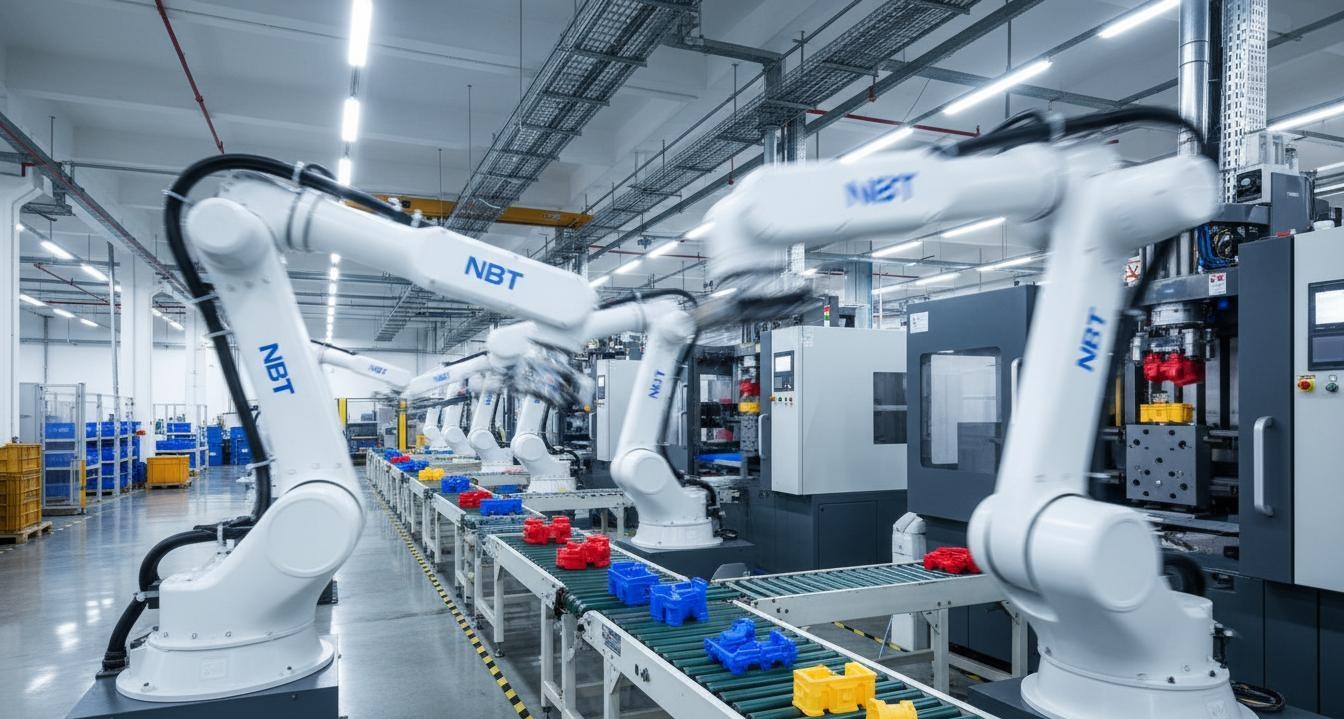
In my two decades working with injection molding factories across Asia and Europe, I have watched countless lines struggle with the same root problem: a take-out system that cannot keep pace with the press. I have seen managers blame cycle time on the molding machine when the real culprit was a underperforming robot arm. I have seen 500-ton presses idling while a pneumatic take-out unit — designed for a different era of part geometry — limped through extractions it was never meant to handle. And I have seen facilities invest in servo robot arms and recover their cost in under 18 months. The difference always came down to understanding what servo drive architecture actually delivers, and choosing a manufacturer that builds for real production floors, not trade show demos.
In this article, I want to share what I have learned about sourcing and specifying servo robot arms for injection molding take-out — including what separates the manufacturers who genuinely understand this equipment from those who simply resell a generic product with aggressive marketing. I have been in the plants, read the spec sheets, and tracked the real-world performance data. What follows is the guide I wish I had when I was earlier in my career.
Why Servo-Driven Robot Arms Dominate High-Speed Take-Out
The shift from pneumatic to servo-driven take-out robots was not merely a technological upgrade — it was a fundamental change in what factories could achieve. I remember working with a plant in Guangdong that was running 18-second cycle times on a 280-ton press producing thin-wall food containers. They were convinced they needed a faster press. What they actually needed was to replace their five-year-old pneumatic take-out robot with a servo-driven unit. The servo arm cut their take-out portion of the cycle from 1.8 seconds to 0.7 seconds. That single change brought their overall cycle time to 14 seconds — without touching the IMM. No new press. No facility expansion. Just the right automation.
Pneumatic drives offered simplicity, but they could not deliver the positional repeatability or variable speed control that modern thin-wall parts demand. When I evaluate a servo robot arm today, I look at the X, Y, and Z AC servo motor configuration as the baseline for genuine high-performance take-out. Each axis is controlled independently, meaning the robot can execute variable acceleration and deceleration profiles tailored to each mold cavity and part geometry. The result is consistently faster minimum take-out times — some models now achieving sub-1-second take-out cycles — without the part deformation that comes from abruptly stopping a thin-wall container mid-extraction.
When we at ROBOT (Ningbo) designed our SPRT3S series, we built them with this independent axis control as the foundation. A typical telescopic servo robot arm from our lineup integrates three independent servo axes: vertical stroke (Z-axis), crosswise extraction (Y-axis), and transverse movement (X-axis). Each axis operates independently, which means the robot can enter the mold at a controlled speed, engage the part without jarring it, and exit along an optimized path that protects the part and minimizes cycle time simultaneously.
Key Specifications When Evaluating a Servo Robot Arm Manufacturer
Minimum Take-Out Time and Cycle Speed
This is the metric that matters most to me when I am evaluating any take-out robot, and it is where genuine manufacturers differentiate themselves. In my field visits, I have seen leading servo robot arm manufacturers publish minimum take-out times of 0.7 seconds on smaller models (160–320T range) and under 2 seconds on heavy-payload units rated for 1000–4500T presses. I always verify these numbers against the actual payload at the time of measurement.
When I review a spec sheet, I pay particular attention to the minimum take-out time listed alongside the maximum load rating. A machine that claims 0.7-second take-out at 3kg payload but degrades to 2.5 seconds at 6kg is not truly a fast robot — it is a lightweight fast robot. I make sure the specs I compare are evaluated at the same load condition, and I ask manufacturers directly for the curve that shows take-out time versus payload weight. If they cannot produce it, that tells me something.
Across our own SPRT3S product line, we publish take-out times at each model’s rated maximum payload, because that is the number our customers need for their real production planning. The SPRT3S1000W delivers 0.7 seconds at 3kg payload. The SPRT3S1200W delivers 0.7 seconds at 6kg payload. The SPRT3S2200W, designed for 1000–1800T presses, achieves 4.5 seconds at 50kg payload. These are real numbers at real load conditions.
Drive System: AC Servo Motors on All Three Axes
Not all “servo robots” are fully servo-driven on every axis. In my experience, some manufacturers use a servo motor for the primary extraction axis while relying on pneumatics for secondary motions. That is a hybrid, not a true servo robot arm. A genuinely high-performance take-out robot uses AC servo motors for X, Y, and Z axes simultaneously, and this is what I recommend to every plant manager I work with.
The advantage is independent axis control: the robot can vary crosswise speed independently from vertical retract rate, optimizing the entry path through the mold opening and the exit path to the drop zone. This matters enormously for parts with delicate features, unsupported geometries, or cosmetic surfaces that cannot tolerate contact forces during extraction. In one memorable case, we helped a customer running automotive lens housings — deep-draw parts with absolutely zero draft — switch to fully servo-driven extraction and immediately saw a reduction in part scratch claims from their OEM customer. The servo-controlled deceleration profile made that difference.
Payload Capacity Matched to Your Press Tonnage
One of the most common mistakes I see when factories select a take-out robot is mismatching payload capacity to machine size. I have personally seen a robot rated for 3kg maximum load mounted on a 530T press producing large industrial containers. The robot was surviving, technically, but it was running so far below its comfortable operating window that its actual take-out time was double what the spec sheet promised. The plant manager did not understand why his cycle times were not improving after the automation upgrade. The answer was simple: wrong robot for the press.
At ROBOT (Ningbo), we segment our SPRT3S series by injection molding machine tonnage because we know from experience that a one-size-fits-all approach does not work here:
- 160–530T machines: Payload ratings of 3kg to 25kg, with crosswise strokes from 920mm to 1550mm
- 530–1800T machines: Payload ratings of 25kg to 100kg, vertical strokes up to 2200mm
- 1000–4500T machines: Heavy-payload models reaching 50kg to 100kg with transverse strokes exceeding 1800mm
I always tell plant managers: let the machine tonnage and part weight dictate the robot model, not the other way around.
Working Air Pressure and Energy Consumption
Servo robot arms for injection molding typically operate at 5–7 kgf/cm² working air pressure. One thing that surprises many buyers is the energy consumption differential between models. Small to mid-range servo robots (suitable for 160–530T presses) run on single-phase AC220V±10% at 12A — the same power specification as a large household appliance. We have installed these in facilities that had no three-phase industrial power infrastructure, and they run without issue.
Larger heavy-payload models require three-phase AC380V±10% at higher amperage. When I am evaluating a plant’s infrastructure, I always confirm whether their power setup can support the robot before we finalize the model selection. Retrofitting three-phase service is a significant expense that belongs in the total cost of ownership calculation, not an afterthought at installation.
The Business Case for Upgrading to Servo Take-Out Robots
I have had conversations with plant managers who were initially hesitant about the capital cost of servo robots versus pneumatic alternatives. The math almost always resolves in favor of servo, and it resolves faster than most people expect. I ran the numbers with a customer in Vietnam running 12 presses producing consumer packaging. Their combined cycle time improvements across all lines after a servo upgrade averaged 0.9 seconds per cycle. They calculated the additional annual revenue from that change and told me it was equivalent to adding a third shift — without adding a single worker. That is the scale of the opportunity we are talking about.
When I help a plant manager build a business case for servo automation, I look at four numbers: current cycle time, current take-out time, achievable servo take-out time, and estimated additional parts per year at their current selling price per unit. The ROI on servo automation is frequently 12–24 months, and in high-volume thin-wall packaging operations, I have seen it go below 12 months.
Total Cost of Ownership: Servo vs. Pneumatic
| Factor | Pneumatic Take-Out Robot | Servo Robot Arm |
|---|---|---|
| Acquisition cost | Lower upfront | Higher upfront |
| Cycle time advantage | Baseline | 30–60% faster on same press |
| Positional repeatability | ±1.5mm typical | ±0.2mm typical |
| Maintenance frequency | Regular airline cleaning, seal replacement | Infrequent, servo calibration as needed |
| Energy cost | Continuous compressed air consumption | Servo power only during motion |
| Part compatibility | Limited to simple extractions | Handles complex geometries, unsimulated paths |
| ROI timeline | Immediate but limited returns | 12–24 months typical for mid-volume operations |
Common Mistakes When Selecting a Take-Out Robot Manufacturer
In my field experience across more than 40 production facilities, I have catalogued the most expensive mistakes buyers make when selecting a take-out robot manufacturer. These are not theoretical concerns — I have seen each one cause real production losses, accelerated equipment wear, and in several cases, damaged molds from robots that could not operate within the mold’s safe envelope.
Mistake 1: Buying by Price Alone
The injection molding automation market includes robots at every price point, from bare-bones pneumatic units selling at 30% of the cost of a servo robot to premium European brands priced at 3–4× the equivalent Chinese manufacturer. I understand the appeal of the low price. But a very low price is almost always a signal that something meaningful has been sacrificed — either in structural integrity, servo motor quality, seal materials, or technical support infrastructure. When a robot fails during a production run and your line is down at 2 AM on a Saturday, the savings from buying the cheapest option evaporate immediately. I have been the person standing in that factory at 2 AM. Buy quality the first time.
Mistake 2: Ignoring the Mounting Interface
Not all injection molding machines have the same robot mounting interface patterns. Some use a standardized pattern defined by the IMM manufacturer; others have proprietary interfaces that require manufacturer-specific adapter plates. A credible servo robot arm manufacturer will ask about your machine brand and model before confirming compatibility. If a manufacturer is willing to quote a robot without asking these questions, that is a red flag in my book. We at ROBOT always confirm the mounting interface before we finalize a quote, and I recommend you hold any supplier to the same standard.
Mistake 3: Specifying by Machine Tonnage Alone
Machine tonnage tells you only part of what you need to know. Two different 500-ton presses from different manufacturers will have different mold platen sizes, different mold opening strokes, and different robot mounting positions. A robot that is correctly sized for one 500T press may be completely wrong for another. I always specify by both tonnage range AND the specific mold dimensions and mounting interface of the target machine. We ask our customers for mold drawings or at minimum the platen dimensions and mounting bolt pattern — not as bureaucracy, but because getting this wrong is the most expensive mistake in the entire purchasing process.
Mistake 4: Not Planning for Future Production Changes
Factories evolve. A robot purchased for today’s 350T line may need to serve a 550T line within three years as the product mix shifts to larger parts. I have seen this happen more times than I can count. A robot manufacturer that offers a wide and overlapping model range — so you can step up to the next model in the same series without changing your infrastructure — is worth paying a premium for in my experience. Buying a robot that only fits your current production window is short-term thinking that costs money in the medium term. We designed the SPRT3S series with overlapping tonnage ranges specifically so our customers can grow their automation capability without changing their mounting setup.
What Certifications and Standards Should You Require from a Manufacturer?
A credible servo robot arm manufacturer should be able to provide documentation of compliance with relevant international standards. When I am vetting a new supplier — or when a customer asks me what to look for — I recommend requiring:
- CE marking — Confirms compliance with EU safety directives for machinery. I treat this as a de facto global quality standard even for non-EU buyers because it demonstrates the manufacturer has submitted their design to third-party safety testing. If a manufacturer says CE is optional or not available, I move on.
- ISO 9001 quality management — Indicates the manufacturer operates under a documented quality system with traceable component sourcing. I ask to see the certificate, not just accept a claim of compliance.
- IP65 electrical enclosure rating — Critical for environments with coolant mist or washdown conditions. I have seen servo robot arms fail prematurely in standard industrial environments because their enclosures were not properly rated.
- Complete documentation package — Operation manuals, electrical schematics, maintenance schedules, and spare parts lists should ship with every robot. We at ROBOT include all of this as standard, and I cannot understand why any manufacturer would treat documentation as an optional extra.
How to Size a Servo Robot Arm for Your Injection Molding Machine
Sizing is where many buyers make expensive mistakes, and I have personally helped several customers avoid this by walking through the sizing process step by step before they place an order. The key parameters are:
1. Match Tonnage Range to Robot Model
Every reputable servo robot arm manufacturer publishes a recommended I.M.M. tonnage range for each robot model. This is not a suggestion — it is an engineering constraint based on the robot’s reach envelope, mounting interface dimensions, and structural load limits. For example, a robot rated for 160–320T is designed with a 1030mm vertical stroke and 920mm crosswise stroke. Mounting that same robot on a 530T press without confirming the mold dimensions first is how you end up with a robot that cannot reach the part at the mold center.
2. Confirm the Gripper Angle Spec
Most standard telescopic servo robot arms specify a 90° gripper angle — meaning the gripper is designed to engage the part with a 90-degree approach angle relative to the mold face. If your mold has restricted access or unusual parting line geometry, I strongly recommend confirming whether a 90° gripper angle is compatible with your part removal path before ordering. We offer custom gripper angle configurations at ROBOT for applications that require non-standard approach angles.
3. Calculate the Drop Zone Clearance
The robot’s crosswise and transverse strokes determine whether it can clear the mold and deliver the part to the drop zone without interfering with sprue channels, cooling lines, or part ejection pins. I always map the robot’s full envelope against the specific mold dimensions — not just the part itself, but every object in the area the robot will traverse during its entire motion sequence.
What Questions to Ask Any Servo Robot Arm Manufacturer Before Signing
Before committing to a purchase order, I recommend asking these five questions to any prospective take-out robot manufacturer — and I tell my own sales team to answer all five directly and without redirecting to a brochure:
- What is your published minimum take-out time, and at what payload load was it measured?
- Do you offer on-site installation and commissioning support, or is the robot drop-shipped with a manual?
- What is your typical lead time from order to shipment, and do you stock common models?
- Can you provide reference customers in my industry with similar tonnage applications?
- What does your warranty cover, and what is your average turnaround time for spare parts?
A manufacturer that answers all five questions directly is demonstrating the transparency that I have found correlates with long-term support quality. You want a partner who knows what they build and stands behind it. I have been that partner to our customers for over two decades, and I believe that is what the robot arm industry should look like.
Why I Recommend ROBOT (Ningbo)’s SPRT3S Series
Having evaluated robots from more than a dozen manufacturers globally, and having been responsible for designing and building our own SPRT3S line since 2004, I have developed a clear picture of what separates genuinely capable automation equipment from marketing-driven product categories. The SPRT3S series covers a remarkably wide range — from compact units for 160T machines with 3kg payload capacity and 0.7-second minimum take-out times, all the way up to heavy-payload models for 4500T presses with 100kg maximum load. Every model in the series uses X, Y, Z AC servo motor drive on all three axes, a 90° gripper angle, and 5–7 kgf/cm² working air pressure.
What I find most practical about our own lineup is the granularity of tonnage segmentation. Rather than offering three models that each cover a broad and overlapping range, we engineered specific models for specific press windows. The SPRT3S1000W (160–320T, 3kg payload) and SPRT3S2200W (1000–1800T, 50kg payload) are each optimized for their respective application windows, rather than being a single design stretched across multiple use cases. If you ask me what I think the biggest mistake buyers make in this market, it is buying an overstretched design and then blaming the manufacturer when it does not perform as promised on page one of the spec sheet.
You can review the complete specifications on our product page, including dimension drawings for each model. Our product catalog is also available as a downloadable PDF resource for cross-referencing specifications during the quoting process.
Conclusion: Choosing the Right Servo Robot Arm Manufacturer in 2026
The servo robot arm market is mature enough that most major manufacturers can deliver a technically competent machine. Where the real differentiation lies — in cycle time consistency at the edge of your machine’s performance window, in responsive technical support when something goes wrong at 2 AM, and in the integrity of published specifications — that is where the quality of a manufacturer becomes unmistakable. I have been on both sides of this comparison, and I know which values I hold our own company to when I am recommending equipment to a customer.
Do not make your decision on specifications alone. Ask for reference customers in your exact application, and insist on seeing the robot run at speed under something close to your actual production conditions. The difference between a great manufacturer and an adequate one becomes apparent the first time you need fast, competent support. I have built our support organization around that reality, because I believe the robot you buy is only as good as the team standing behind it after the sale.
For those already deep in the evaluation process, I recommend starting with the SPRT3S series product page and working backward from your specific machine tonnage and payload requirements. The specifications are publicly available and detailed enough to allow meaningful comparison before engaging a sales conversation.
Author Card
Mr. Chen — Technical Director, ROBOT (Ningbo) Intelligent Technology Co., Ltd.
ROBOT (Ningbo) was established in 2004, specializing in plastic injection molding automation equipment. From hopper dryers and auto loaders to servo robot arms, central conveying systems, and turnkey plant planning, we help factories worldwide improve efficiency with practical, field-proven solutions. As Technical Director, I focus on the real-world performance of automation equipment — cycle time, uptime, and the specifications that actually matter on the production floor.
Social: 田田 | Facebook
Post time: May-29-2026