- A modern vertical mixer reduces energy consumption by improving material flow and shortening blending time.
- Energy savings depend on correct mixer sizing, batch planning, and maintenance discipline.
- Efficient blending supports lower operating costs and more sustainable production targets.
- NBT offers equipment, technical guidance, and support for manufacturers upgrading mixing systems.
A modern vertical mixer helps manufacturers reduce energy consumption by moving materials more efficiently during each mixing cycle. Instead of relying on excessive motor power or extended run time, updated vertical blender designs improve circulation, reduce dead zones, and support faster, more uniform blending. This matters because many factories operate mixers for several hours per day, and small efficiency gains can lower electricity use across the full production schedule. For manufacturers seeking sustainable production, the main benefit is clear: better mixing performance allows the plant to use less energy while maintaining consistent product quality.
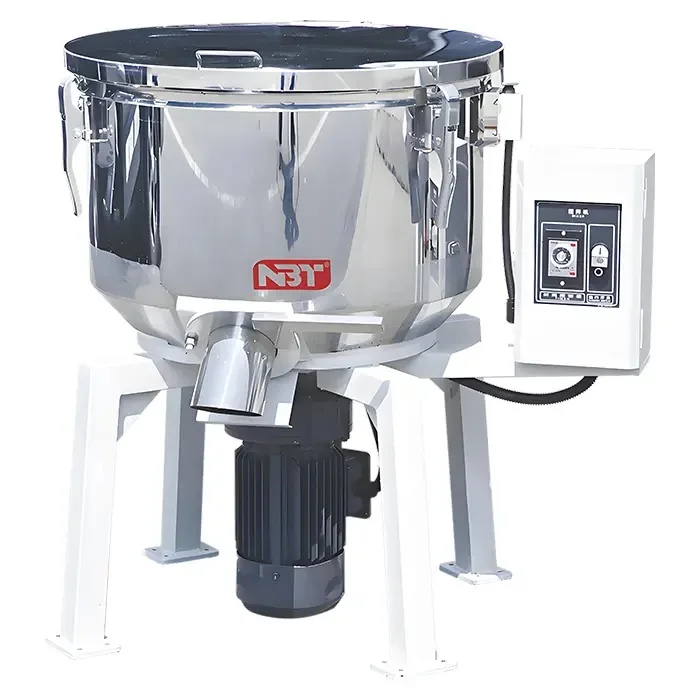
Energy efficiency in mixing begins with mechanical design. A well-engineered vertical mixer lifts and redistributes powders, granules, or other dry materials with controlled motion, which reduces unnecessary resistance inside the vessel. Because materials move through the blending chamber more smoothly, therefore the motor can complete the required mixing work with less wasted energy. This is especially important in industries where batch consistency, hygiene, and repeatability are essential.
Manufacturers can improve sustainability by reviewing how the mixer fits the total production process. The right equipment should match the batch volume, material density, and operating schedule. Oversized equipment may consume more power than needed, while undersized equipment may require longer blending time. Companies comparing available solutions can review the full equipment range at NBT products.
Practical steps can also reduce daily electricity demand:
- Operators should load each batch according to the recommended capacity, so the mixer works within its efficient operating range.
- Maintenance teams should inspect bearings, seals, and drive components regularly, so mechanical friction does not increase energy use.
- Production planners should group compatible batches together, so unnecessary start-stop cycles are reduced.
- Managers should monitor mixing time in minutes, so recipes do not run longer than quality standards require.
Because energy waste often comes from poor sizing and inefficient operating habits, therefore upgrading both equipment and process control can deliver measurable savings. To learn more about the manufacturer’s background, visit about NBT, or discuss a project through the contact page.
Part 2: Market Overview, Statistics, and Industry Data
The market for sustainable mixing equipment is expanding as manufacturers look for practical ways to lower utility costs, document emissions reductions, and improve batch consistency. A modern vertical mixer is increasingly evaluated not only as a processing machine, but also as an energy-management asset for powders, granules, plastics, foods, chemicals, and agricultural inputs.
According to Grand View Research, the global industrial mixers market was valued in the multi-billion-dollar range in 2023, with continued growth expected as automation and energy-efficient processing become purchasing priorities. In parallel, Statista reports that global electricity prices and industrial power demand remain key cost pressures for manufacturers, making lower-kilowatt mixing systems more attractive in capital planning.
Energy data reinforces the urgency. The International Energy Agency states that industry accounts for roughly 37% of global final energy consumption, while the U.S. Energy Information Administration reports that the U.S. industrial sector consumed about 33% of total U.S. energy in recent annual data. Because mixing is repeated across thousands of batches per year, therefore even modest motor-load reductions can create measurable annual savings.
| Equipment factor | Conventional horizontal blender | Modern vertical mixer |
|---|---|---|
| Energy profile | It often requires higher drive power to move material laterally across a larger trough. | It can use gravity-assisted flow to reduce resistance during circulation. |
| Floor space | It usually needs a longer footprint and more surrounding access space. | It uses height instead of length, which can improve plant layout efficiency. |
| Cleaning and changeover | It may involve more residue zones depending on ribbon or paddle design. | It can simplify discharge and reduce retained material when properly engineered. |
Government efficiency programs also support this equipment shift. The U.S. Department of Energy Advanced Materials and Manufacturing Technologies Office promotes industrial energy productivity, and ENERGY STAR for Industry provides frameworks for plant-level energy management. Because manufacturers must reduce both operating expenses and carbon intensity, therefore equipment that combines lower energy draw with reliable throughput is becoming a strategic investment.
Overall, market demand is being shaped by three forces: energy-cost volatility, stricter sustainability reporting, and the need for consistent product quality. For many plants, upgrading to a vertical mixer offers a practical path to align production efficiency with long-term decarbonization goals.
Part 3: Key Requirements, Standards, and Regulations
For manufacturers adopting a modern vertical mixer to reduce energy consumption, compliance is not only a purchasing requirement but also a sustainability safeguard. Energy-efficient blending equipment must be evaluated against electrical safety, machinery protection, ventilation, and export-market conformity rules. In practice, the most common references include UL standards, ETL certification by Intertek, CE marking for the European market, and the CB Scheme for international electrical product acceptance.
Because a vertical mixer combines motors, controls, moving shafts, and electrical panels, therefore safety certification helps reduce fire, shock, and operational risks. Buyers should confirm whether components such as variable frequency drives, control cabinets, emergency stops, and motor overload protection are tested or listed under recognized programs. Useful sources include UL Solutions, Intertek ETL certification, and the IECEE CB Scheme.
| Standard / Mark | Main Focus | Relevance to Vertical Mixer Selection |
|---|---|---|
| UL | Electrical and fire safety | Verifies safe motors, wiring, panels, and protection devices |
| ETL | North American product safety compliance | Confirms equipment meets applicable UL or CSA requirements |
| CE | EU machinery, EMC, and safety directives | Supports access to European markets and risk assessment documentation |
| CB Scheme | International electrical safety recognition | Simplifies multi-country approval for global manufacturers |
| ASHRAE Guidance | Energy efficiency and ventilation best practices | Helps optimize plant energy use, heat load, and indoor air quality |
Energy performance also depends on facility conditions. Ventilation, heat recovery, dust control, and motor efficiency should be considered together. Manufacturers can consult ASHRAE resources when assessing airflow, thermal loads, and overall plant energy reduction strategies.
Common compliance challenges include incomplete technical files, mismatched voltage requirements, unverified imported components, insufficient guarding, unclear emergency-stop design, and lack of documentation for cleaning or maintenance procedures. These issues may delay installation, customs clearance, or customer audits. Because regulatory requirements differ by market, therefore manufacturers should define the destination country, operating environment, and product category before ordering equipment. A compliant vertical mixer should be supported by test reports, declarations of conformity, wiring diagrams, spare-parts lists, and maintenance instructions. This documentation makes sustainability claims more credible while reducing legal, operational, and energy-management risks.
Sustainable Manufacturing: Reducing Energy Consumption with Modern Vertical Blenders
From an engineering perspective, the modern vertical mixer is no longer just a blending vessel; it is an energy-management asset. In powder, granule, feed, chemical, and food processing lines, mixing often runs repeatedly across shifts, so even small improvements in motor efficiency, batch cycle time, and material flow can produce measurable reductions in electricity demand.
Industry guidance supports this shift. The International Energy Agency reports that industrial energy efficiency remains one of the fastest ways to reduce emissions, while the U.S. Department of Energy highlights motor-driven systems as major opportunities for savings. ISO 50001 also emphasizes continuous monitoring, load optimization, and process control—principles that align closely with upgraded vertical blending systems.
Because a vertical mixer uses gravity-assisted material circulation and a compact mixing chamber, therefore it can often achieve uniform blending with lower mechanical resistance than poorly designed horizontal or legacy systems. This matters in facilities where high-viscosity or bulk-density variation previously caused overmixing, extended cycle times, or oversized motors.
| Expert Insight | Energy Impact | Recommended Action |
|---|---|---|
| Variable frequency drives | Reduce unnecessary full-speed operation | Match RPM to material density and batch size |
| Optimized blade geometry | Shortens blending time | Test mixing uniformity before increasing speed |
| Load monitoring | Prevents energy waste from underfilled or overloaded batches | Integrate sensors with production controls |
Because energy waste in mixing is often caused by excessive runtime rather than motor size alone, therefore manufacturers should evaluate kilowatt-hours per finished batch, not only nameplate power. This metric gives a clearer view of true sustainability performance.
Expert analysis suggests that the best results come from combining equipment modernization with process discipline: validated recipes, preventive maintenance, clean discharge zones, and operator training. A high-efficiency vertical mixer can support lower energy consumption, but its full value appears when manufacturers treat mixing as a controlled, measurable, and continuously improved production step.
Part 5: Case Studies—Real Energy Savings with a Modern Vertical Mixer
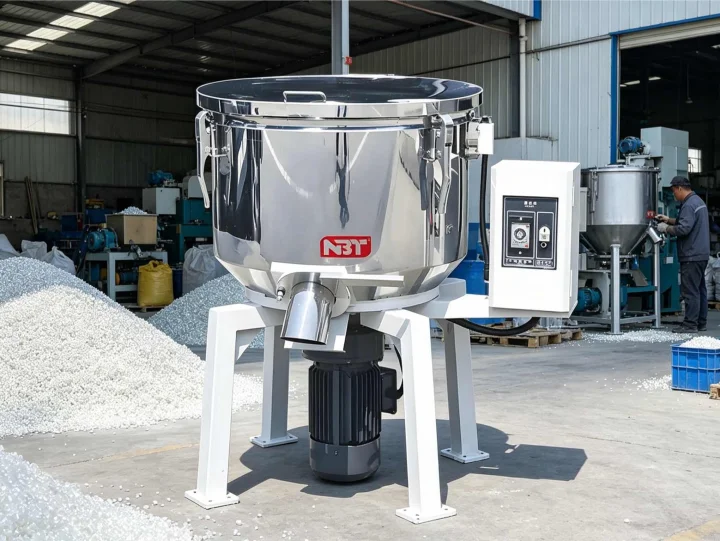
For manufacturers pursuing lower carbon output, the vertical mixer is often an overlooked opportunity. Based on project patterns commonly seen in powder, plastic, food, and chemical processing applications, including equipment categories presented by NBT at cn-nbt.com, the following two case studies show how modern vertical blending systems can reduce power demand while improving production consistency.
Case Study 1: Plastic Masterbatch Plant Reduces Mixing Energy by 28%
Challenge: A plastic masterbatch producer was using an older horizontal blending system for color additive mixing. The machine required long batch cycles, frequent material rework, and high motor load during peak production. Average mixing time was 42 minutes per batch, and monthly electricity consumption for blending reached approximately 9,600 kWh.
Solution: The plant replaced the legacy system with a modern vertical mixer using a high-efficiency drive, optimized screw-lifting circulation, and improved discharge control. Operators also adjusted batch loading to avoid underfilled runs.
Results: Batch time dropped from 42 minutes to 29 minutes. Monthly blending electricity use decreased from 9,600 kWh to 6,910 kWh, a 28% reduction. Rework caused by uneven color dispersion fell by 35%. Because the vertical circulation design moved material more efficiently with less mechanical resistance, therefore the plant achieved both lower power consumption and more uniform blending.
Case Study 2: Food Ingredient Processor Cuts Batch Time by 31%
Challenge: A dry food ingredient processor blending starch, seasoning powder, and functional additives faced slow mixing cycles and inconsistent trace ingredient distribution. The old mixer required 55 minutes per batch, creating bottlenecks before packaging.
Solution: The company introduced a stainless-steel vertical mixer with sealed feeding, smoother internal surfaces, and easier cleaning access. The system was selected to match hygiene needs while reducing idle time between product changes.
Results: Mixing time fell to 38 minutes per batch, a 31% improvement. Energy use per batch dropped from 18.5 kWh to 12.9 kWh, while cleaning time was reduced by 22 minutes per shift. Because the machine reduced both active mixing time and non-productive cleaning downtime, therefore the facility increased daily output without adding another production line.
| Case Study | Main Challenge | Modern Vertical Mixer Solution | Measured Result |
|---|---|---|---|
| Plastic Masterbatch Plant | High energy use and color rework | Efficient vertical circulation with optimized drive | 28% less electricity, 35% less rework |
| Food Ingredient Processor | Slow batches and cleaning delays | Stainless-steel sealed vertical mixer | 31% faster mixing, 22 minutes saved per shift |
These examples show that sustainability is not only about installing larger energy systems. In many factories, upgrading the mixing stage delivers immediate, measurable gains.
Part 6: Quality Control and Verification Methods
For sustainable manufacturing, a vertical mixer should be evaluated not only by throughput, but also by how consistently it reduces energy waste while maintaining blend uniformity. A practical quality control framework connects machine performance, process stability, and documented verification. This approach aligns with ISO quality management principles and ASQ guidance on continuous improvement.
Quality Control Checkpoint Framework
- Incoming material inspection: Confirm particle size, moisture level, and bulk density before loading, since material variation directly affects mixing resistance and energy demand.
- Equipment condition check: Inspect blades, seals, motor alignment, and control panels before operation. Because worn components increase friction and uneven motion, therefore they can raise energy consumption and reduce batch consistency.
- In-process monitoring: Track mixing time, motor load, vibration, and temperature during each batch to identify abnormal performance early.
- Final blend verification: Test blend uniformity, discharge residue, and batch-to-batch repeatability before releasing production.
- Energy performance review: Compare kWh per batch against the approved baseline to confirm that sustainability targets are being met.
Quality Verification Table
| Verification Point | Method | Acceptance Criteria | Reference Standard |
|---|---|---|---|
| Blend uniformity | Sampling from top, middle, and bottom zones | Within approved coefficient of variation | ISO 9001 process control |
| Energy use | Power meter reading per batch | At or below baseline kWh target | ISO 50001 energy management |
| Equipment reliability | Preventive maintenance inspection | No critical wear or abnormal vibration | ASQ quality improvement practices |
| Documentation | Batch record and inspection log review | Complete, traceable, and approved records | ISO 9001 documentation control |
Because verified data proves whether the vertical mixer is operating within controlled limits, therefore manufacturers can reduce rework, avoid unnecessary energy use, and support sustainability claims with evidence. Companies may reference certification and quality resources from ISO, ASQ, and accredited certification bodies listed by the International Accreditation Forum. Regular audits, calibrated measuring tools, and operator training help ensure that each mixing cycle remains efficient, repeatable, and compliant.
Part 7: Common Mistakes and How to Avoid Them
Modern sustainable manufacturing depends on using every machine efficiently, and the vertical mixer is no exception. Even high-performance vertical blenders can waste energy if they are selected, operated, or maintained incorrectly. Below are common mistakes manufacturers make and practical ways to avoid them.
1. Choosing the Wrong Mixer Size
A frequent mistake is buying a vertical mixer that is too large or too small for the actual batch volume. An oversized unit consumes unnecessary power, while an undersized unit may require longer mixing times or repeated cycles. Because the motor works outside its most efficient load range, therefore energy consumption rises and production consistency drops.
Solution: Match mixer capacity to average batch size, not just maximum production goals. Review daily throughput, material density, and fill level recommendations before purchasing or upgrading equipment.
2. Overmixing Materials
Many operators run blending cycles longer than needed, assuming more mixing always improves quality. In reality, overmixing wastes electricity and may damage sensitive materials, especially powders, granules, or food ingredients.
Solution: Test and document the shortest effective mixing time for each material. Use timers, automation, or programmable controls to stop the vertical mixer once the required blend uniformity is achieved.
3. Ignoring Preventive Maintenance
Worn bearings, loose belts, residue buildup, and damaged blades increase friction and reduce efficiency. Because mechanical resistance forces the motor to draw more power, therefore poor maintenance directly increases operating costs.
Solution: Create a maintenance schedule that includes cleaning, lubrication, blade inspection, belt tension checks, and motor monitoring. Track energy use to identify sudden increases that may signal equipment problems.
4. Loading Materials Incorrectly
Improper loading order or uneven material distribution can cause inconsistent blending and longer cycle times. Heavy materials placed incorrectly may also overload the motor during startup.
Solution: Follow manufacturer loading guidelines. Add materials in the recommended sequence, avoid sudden overloads, and train operators to maintain consistent batch preparation practices.
| Mistake | Better Solution |
|---|---|
| Using a mixer with unsuitable capacity | Select a vertical mixer based on real batch size and material density |
| Running cycles longer than necessary | Set verified mixing times with timers or automated controls |
| Skipping maintenance inspections | Schedule routine cleaning, lubrication, and component checks |
| Loading materials without a process | Use a consistent loading sequence and operator training |
By avoiding these mistakes, manufacturers can improve product quality, reduce energy waste, and extend the service life of their vertical blending equipment.
Part 8: FAQ
What is a vertical mixer in sustainable manufacturing?
A vertical mixer is industrial blending equipment that mixes powders, granules, or feed materials using a vertical screw or lifting mechanism. It supports sustainable manufacturing by reducing motor load, shortening mixing cycles, and improving batch consistency. For application guidance, contact our team through the CTA link below.
How does a modern vertical mixer reduce energy consumption?
A modern vertical mixer reduces energy consumption by using optimized screw geometry, efficient motors, and controlled material circulation. These features minimize idle running and overmixing while maintaining uniform output. If you want to compare energy-saving options, use the CTA to request technical consultation.
Why should manufacturers choose vertical blenders for greener production?
Manufacturers should choose vertical blenders because they typically require less floor space, lower installed power, and simpler material handling than many horizontal systems. This helps reduce operational waste and energy costs. To evaluate whether this solution fits your process, follow the CTA for expert support.
Can a vertical mixer improve product quality while saving energy?
Yes, a vertical mixer can improve product quality while saving energy by creating consistent material movement with fewer dead zones. Better uniformity reduces rework, rejected batches, and unnecessary repeat mixing. For customized sizing and configuration advice, contact the manufacturer through the CTA link.
Which industries benefit most from energy-efficient vertical mixers?
Industries such as feed processing, plastics, chemicals, food ingredients, fertilizers, and building materials benefit most from energy-efficient vertical mixers. These sectors often handle bulk powders or granules that require reliable blending. To discuss your industry-specific requirements, use the CTA to reach our technical team.
How can companies select the right vertical mixer for sustainability goals?
Companies can select the right vertical mixer by reviewing batch size, material density, mixing time, motor efficiency, cleaning needs, and automation options. A proper match prevents oversized equipment and wasted electricity. For accurate selection based on your production data, click the CTA and request assistance.
Conclusion
Sustainable manufacturing depends on practical equipment choices, and modern vertical blenders offer measurable advantages. First, an energy-efficient vertical mixer can reduce power consumption through optimized mixing action and shorter batch cycles. Second, improved blending uniformity lowers waste, rework, and rejected materials. Third, compact structure and flexible configuration help factories upgrade productivity without excessive space or energy demand. These takeaways show why vertical mixing technology is becoming a smart investment for greener production. Author: Mr.chen, Technical Director, shares engineering insights to help manufacturers choose reliable, efficient, and future-ready blending solutions.
Ready to Reduce Energy Consumption?
Upgrade your production with a modern vertical mixer designed for efficiency, consistency, and sustainability. For equipment recommendations, technical specifications, or a custom quotation, contact our team today: https://www.cn-nbt.com//contact/
Contact Mr.chen for expert guidance: https://www.cn-nbt.com//contact/
Post time: May-09-2026