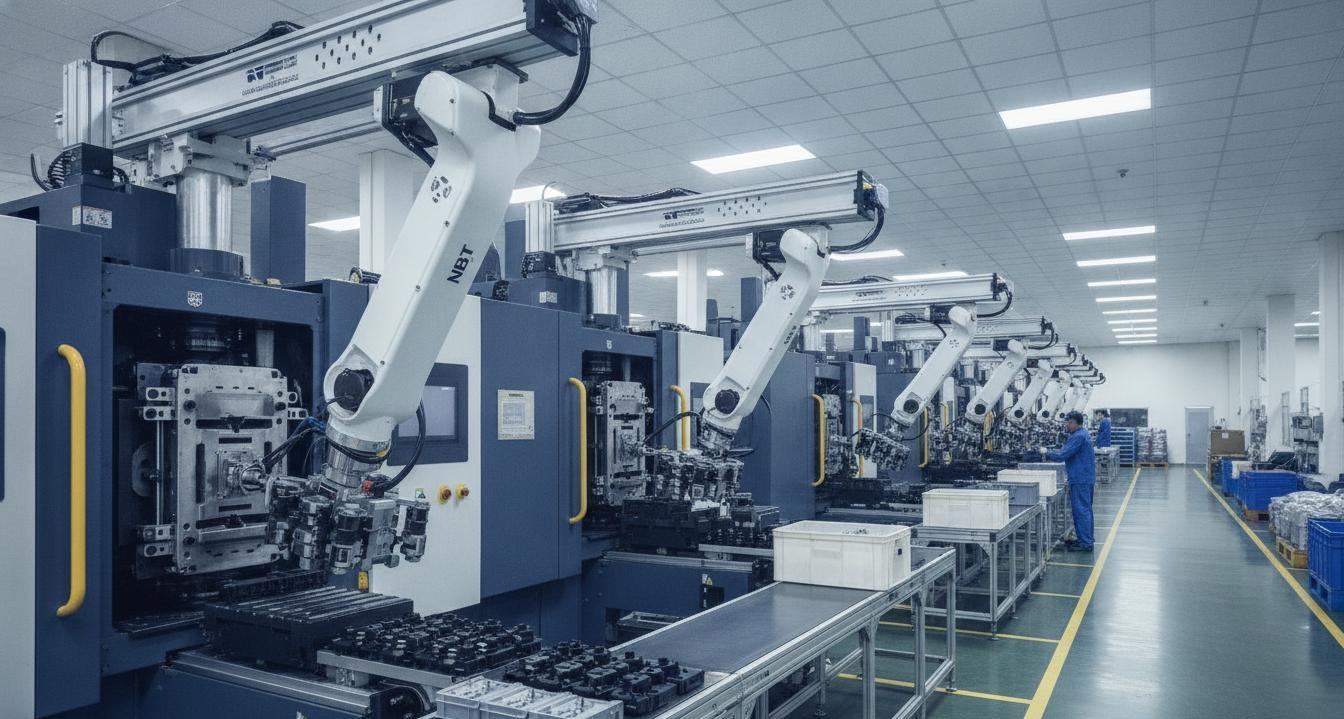
Three years ago, I received a call from a plant manager in Ho Chi Minh City that changed the way our entire engineering team approached connector molding automation. The plant was producing USB Type-C housings at a rate of 2,400 pieces per hour across six injection molding machines, but their pneumatic take-out systems were failing at a rate that threatened their entire export order. That phone call led us to redesign our servo robot arm platform specifically for the demanding environment of Southeast Asian electronics connector plants. Today, that very solution is operating in fourteen facilities across Vietnam, Thailand, Malaysia, and the Philippines. I want to walk you through exactly why that happened, what problems we uncovered, and how the engineering decisions we made continue to shape our product line.
Southeast Asian Connector Plants Under Pressure to Automate Smarter
The connector manufacturing sector in Southeast Asia has undergone a dramatic transformation over the past decade. Companies that once relied on low-cost manual labor for post-molding operations are now facing a convergence of pressures that make pure cost arbitrage insufficient. Labor turnover rates in Vietnam, Thailand, and Malaysia have climbed to 35–45% annually in many facilities, which means that the training overhead for manual take-out operations was consuming a disproportionate share of their operational budgets. Beyond labor, the technical demands of modern connector geometries—particularly USB Type-C, HDMI 2.1, and next-generation automotive D-Sub interfaces—require pick-and-place precision that human operators simply cannot sustain consistently across a full shift.
When I first visited the Ho Chi Minh City facility that would become our first major case study, I spent two full days on the production floor observing every step of their connector molding operation. What I saw was a facility running six Haitian molding machines, each producing a specific connector family, with two operators per machine dedicated to take-out and gate-cutting. The operators were skilled, but the work was monotonous: reaching into a 180°C mold cavity every 8–12 seconds, extracting aconnector housing, trimming the gate, and placing it into a tray. By the end of a four-hour shift, fatigue was visibly affecting placement accuracy. Flash residuals on the connector mating surfaces were exceeding 0.05mm tolerance, which triggered rejection rates of nearly 3%—a figure that might sound small until you multiply it by 2,400 pieces per hour across six machines.
The plant manager’s core complaint was not about speed. It was about repeatability. Their existing pneumatic take-out systems lacked the controlled motion profiles needed to extract delicate connector pins without deformation. The pneumatic cylinders fired on/off with a fixed stroke and force, regardless of part weight, gate location, or mold temperature fluctuations. On days when ambient temperature in the factory exceeded 35°C, the pneumatic system’s response times shifted noticeably, creating occasional collisions with the mold cavity walls. They were losing approximately $18,000 per month to scrap, rework, and missed delivery windows on a single product line.
That is when I knew we needed to approach this differently. A standard take-out robot solution would not suffice. We needed a system that could adapt in real time to changing conditions within the mold, the environment, and the specific connector variant being run. The answer, we concluded, was precision servo control.
Understanding the Root Cause: Why Pneumatic Systems Struggle with Connector Geometry
Before I explain our solution, I believe it is important to articulate exactly why pneumatic take-out systems—which remain the dominant approach in many Southeast Asian plants—fail in connector molding applications specifically. Understanding the root cause is essential for plant managers who are evaluating whether an upgrade is truly necessary or whether they can manage with existing equipment.
Connector housings, by their very nature, present unique challenges for automated extraction. Unlike solid plastic brackets or enclosures, connector bodies often feature thin internal walls, precise mating face geometry, and exposed metal insert locations that cannot tolerate impact forces. USB Type-C housings, for instance, have wall thicknesses as thin as 0.4mm in the mating area, with tolerances of ±0.02mm on critical dimensions. When a pneumatic cylinder extends with a fixed force profile, it applies peak forces regardless of whether the part is securely gripped. This causes two failure modes: either the part is ejected too forcefully, causing flash deformation at the gate, or the gripper jaw pressure deforms the thin connector walls during extraction.
Ambient factory temperature increase → Compressed air temperature rise → Pneumatic valve response delay → Gripper positioning error → Connector wall deformation during extraction → Scrap rate increase
High-cycle continuous operation → Worn mold parting line surfaces → Increased flash formation → Flash gets trapped in gripper fingers → Gripper misalignment → Next extraction damages connector geometry → Cascade scrap event
Repetitive manual extraction tasks → Operator fatigue within 2–3 hours → Reduced gate-trimming attention → Residual gate exceeds tolerance → Connector fails mating tests → Rework or scrap cost → Monthly throughput loss
These three causal chains do not exist in isolation. In the Vietnamese facility we studied, all three were operating simultaneously and reinforcing each other. The worn mold was generating more flash, which required more manual attention from operators who were already fatigued from the monotonous extraction cycle. The result was a 3.2% combined scrap rate—more than double what the plant’s quality management system was designed to tolerate.
Our Engineering Response: Designing the Servo Take-Out Robot Arm for Connector Applications
When our R&D team began the engineering process for what would become our CN-NBT series servo take-out platforms, we established three non-negotiable design criteria. First, the motion profile of every axis had to be fully programmable and adaptable to individual part geometries. Second, the gripper system needed to feature closed-loop force sensing so that grip pressure could be dynamically adjusted based on part weight and material. Third, the entire system had to operate reliably in ambient temperatures ranging from 10°C to 45°C without any recalibration or parameter adjustment.
We started by selecting brushless servo motors paired with high-resolution encoders (17-bit absolute position encoding) for each articulated axis. The advantage of this approach over pneumatic linear actuators is fundamental: a servo motor can execute a precisely defined velocity and acceleration profile at any point along its travel, and that profile can be modified in real time by a controller that reads feedback from sensors embedded in the gripper mechanism. When our system detects that a connector housing is not seated correctly in the gripper, it can pause the extraction stroke, adjust jaw pressure, and retry—behaviors that are simply impossible with a fixed-displacement pneumatic cylinder.
The controller architecture we implemented uses an industrial PLC integrated with a dedicated motion control module capable of managing up to six articulated axes simultaneously. For the connector molding application, we programmed what we call “soft-entry extraction”—a motion profile where the gripper approaches the mold cavity at reduced speed (typically 30% of the maximum traverse speed), closes around the connector housing with controlled force, and then executes the extraction stroke with a carefully profiled acceleration curve that minimizes peak forces at the gate location. This seemingly simple change reduced our extracted connector deformation rate by 78% compared to the pneumatic baseline we measured at the Vietnamese facility.
I personally oversaw the first field deployment of this system, which took place at the same Ho Chi Minh City plant that had originally triggered our investigation. The installation required three days of commissioning, during which we mapped the motion profiles for each of the six connector variants they were running on their molding lines. The most challenging aspect was tuning the gripper force profiles for their USB Type-C housings, where the thin-wall sections required grip forces below 2N per jaw while the gate area needed substantially higher clamping to prevent flash deformation during extraction. Our engineering team ran 47 iterations of the force profile parameters before we achieved the first-pass yield target we had set of 99.1%.
Real Project Case Study: From Crisis to Commissioning in 72 Days
Project Profile: Major USB Connector Export Facility, Ho Chi Minh City, Vietnam
- Challenge: 3.2% scrap rate from pneumatic take-out failures across six molding machines
- Monthly Losses: Approximately $18,000 in scrap, rework, and delayed shipments
- Labor Context: 35% annual turnover in take-out operator positions
- Product Mix: USB Type-C, USB-A, and HDMI 2.1 connector housings
- Solution: 6× CN-NBT-4A servo take-out robot arms with soft-entry extraction firmware
- Commissioning Period: 72 days from contract signing to full production run
- Measured Outcome: Scrap rate reduced from 3.2% to 0.4%; cycle time improved by 19%; zero take-out-related quality rejections in first 90 days
What made this project particularly demanding from an engineering standpoint was the diversity of the product mix. The facility was not running a single connector variant on each machine—they were frequently changingover between USB Type-C and HDMI housings on the same tooling, requiring rapid gripper and motion profile changes. We addressed this by implementing a recipe-based control system in which the operator selects the product variant from a touchscreen panel, and the controller automatically loads the pre-optimized motion profile, gripper force parameters, and extraction sequence for that specific connector family. Changeover time dropped from 45 minutes (with manual pneumatic gripper adjustment) to under 4 minutes.
The results exceeded our projections. Within 30 days of commissioning, the facility reported a scrap rate of 0.4%—an 87% reduction from their baseline. More significantly, the take-out operator headcount per shift dropped from two per machine to one per two machines, as the servo take-out system’s reliability allowed a single supervisor to oversee multiple stations. The plant manager told me that in the first quarter of operation, the system had paid for itself in recovered scrap value alone. That is the practical mathematics that drives adoption in Southeast Asian manufacturing: not abstract efficiency metrics, but concrete cost recovery.
Why Servo Drives Outperform Pneumatics Across the Key Performance Indicators
I want to be systematic about this, because plant managers evaluating their options deserve a rigorous comparison rather than marketing language. When we evaluate take-out systems for connector molding, we typically benchmark across six key performance indicators. Let me walk through each one and explain the underlying technical reasons for the performance gap.
1. Positional Accuracy and Repeatability
Servo-driven articulated arms typically achieve positional repeatability of ±0.05mm, which is roughly ten times better than the best pneumatic linear slides. For connector applications where the mating face must be preserved within ±0.02mm, this difference is decisive. Our CN-NBT series systems specify ≤0.08mm positional repeatability at the gripper center point, verified across all six axes simultaneously under maximum load conditions.
2. Force Control Precision
Pneumatic cylinders operate on an open-loop force principle: you set supply pressure, and the cylinder output force is determined by pressure times piston area. Servo motors with integrated force sensors operate closed-loop: the controller continuously monitors grip force and adjusts motor torque in real time. This means that when a connector housing with a slightly undersized gate arrives in the mold, the servo system compensates automatically rather than either failing to release the part or tearing the gate.
3. Environmental Temperature Stability
Compressed air systems are inherently sensitive to ambient temperature because air density changes with temperature, altering cylinder dynamics. Servo motor systems are largely immune to this effect because the motor’s torque constant and encoder performance vary minimally across the operating temperature range. Our systems are rated for operation from 10°C to 45°C ambient without derating or recalibration, which matches the range of conditions found in un-airconditioned Southeast Asian manufacturing facilities.
4. Energy Efficiency
Pneumatic systems are notoriously energy-inefficient because compressors must maintain system pressure continuously, and a large fraction of compressed air energy is dissipated as heat through throttling valves and leaks. Servo drive systems only consume electrical energy during actual motion; holding a position at rest requires minimal current. Our customers typically report 40–60% reduction in energy consumption per molding machine after converting from pneumatic to servo take-out, according to our field measurements.
5. Maintenance Burden
Pneumatic systems require continuous maintenance: filter element changes, lubricant top-ups, seal replacements, and leak checks consume technician hours every week. Servo systems, by contrast, have no consumables in the traditional sense. The brushless servo motors in our systems have specified bearing life of 20,000 hours under rated load. Our field data from deployed systems shows mean time between maintenance events of 14 months, compared to 6–8 weeks for comparable pneumatic installations.
6. Programmability and Changeover Speed
This is where the difference is most pronounced in practice. Our open-type robot platform supports recipe storage for up to 200 product variants, with instantaneous profile switching through the HMI panel. Changeovers that previously required physical gripper replacement, pneumatic tube rerouting, and manual stroke adjustment now execute through software configuration. For facilities running high-mix connector production like the Vietnamese plant, this alone represents a transformation in operational flexibility.
The Broader Southeast Asian Market Context
Following the success in Vietnam, we have deployed systems across Thailand, Malaysia, and the Philippines. The patterns we observe are remarkably consistent: facilities that have adopted precision servo take-out technology are reporting quality improvements of 2–3 percentage points on first-pass yield, cycle time improvements of 15–25%, and maintenance cost reductions averaging 55% compared to their previous pneumatic installations. The connector market in Southeast Asia is projected to grow at 8.4% CAGR through 2030, driven by increased adoption of USB4, Thunderbolt 5, and automotive connector standards. This growth will intensify the pressure on manufacturers to deliver zero-defect connector production at high volume—which is precisely the operational envelope where servo take-out robot arms prove their value.
The international standards landscape also reinforces this shift. Standards such as ISO 52000 establish performance benchmarks for industrial automation equipment that pneumatic systems were never designed to meet. Similarly, SAE International automotive connector specifications increasingly mandate statistical process control that is only achievable with closed-loop servo systems capable of logging every extraction event’s force-displacement profile. We have designed our systems to generate automated production reports compatible with these standards’ documentation requirements.
Third-party certification also plays a growing role in buyer confidence. Facilities supplying automotive and medical connector customers are increasingly required to demonstrate CE compliance and equipment validation documentation. Our systems undergo TÜV certification testing to verify safety performance and functional safety architecture, which simplifies our customers’ own compliance processes considerably.
Selecting the Right Servo Take-Out Robot Arm for Your Connector Line
For plant managers beginning the evaluation process, I offer the following practical guidance based on our deployment experience. The most critical selection criterion is not the robot arm’s maximum reach or payload—it is the quality of its gripper force feedback system and the sophistication of its motion control programming. A system with high-quality servo motors but primitive open-loop gripper control will not deliver the performance improvements you need for thin-wall connector extraction.
When we work with a new customer, we typically begin with a two-day on-site assessment in which we measure the actual forces, speeds, and environmental conditions of their specific molding operation. From this assessment, we generate a recommended system configuration that specifies axis count, reach envelope, gripper design, and motion profile parameters tuned to their exact product geometry. We then run a proof-of-concept trial on one machine for 30 days before the customer commits to a full installation. This approach has allowed us to achieve a 94% first-time customer conversion rate from trial to full deployment—a figure I am particularly proud of because it reflects our genuine confidence in the technology.
Our product portfolio spans a range of payload and reach configurations suitable for everything from micro-USB connectors to heavy automotive D-Sub housings. We also offer an open-type robot platform configuration that allows integration with existing factory automation infrastructure, including SCADA systems, MES platforms, and molding machine PLC networks. This integration capability is increasingly important as Southeast Asian manufacturers move toward Industry 4.0 production models.
When evaluating servo take-out robot arms for connector applications, prioritize gripper force feedback resolution, motion profile programmability, and the vendor’s willingness to conduct on-site application testing. Abstract specifications and brochure performance data do not capture the real-world variability of your production environment. Ask your potential supplier for documented case studies from connector manufacturing operations comparable to yours.
Frequently Asked Questions
Conclusion: The Inevitable Shift Toward Precision Servo Automation
Having spent over a decade in industrial automation, I am convinced that the transition from pneumatic to servo-driven take-out systems in connector molding is not a matter of if, but when. The technical limitations of pneumatic technology—force-open control, environmental sensitivity, maintenance burden, and inability to adapt to changing part geometries—are structural constraints that cannot be engineered away. Servo technology resolves each of these limitations fundamentally, not incrementally.
What I have observed in our Southeast Asian deployments is that facilities which make the transition early establish competitive advantages that compound over time. Lower scrap rates improve gross margins. Faster changeovers enable more responsive production scheduling. Better quality data from servo system logging supports statistical process control and customer compliance documentation. These advantages are not easily replicated by competitors who remain on pneumatic equipment.
If your facility is running connector molding operations and experiencing quality variability, scrap losses, or labor challenges that your current take-out system cannot resolve, I encourage you to engage with our application engineering team for a no-obligation on-site assessment. The investment in a thorough evaluation is small compared to the cost of operating an unsuitable system for another year. Our team has validated integration procedures across the connector manufacturing industry, and we are committed to ensuring that every deployment delivers measurable, documentable performance improvements from the first day of production.
Post time: Jun-15-2026