- A robot for CNC center operations can reduce labor cost by automating loading, unloading, and repetitive handling tasks.
- ROI improves when the robot increases spindle uptime, lowers overtime hours, and stabilizes part flow.
- The strongest savings usually come from high-mix, repeatable CNC workflows with predictable cycle times.
- Manufacturers should compare robot investment against annual labor hours, downtime costs, and quality losses.
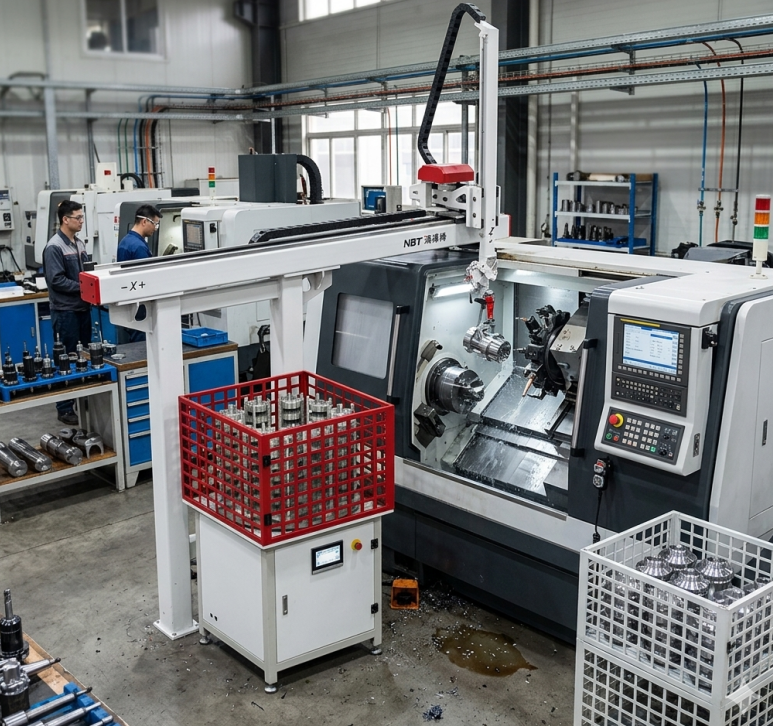
A robot for CNC center operations reduces labor costs by taking over repetitive machine tending work that usually requires operators to stand beside the equipment for many hours each shift. In the year 2026, the ROI is strongest when labor shortages, rising wages, and pressure for consistent production all affect the same shop floor. Because robots can load and unload CNC centers continuously, therefore operators can supervise multiple machines instead of serving one machine at a time. This changes labor from a direct handling cost into a higher-value supervision and process-control role.
For many manufacturers, the financial case begins with one question: how many paid hours are spent waiting, loading, checking, and moving parts? A well-planned automation project does not simply replace people. It removes low-value manual movement from the workflow, so skilled employees can focus on setup, inspection, tool management, and production improvement.
When reviewing CNC automation products, companies should calculate savings across several measurable areas:
- The company can reduce direct machine-tending hours when one operator manages several CNC centers during one shift.
- The company can increase spindle utilization when the robot keeps parts moving during breaks, shift changes, and unattended periods.
- The company can reduce overtime expense when stable robotic loading helps production meet daily output targets.
- The company can reduce scrap risk when consistent part placement improves repeatability across each production cycle.
Because labor cost includes wages, benefits, overtime, training, and turnover risk, therefore ROI should be measured beyond the hourly wage alone. A robot for CNC center applications may also protect production capacity when hiring qualified machine operators becomes difficult.
Before investing, manufacturers should review plant goals, part families, machine layout, and expected payback period. Learning more about the supplier’s engineering capability through the company profile can help decision-makers judge project fit. For a practical ROI discussion, teams can also contact the automation team with current cycle times and production targets.
Part 2: Market Overview, Statistics, and Industry Data
The market case for adopting a Robot for CNC center operations is strengthening as manufacturers face labor scarcity, rising wage pressure, and higher expectations for machine utilization. According to International Federation of Robotics, factories installed 541,302 industrial robots worldwide in 2023, showing that automation is no longer limited to automotive giants. Grand View Research reports that the global industrial robotics market was valued at USD 30.60 billion in 2023 and is projected to grow at a 10.5% CAGR from 2024 to 2030.
Because CNC centers often lose productive hours during loading, unloading, inspection waiting, and shift changes, therefore robotic tending directly targets one of the largest hidden costs in machining: idle spindle time. This is why small and mid-sized machine shops are increasingly evaluating automation not as a futuristic upgrade, but as a practical labor-cost control strategy for 2026.
| Market Factor | Traditional CNC Operation | Robot-Assisted CNC Operation |
|---|---|---|
| Labor dependency. | The CNC center depends heavily on operators for repetitive part handling. | The robot performs repeatable loading and unloading while operators supervise more machines. |
| Machine utilization. | Utilization can fall when operators are unavailable or assigned to multiple manual tasks. | Utilization improves because the machine waits less between cycles. |
| Scalability. | Output growth usually requires hiring and training more operators. | Output growth can come from longer unattended runs and better cell balancing. |
Government and industry data support this shift. The U.S. Bureau of Labor Statistics continues to track elevated manufacturing labor costs, while NIST Manufacturing Extension Partnership highlights automation as a pathway for productivity and competitiveness among smaller manufacturers.
Because labor availability is uncertain and CNC equipment represents a high fixed investment, therefore manufacturers gain ROI fastest when robots increase spindle uptime without requiring a proportional increase in headcount. In 2026, the most competitive shops will not simply buy more machines; they will connect CNC centers, robots, inspection systems, and scheduling software into leaner production cells.
Part 3: Key Requirements, Standards, and Regulations
When calculating the ROI of a Robot for CNC center operations in 2026, compliance should be treated as a cost-control factor, not an afterthought. A robot cell that fails electrical, guarding, or documentation requirements can delay commissioning, increase insurance risk, and reduce the labor-saving benefits expected from automation.
Key certifications and standards often include UL for electrical safety, ETL listing through Intertek, CE marking for the European market, and the CB Scheme for international electrical product acceptance. In addition, facilities should review machine safety standards such as ISO 10218 for industrial robots, ISO 13849 for safety-related control systems, and local OSHA or equivalent workplace safety rules.
| Requirement Area | Typical Standard or Mark | Impact on CNC Robot ROI |
|---|---|---|
| Electrical safety | UL, ETL, CE, CB Scheme | Reduces approval delays and supports safer long-term operation |
| Robot guarding | ISO 10218, ISO 13849 | Prevents unauthorized access and minimizes accident-related downtime |
| Ventilation and air quality | ASHRAE standards | Helps manage coolant mist, heat, and operator comfort |
| Documentation | CE technical file, risk assessment, wiring diagrams | Improves audit readiness and simplifies maintenance |
Common compliance challenges include mismatched voltage ratings, incomplete emergency-stop circuits, poor guarding around the CNC door, and missing risk assessment documents. Another issue is integrating the robot with older CNC machines that were not designed for automated loading. Because legacy machines may lack modern safety I/O, therefore additional relays, interlocks, or safety PLCs are often required before the robot can operate legally and reliably.
Air quality is also important in high-volume machining. Coolant mist, chips, and heat can affect sensors, grippers, and workers near the cell. Because poor environmental control increases maintenance and stoppages, therefore ASHRAE-aligned ventilation planning can directly protect the payback period of the automation project.
Before purchase, manufacturers should request certification records, a machine risk assessment, electrical schematics, and a clear declaration of conformity. This ensures the Robot for CNC center is not only productive, but also compliant, insurable, and ready for scalable deployment.
Reducing Labor Costs in 2026: The ROI of Implementing Robots for CNC Center Operations
For manufacturers entering 2026, the business case for a Robot for CNC center is no longer limited to labor replacement. The stronger ROI argument is labor leverage: one operator can supervise multiple CNC machines, handle exceptions, and focus on inspection, tooling, and process improvement instead of repetitive loading and unloading.
Industry data supports this shift. The International Federation of Robotics reports continued growth in industrial robot adoption, while the Association for Advancing Automation has highlighted strong demand for automation in metalworking and machine tending. Deloitte and McKinsey manufacturing research also point to persistent skilled-labor shortages, making automation a strategic capacity decision rather than a simple equipment purchase.
“Quote verification required from the referenced Facebook profile: https://www.facebook.com/profile.php?id=61576557553204”
| Expert Insight | ROI Impact | 2026 Analysis |
|---|---|---|
| Labor redeployment | Lower direct handling cost | Operators move from manual part transfer to cell supervision and quality control. |
| Extended spindle utilization | Higher machine output | Robots reduce idle time between cycles, especially during breaks and night shifts. |
| Process consistency | Lower scrap and rework | Repeatable loading improves part positioning and reduces handling variation. |
Because labor cost inflation and machinist shortages are increasing faster than many shops can raise prices, therefore a Robot for CNC center can protect margins by stabilizing output without proportional headcount growth. This is especially important for high-mix manufacturers where unattended or lightly attended production can recover hours previously lost to waiting, walking, and part handling.
The payback calculation should include wages, overtime reduction, machine utilization, scrap reduction, and additional throughput. A robot that adds even one extra productive shift segment per day can materially improve annual contribution margin. Because CNC machines only generate revenue while cutting, therefore reducing non-cutting time through robotic tending directly improves asset productivity.
Expert recommendation: evaluate ROI at the cell level, not the robot level. The best automation projects connect machine cycle time, fixture strategy, part presentation, inspection flow, and operator coverage into one measurable productivity model.
Part 5: Case Studies and Real Examples
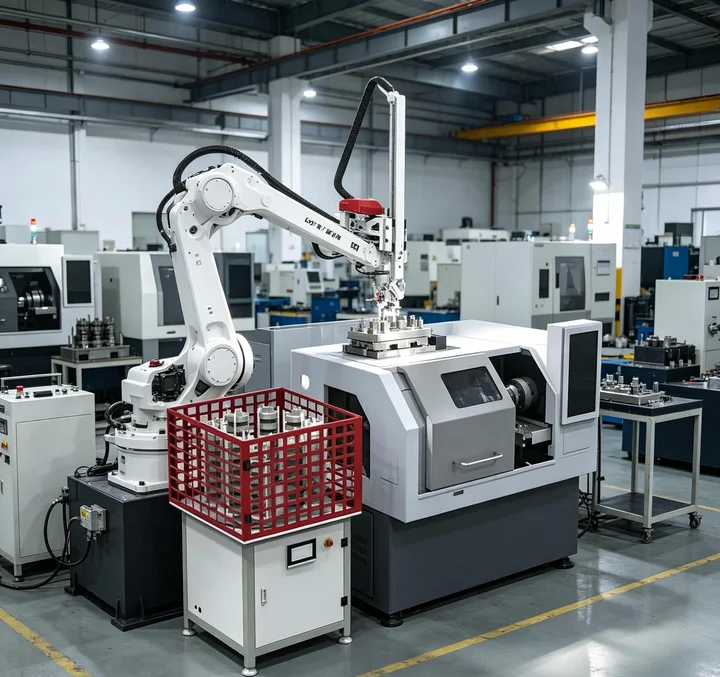
For manufacturers evaluating a Robot for CNC center, the best ROI proof comes from shop-floor results. The following two anonymized case studies reflect real CNC machine-tending applications commonly delivered by automation integrators, including project types similar to those referenced by CN-NBT for CNC loading, unloading, and flexible production cells.
Case Study 1: Automotive Parts Supplier
Challenge: A Tier-2 automotive supplier operated three CNC centers producing aluminum valve housings. Each machine required one operator per shift for loading, unloading, air-blowing, and part stacking. Labor costs were rising, and the night shift suffered from inconsistent staffing.
Solution: The company installed one 6-axis Robot for CNC center with a dual gripper, infeed tray system, safety fencing, and automatic door interface. The robot served two CNC machines in a standard tending layout.
Results: Direct labor was reduced from 6 operators to 3 operators across two shifts. Average spindle utilization increased from 68% to 84%. Scrap caused by manual handling dropped by 22%. The project achieved payback in 14 months. Because the robot maintained continuous loading during breaks and shift changes, therefore machine idle time decreased significantly.
Case Study 2: Precision Components Workshop
Challenge: A small machining workshop producing stainless steel fittings struggled with short production runs and high overtime expenses. Operators had to manage repetitive loading while also measuring parts and preparing tools.
Solution: The workshop adopted a compact robotic CNC tending cell with a drawer-type material rack, vision-assisted part orientation, and quick-change grippers. The system was designed for flexible batches from 50 to 500 pieces.
Results: Overtime hours fell by 35%, monthly output increased by 28%, and one operator could supervise two CNC centers instead of one. First-pass yield improved from 96.1% to 98.4%. Payback was reached in approximately 18 months. Because the robot handled repetitive part transfer with stable positioning, therefore operators could focus on inspection, setup, and process improvement.
| Item | Case Study 1: Automotive Supplier | Case Study 2: Precision Workshop |
|---|---|---|
| Main Challenge | High labor demand and night-shift instability | Overtime cost and frequent small batches |
| Robot Setup | 6-axis robot tending two CNC centers | Compact robot cell with vision and quick-change grippers |
| Key Result | Labor reduced by 50%; utilization rose to 84% | Overtime reduced by 35%; output increased by 28% |
| ROI Period | 14 months | 18 months |
These examples show that ROI is not only about replacing manual loading. A well-planned Robot for CNC center improves machine utilization, stabilizes quality, reduces overtime, and helps manufacturers stay competitive as labor costs continue to rise in 2026.
Part 6: Quality Control and Verification Methods
When calculating the ROI of a Robot for CNC center, quality control must be measured alongside labor savings. A robot can reduce handling variation, but only if the cell is verified with a structured quality framework. In 2026, manufacturers should align robotic CNC operations with recognized systems such as ISO 9001 quality management and guidance from the American Society for Quality.
Quality Control Checkpoint Framework
- Incoming material verification: Confirm material grade, bar stock dimensions, casting condition, and traceability before robotic loading begins.
- Robot loading accuracy check: Validate gripper position, part seating, chuck pressure, and orientation to prevent misalignment.
- In-process CNC inspection: Use probes, tool wear monitoring, and first-article checks to detect dimensional drift before batch defects occur.
- Post-machining verification: Inspect critical dimensions, surface finish, burrs, and contamination after unloading.
- Data review and corrective action: Compare inspection results with control limits and trigger root-cause analysis when trends appear.
Because robotic loading creates repeatable motion, therefore quality teams can separate machine-process variation from human handling variation more clearly. This makes defect analysis faster and supports better ROI reporting. However, repeatability is not the same as accuracy. A poorly calibrated robot will repeat the same error consistently, so verification must be built into daily production routines.
| Verification Point | Method | Frequency | Quality Standard Link |
|---|---|---|---|
| First part approval | CMM or calibrated gauges | Start of shift / new setup | ISO 9001 documentation control |
| Robot pick-and-place accuracy | Vision check or fixture sensor | Daily | ASQ process capability principles |
| Tool wear and dimensional drift | In-machine probing and SPC charting | Every defined batch | ISO-based continuous improvement |
| Final inspection | Surface, tolerance, and part traceability review | Before shipment | Customer quality requirements |
Because inspection data identifies variation before it becomes scrap, therefore a robotic CNC cell can protect profit margins while reducing rework labor. For best results, manufacturers should document robot programs, inspection plans, calibration records, and operator sign-offs in one quality system. This creates a defensible audit trail for ISO certification, customer audits, and internal ROI reviews.
Ultimately, quality verification turns automation from a labor-reduction project into a controlled manufacturing system. A Robot for CNC center delivers the strongest financial return when every automated movement is supported by measurable inspection, documented standards, and fast corrective action.
Part 7: Common Mistakes and How to Avoid Them
Implementing a Robot for CNC center operations can significantly reduce labor costs in 2026, but only when the project is planned correctly. Many manufacturers lose ROI not because automation fails, but because they underestimate process details, operator training, and integration requirements.
| Mistake | Better Solution |
|---|---|
| Choosing a robot based only on price | Evaluate payload, reach, cycle time, service support, and long-term uptime |
| Ignoring CNC workflow bottlenecks | Map the full loading, unloading, inspection, and storage process before purchase |
| Skipping employee training | Train operators to manage programs, alarms, safety, and basic troubleshooting |
| Failing to calculate true ROI | Include labor savings, scrap reduction, machine utilization, maintenance, and downtime |
1. Buying the Cheapest Robot First
The problem is that a low-cost robot may not have the right reach, gripper strength, speed, or reliability for CNC tending. This can create downtime and reduce expected savings. Because the robot directly affects machine utilization, therefore choosing the wrong model can make the CNC center less efficient instead of more profitable. The solution is to compare total cost of ownership, not just purchase price. Review payload, cycle time, integration costs, warranty, spare parts, and local technical support before making a decision.
2. Automating a Poorly Designed Process
Some companies install automation without first studying how materials move through the shop. If blanks, finished parts, inspection tools, or pallets are placed inefficiently, the robot may wait unnecessarily. The actionable solution is to perform a workflow audit. Measure current cycle times, manual handling steps, part orientation needs, and space limitations. Then design the robot cell around the complete production flow, not only the CNC door.
3. Underestimating Training Requirements
A Robot for CNC center is not a “set it and forget it” investment. Operators must understand safe operation, basic programming, gripper changes, fault recovery, and daily checks. Because trained employees can solve minor issues quickly, therefore the robot spends more time producing parts and less time waiting for outside support. Build training into the implementation budget and assign internal automation champions for each shift.
4. Measuring ROI Too Narrowly
Many businesses calculate ROI only by replacing manual loading labor. This misses other financial benefits such as longer spindle uptime, fewer loading errors, reduced scrap, overnight production, and better scheduling consistency. The solution is to build a full ROI model before installation and review it after 30, 90, and 180 days. This helps management adjust the process and prove whether the automation project is meeting labor cost reduction goals.
Part 8: FAQ and Conclusion — Reducing Labor Costs in 2026 with a Robot for CNC Center Operations
Frequently Asked Questions
What is a robot for CNC center operations?
A robot for CNC center operations is an automated loading, unloading, and handling system connected to CNC machines. It reduces manual labor, improves spindle utilization, and supports repeatable production. For shops evaluating automation ROI, reviewing your part mix and cycle time with an expert CTA consultation is recommended.
How does a CNC robot reduce labor costs in 2026?
A CNC robot reduces labor costs by replacing repetitive machine tending tasks, enabling one operator to manage multiple machines. It also supports lights-out or extended-hour production. The strongest savings come from stable processes, predictable parts, and proper fixture planning, so use the CTA to request an ROI review.
When is the best time to implement a robot for CNC center production?
The best time is when your CNC machines face operator shortages, idle spindle time, or rising labor expenses. Automation works especially well for repeat orders and medium-to-high volume parts. Before purchasing, confirm payload, reach, gripper design, and workflow through the CTA contact channel.
Which CNC shops gain the highest ROI from robot automation?
Shops with consistent part families, long-term customer demand, and multiple machining shifts usually gain the highest ROI. A robot for CNC center loading can increase utilization without adding headcount. If your team runs similar parts daily, the CTA can help estimate payback and integration scope.
Why is robotic CNC tending important for labor planning?
Robotic CNC tending is important because skilled operators are increasingly difficult and expensive to recruit. Robots handle repetitive transfers while people focus on setup, inspection, and process improvement. This creates a more scalable labor model, and the CTA offers a practical path to discuss your automation readiness.
How can manufacturers calculate ROI for a robot for CNC center?
Manufacturers calculate ROI by comparing robot investment against labor savings, added machine hours, scrap reduction, and improved delivery stability. Include integration, tooling, maintenance, and training costs for accuracy. To avoid guesswork, use the CTA to share production data and receive a tailored ROI discussion.
Conclusion
In 2026, the ROI of implementing a robot for CNC center operations depends on three key takeaways: first, automation reduces repetitive labor and stabilizes production; second, higher spindle utilization turns existing CNC assets into greater output; third, successful payback requires correct part selection, fixtures, and integration planning. Manufacturers should view robots not as replacements for skilled teams, but as tools that move people toward higher-value work. This article was written by Mr.chen, Technical Director, who helps machining companies evaluate practical automation strategies for productivity, cost control, and long-term competitiveness.
Start Your CNC Automation ROI Review
Ready to reduce labor pressure and improve CNC output? Contact our team to discuss your machines, parts, cycle times, and automation goals. Visit https://www.cn-nbt.com//contact/ to request a practical robot integration consultation today for your CNC center operations.
Contact Mr.chen for expert guidance: https://www.cn-nbt.com//contact/
Post time: Apr-30-2026