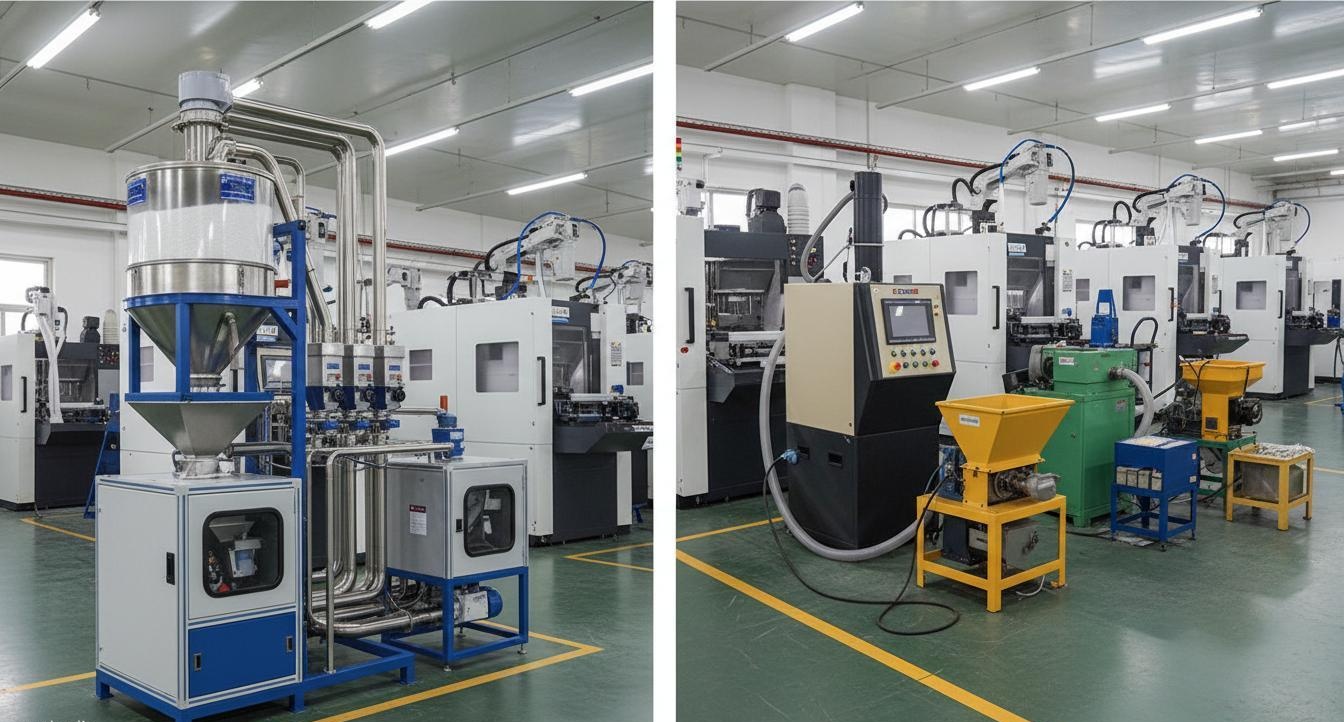
ROBOT (Ningbo) Intelligent Technology Co., Ltd. — established in 2004, specializing in plastic injection molding automation equipment — manufactures the complete range of plastic auxiliary equipment from hopper dryers and auto loaders through central conveying systems and turnkey plant planning. Their integrated system approach provides the reference case for understanding the practical and financial advantages of single-source auxiliary equipment procurement. The following analysis applies regardless of which supplier you are evaluating.
Why the Unit Price Comparison Is the Wrong Starting Point
When factories evaluate auxiliary equipment purchases, they almost always start with the unit price comparison — which is exactly the wrong starting point for a total cost of ownership analysis. The purchase price of a hopper dryer, auto loader, or conveying system represents only 30–45% of the total cost of owning and operating that equipment over its 8–12 year service life. The remaining 55–70% is operating cost (energy), maintenance cost, downtime cost when equipment fails, and — most significantly — the productivity cost of material handling errors, drying quality variability, and feed interruptions caused by incompatible or poorly integrated equipment. The supplier who quotes $4,200 for a standalone dryer may actually cost you more over 5 years than the supplier who quotes $6,800 for an integrated system — because the integration cost, the downtime risk, and the operating efficiency difference are not visible in the unit price.
What Plastic Auxiliary Equipment Actually Does in the Production Chain
Before comparing integrated vs. standalone procurement, it helps to understand the functional chain that auxiliary equipment serves in a plastics processing factory.
The Material Flow Chain
Raw plastic resin arrives at the factory in bags, big bags, or gaylord containers. It must be: (1) transported from storage to the drying station; (2) dried to the required moisture level for the specific polymer (hygroscopic polymers like PA, PET, PC require aggressive drying to ppm levels); (3) conveyed from the dryer to the injection molding machine or extruder feed throat; (4) metered and dosed into the machine at the correct rate; (5) any recycled material must be blended with virgin material at the correct ratio and fed into the system.
Each step in this chain has an associated equipment category:
- Hopper dryers: Remove moisture from hygroscopic resins before processing — critical for PA, PET, PC, and other polymers that degrade if processed with excess moisture
- Auto loaders (auto feeders): Automatically transport resin from storage to the dryer or machine feed throat using vacuum conveying
- Vertical mixers / blenders: Homogenize virgin and recycled material in controlled ratios before feeding the processing machine
- Vacuum dosers: Precisely meter virgin and recycled material into the machine feed at programmed blend ratios
- Central conveying systems: Piped vacuum systems that connect multiple machines to a central resin storage and drying station — eliminating individual loader units at each machine
The True Cost of Standalone Auxiliary Equipment
1. Purchase Price (Visible, But Not the Full Story)
The standalone purchase price for each auxiliary unit is the most visible cost and the most commonly compared. Indicative 2026 pricing for standalone plastic auxiliary equipment from Chinese manufacturers:
| Equipment Type | Specification | Standalone Price Range (FOB) |
|---|---|---|
| Hopper dryer (50kg capacity) | 120C max temp, dehumidifying | $1,800–$3,200 |
| Auto loader (single machine) | 200kg/hr conveying capacity | $1,200–$2,400 |
| Vertical mixer (200L) | Stainless steel, timer, discharge valve | $1,500–$3,000 |
| Vacuum doser (single component) | Gravimetric or volumetric | $2,800–$5,500 |
| Central conveying system (6 machines) | Includes main receiver, piping, controls | $18,000–$35,000 (system) |
For a factory with 6 injection molding machines, equipping each machine with a standalone dryer, loader, and mixer — plus a shared central conveying system — results in a total auxiliary equipment investment of approximately $40,000–$80,000 from multiple suppliers.
2. Integration Cost (Frequently Omitted from the Comparison)
When equipment comes from multiple suppliers, integration is the responsibility of the factory — and it is not free. The integration costs that do not appear in any supplier’s quotation include:
- Control interface development: Standalone equipment from different suppliers uses different control systems and communication protocols. Getting them to work together — the dryer communicating with the loader, the loader responding to the machine’s feed request — requires custom PLC programming or manual interlock wiring. This typically requires 40–120 hours of in-house engineering time or 3–6 weeks of contractor time.
- Physical installation and pipe routing: When each machine has individual equipment from different suppliers, the physical installation of conveying lines, electrical connections, and control wiring is more complex and time-consuming than a coordinated system installation.
- Commissioning and debug: A system where each component comes from a different supplier and was never tested together requires extensive commissioning. When a problem occurs during commissioning, each supplier blames the other — and the factory’s maintenance team spends the debugging time in the middle.
3. Operating Cost Differences
An integrated auxiliary system engineered as a coordinated whole operates more efficiently than a collection of individually sourced components:
- Energy efficiency: An integrated dryer-loader system from a single manufacturer uses the material handling data to optimize dryer loading and cycling — reducing energy consumption by 10–20% compared to independently operated standalone units
- Material waste reduction: A vacuum conveying system with integrated level sensing optimizes material flow to each machine, reducing overfilling and spillage that occurs with manually loaded standalone loaders
- Operator time for material handling: A factory relying on standalone equipment requires operators to manually monitor material levels, change loader filters, and manage the interface between components — all of which is automated in an integrated system
4. Maintenance Cost of Fragmented Equipment
When auxiliary equipment fails in a factory running standalone units from multiple suppliers, the maintenance department must diagnose which supplier’s equipment caused the problem — and then coordinate with that supplier’s service organization. This process adds 4–24 hours of diagnostic delay before any actual repair begins. With a single-source integrated system, the maintenance call goes to one party who has visibility of the entire system and responsibility for the whole chain.
Integrated Auxiliary Systems: Total Cost of Ownership Model
An integrated auxiliary system from a single manufacturer — covering drying, conveying, mixing, and dosing — presents a different cost structure:
Total Cost of Ownership: Integrated vs. Standalone (6-Machine Factory, 5 Years)
| Cost Component | Standalone (Multi-Supplier) | Integrated (Single Manufacturer) |
|---|---|---|
| Equipment purchase | $45,000–$80,000 | $55,000–$90,000 |
| Integration engineering + commissioning | $8,000–$20,000 | $2,000–$5,000 (included) |
| Energy cost premium (standalone inefficiency) | $12,000–$18,000 over 5 years | Baseline |
| Downtime from equipment conflicts | $8,000–$25,000 over 5 years | $2,000–$5,000 |
| Maintenance management overhead | $6,000–$12,000 over 5 years | $2,000–$4,000 |
| Total 5-year TCO | $79,000–$155,000 | $63,000–$108,000 |
The integrated system typically achieves a 20–35% lower total cost of ownership over 5 years, even though its initial purchase price is 15–25% higher than the sum of standalone components.
When Standalone Equipment Is the Right Choice
There are legitimate cases where standalone auxiliary equipment is the better procurement decision:
- Capacity expansion of an existing multi-supplier system: If you already have a working multi-supplier setup and are adding one machine, buying the auxiliary for that machine from a new supplier that is compatible with your existing system is practical
- Very small factories (1–2 machines): For a factory with one or two machines, the integration benefit is smaller and the standalone equipment is simpler to manage on a per-unit basis
- Specialized equipment requirements: If you have a specific drying requirement (very high temperature, ultra-low dew point) that is better served by a specialist supplier, the additional integration cost may be justified by the performance benefit
- Budget constraints: If the integrated system is outside the current capital budget, a phased approach — starting with standalone equipment and planning for system integration as the factory grows — is a reasonable approach
Evaluating a Plastic Auxiliary Equipment Manufacturer for Integrated Systems
System Engineering Capability
The key differentiator between a supplier who sells boxes and a supplier who engineers systems is the ability to design a complete material handling solution — from resin storage through machine feed — that is coordinated across all equipment categories. Questions to ask:
- Do they provide a system schematic showing the complete material flow from storage to machine, including pipe routing, equipment positioning, and control architecture?
- Do they provide a single-point-of-contact for the entire system — including commissioning, operator training, and documentation?
- Do they offer on-site installation and commissioning, or do they sell equipment-only with the expectation that a third-party contractor handles installation?
Control System Integration
The control system is where integrated systems demonstrate their advantage most clearly. A quality integrated auxiliary system uses a single control platform — typically a touchscreen HMI panel — that manages the complete chain: dryer temperature profiles, loader sequencing, material level sensing, and vacuum conveying optimization. Standalone equipment from multiple suppliers means multiple control panels, multiple interfaces, and multiple things that can go wrong.
Service and Spare Parts Infrastructure
An integrated system is only as good as the supplier’s ability to support it. Evaluate:
- Regional service coverage: Does the supplier have service engineers in your region, or do they rely on a distributor network with variable technical capability?
- Spare parts lead time: For critical auxiliary equipment, the ability to get a replacement component quickly matters — a supplier who stocks common wear parts locally vs. one who ships from the factory changes the downtime equation significantly
- Remote diagnostics capability: Modern integrated systems increasingly offer remote monitoring and diagnostics — the supplier can access the control system remotely to diagnose faults and provide solutions without a service visit
ROBOT Ningbo’s integrated auxiliary system offering covers the complete material handling chain with single-source engineering responsibility — from hopper dryers and auto loaders through central conveying systems — backed by a documented technical specification portfolio for international customers.
Phased Implementation: A Practical Path from Standalone to Integrated
For factories currently running standalone equipment who want to transition to an integrated system, a phased approach reduces the capital commitment and operational disruption:
| Phase | Equipment Action | Integration Benefit |
|---|---|---|
| Phase 1 | Add a central dryer and loader system for new machine(s) | New machines run on integrated system while existing machines stay standalone |
| Phase 2 | Connect existing standalone loaders to the central material station | Centralized material management; individual loaders become backup |
| Phase 3 | Integrate control systems into single HMI platform | Single control interface for full material handling chain |
This phased approach allows the factory to migrate to an integrated system over 18–36 months while maintaining production continuity and managing capital expenditure within realistic annual budgets.
Procurement Checklist: Integrated vs. Standalone Auxiliary Equipment Decision
- Calculate the 5-year total cost of ownership for both the integrated and standalone options — do not compare only the unit prices
- Quantify the integration cost for standalone equipment: engineering hours, commissioning time, and third-party contractor costs
- Estimate the energy efficiency premium for standalone vs. integrated systems (typically 10–20% higher energy cost for standalone)
- Assess the downtime risk from equipment conflicts and multi-supplier finger-pointing when things go wrong
- Verify the supplier’s system engineering capability — ask for a complete material flow schematic before quoting
- Confirm the control system architecture: is it a single integrated platform or a collection of separate controllers?
- Evaluate the service model: one supplier to call vs. multiple supplier coordination for system-level problems
- Assess remote diagnostics capability — can the supplier access the system remotely to diagnose faults?
- Consider a phased implementation if capital constraints prevent an immediate full integrated system migration
- Request references from factories of similar size and application running the supplier’s integrated system — not just individual unit references
Need a Plastic Auxiliary Equipment Manufacturer for an Integrated System?
ROBOT (Ningbo) Intelligent Technology Co., Ltd. — established in 2004 — offers the complete range of plastic injection molding auxiliary equipment as an engineered, integrated system: hopper dryers, auto loaders, vertical mixers, vacuum dosers, and central conveying systems, all designed and commissioned as a coordinated material handling solution. Our integrated approach delivers lower total cost of ownership than multi-supplier standalone equipment procurement. Browse our complete product range and download our technical specification portfolio. Contact our engineering team for a material handling system design and TCO analysis for your specific factory configuration.
Frequently Asked Questions
Q1: What is the typical price difference between an integrated auxiliary system and standalone equipment for a 6-machine factory?
For a 6-machine injection molding factory, the integrated system (central dryer + loader + mixer + conveying + control) typically costs 15–25% more in total equipment purchase price than buying equivalent standalone units from multiple suppliers. However, when you include integration engineering ($8,000–$20,000), the additional energy cost of standalone inefficiency ($12,000–$18,000 over 5 years), and the downtime risk from multi-supplier conflicts ($8,000–$25,000 over 5 years), the integrated system typically achieves a 20–35% lower total cost of ownership over 5 years. The payback of the integrated approach over standalone equipment is typically 18–30 months for a factory of this scale.
Q2: How do I evaluate whether an integrated system’s control system is truly integrated vs. just packaged separately?
Ask to see the control panel. A truly integrated system has one HMI touchscreen that manages all equipment categories — you can view dryer temperature profiles, loader status, conveying system vacuum levels, and material consumption data on the same screen. A packaged standalone system has multiple control boxes from different manufacturers mounted together but connected only by interlock wiring, with separate operator interfaces for each unit. Ask for a live demonstration of the control system operation — not just a product brochure. A supplier who can demonstrate their integrated control platform in operation is engineering systems; one who cannot show you the control integration is selling boxes.
Q3: Can an integrated system work with my existing molding machines from different brands?
Yes — integrated auxiliary equipment systems are designed to interface with injection molding machines from any manufacturer via standard signal interfaces: dry contact relay outputs, 4–20mA analog signals, or digital communication via Modbus or similar protocols. The central conveying system connects to each machine’s material feed throat regardless of the machine brand. When evaluating suppliers, confirm their system has been deployed with your specific machine brands and ask for references from those installations.
Q4: What is the realistic lead time for an integrated auxiliary system from a Chinese manufacturer?
For a complete integrated auxiliary system (central dryer, conveying, loading, and control), the typical manufacturing lead time from a Chinese manufacturer is 6–10 weeks after drawing approval. For standalone equipment units, the lead time is 3–5 weeks per unit. Commissioning and installation at the factory typically requires 1–3 weeks depending on system complexity and whether it is a greenfield installation or a retrofit. Total elapsed time from order to first production is typically 10–16 weeks for a complete integrated system vs. 6–10 weeks for individual standalone units delivered piecemeal.
Q5: How do I maintain a single-source integrated system vs. a multi-supplier standalone system?
An integrated system’s maintenance relationship is simpler: one maintenance call covers the entire material handling chain. The supplier’s service team has visibility of the complete system and can diagnose faults across all components. For multi-supplier standalone equipment, the factory’s maintenance team must first determine which supplier’s equipment is at fault — a process that can take 4–24 hours of diagnostic time before any actual repair begins. An integrated system supplier who offers remote diagnostics can typically identify and resolve 40–60% of system faults remotely, eliminating the need for an on-site service visit.
Mr. Chen is Technical Director at ROBOT (Ningbo) Intelligent Technology Co., Ltd., established in 2004 and specializing in plastic injection molding automation equipment. From hopper dryers and auto loaders to servo robot arms, central conveying systems, and turnkey plant planning, ROBOT helps factories worldwide improve efficiency with field-proven automation solutions. As Technical Director, Mr. Chen focuses on the real-world performance of automation equipment — cycle time, uptime, and the specifications that actually matter on the production floor. Follow ROBOT Ningbo on Facebook.
Post time: May-26-2026