TL;DR — Key Takeaways
- A complete auxiliary system covers: drying, material conveying, temperature control, and recycling—one accountable supplier beats managing 4 separate vendors.
- Central drying pays back when running 6+ machines with hygroscopic polymers (PA, PET, PC, ABS); energy savings of 30–40% vs. individual hoppers.
- Hidden multi-supplier costs: blame-shifting on quality issues, incompatible PLCs/HMIs, and fragmented maintenance.
- Granulator capacity: spec at 5–8% of total material consumption (kg/hour basis); consistent regrind particle size matters.
- One-stop supplier reduces 5-year TCO by 15–25% through integration, accountability, and streamlined maintenance.
When a factory I worked with in Kazakhstan was struggling with inconsistent part quality across their 12-machine injection molding shop, the root cause turned out to be something no one had looked at: their three different dryer suppliers all used different control philosophies, different dew point measurement standards, and none of them could tell us what the actual moisture content of the material was at the machine hopper. The material looked dry. The process settings were correct. But the parts were failing.
That experience shaped my conviction about auxiliary equipment: the material preparation system is not a collection of independent machines—it is an integrated system where each component affects the performance of the others. When you buy your dryer from one supplier, your loader from another, your granulator from a third, and your conveying system from a fourth, you create accountability gaps that no amount of specification diligence can fully close.
A one-stop plastic auxiliary equipment supplier changes this equation. In this guide, I explain what a complete auxiliary system actually includes, when central drying makes economic sense, how to evaluate an auxiliary equipment supplier, and the hidden costs of the multi-vendor approach that buyers rarely factor into their procurement decisions.
What a Complete Plastic Auxiliary System Includes
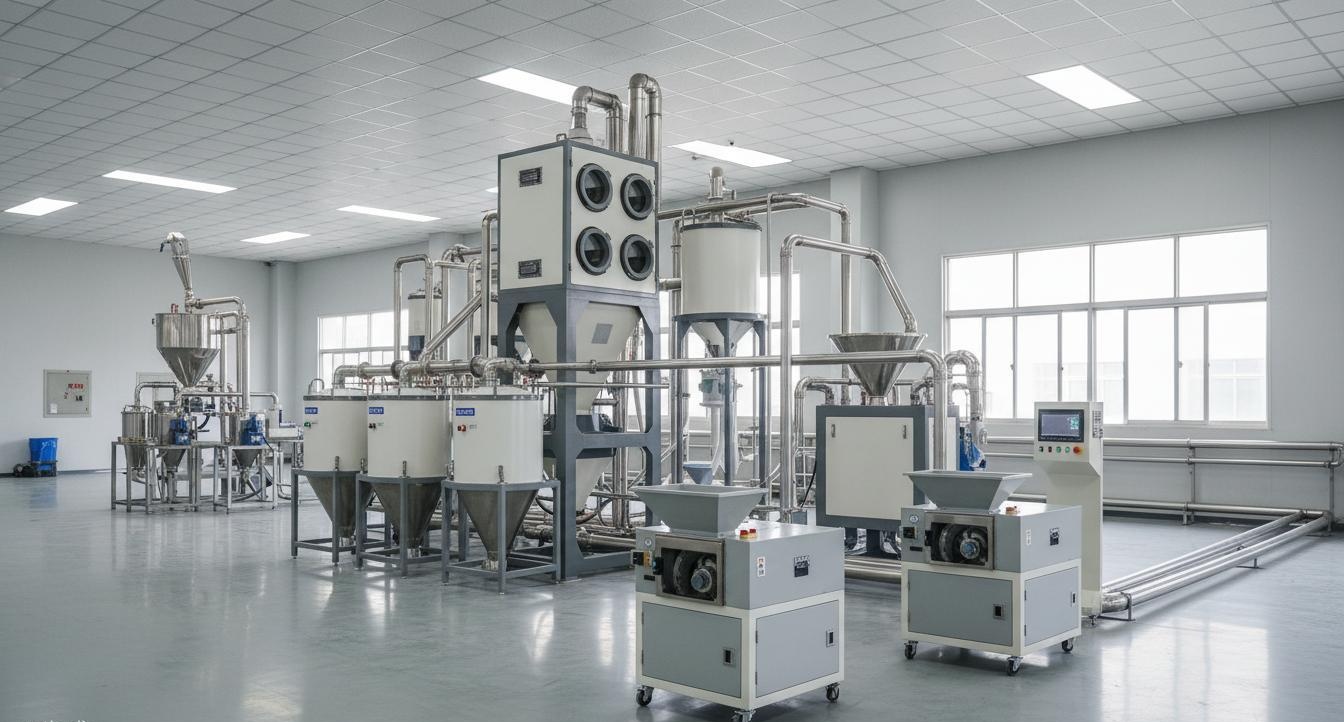
The auxiliary system for an injection molding operation covers the full material preparation and handling cycle. Each subsystem serves a specific function, and each interacts with the others in ways that affect overall part quality and system efficiency.
1. Material Drying
Most engineering polymers used in injection molding are hygroscopic—they absorb moisture from the air during storage and handling. When moist polymer is melted in the injection molding machine, the moisture turns to steam, causing voids, surface defects, part breakage, and degradation of mechanical properties. The drying requirement varies by polymer:
- PA (Nylon): requires drying at 75–85°C for 4–6 hours, final moisture content below 0.10%
- PET: requires drying at 140–160°C for 4–6 hours, final moisture below 0.02%
- PC (Polycarbonate): requires drying at 110–120°C for 3–4 hours, final moisture below 0.02%
- ABS: requires drying at 80–90°C for 2–4 hours, final moisture below 0.05%
Hopper dryers (individual dryers mounted on each machine) are the standard approach for operations with fewer than 6 machines. For larger operations, central drying systems provide better energy efficiency and more consistent material quality. The critical measurement is dew point—the temperature at which moisture condenses from the drying air. A dew point below -40°C is required for engineering polymers like PA, PET, and PC. Per ISO 2923 (Determination of moisture in plastics), moisture content testing is the definitive quality check—not just the dryer temperature setting.
2. Material Conveying
Material conveying systems move polymer from storage (silos, gaylords, or big bags) to the machine-mounted hoppers. The two dominant approaches are:
Individual vacuum loaders: each machine has its own loader drawing from a nearby source. Simple, low capital cost, but creates multiple material batch exposures and inconsistent material conditioning.
Central conveying systems: a single vacuum source draws material through a pipeline network to multiple machines. More complex to design and install, but eliminates material batch variation, reduces labor for material handling, and can be integrated with the central drying system for fully controlled material delivery. Because central conveying systems require careful pipeline design (pipe diameter, bend radius, source-to-machine distance), the design quality of the conveying system is as important as the equipment itself.
3. Temperature Control
Process cooling and mold temperature control are part of the auxiliary system but are sometimes handled separately. Mold temperature controllers (MTCs) heat or cool the mold’s circulating fluid to maintain precise surface temperatures that affect part dimensional stability, surface finish, and internal stress distribution. For precision engineering parts, a 2°C variation in mold surface temperature can cause measurable dimensional drift. ROBOT (Ningbo)’s robot arms and auxiliary equipment are typically integrated alongside the temperature control infrastructure as part of a complete turnkey plant planning approach.
4. Material Recycling
Sprues, runners, and reject parts are collected, granulated, and reintroduced into the production process as regrind. The granulator must produce regrind with consistent particle size distribution—excessive fines (particles below 0.5mm) cause feeding problems, inconsistent melt flow, and poor mechanical properties in parts incorporating regrind. Per ISO 13902, particle size analysis should be part of the quality specification for regrind. The typical granulator sizing rule: throughput capacity (kg/hour) = 5–8% of total material consumption (kg/hour) across the operation.
When Central Drying Makes Sense
Central drying is not always the right choice. Here is the decision framework:
Central Drying Is Right When:
- You operate 6 or more injection molding machines
- You process hygroscopic polymers (PA, PET, PC, ABS, PMMA) that require precise dew point control below -40°C
- You want consistent material quality across all machines from a single drying source
- Your material consumption rate is high enough to achieve high utilization of a central dryer’s capacity
- You are building a new facility or significantly expanding an existing one
Individual Hopper Dryers Are Right When:
- You operate fewer than 6 machines
- Your polymer mix is dominated by non-hygroscopic materials (PE, PP, PS) that only require brief drying
- You have a high-mix, low-volume operation where different machines run different materials frequently
- The capital is not available for central drying infrastructure
The energy efficiency argument for central drying is real: when running at 70%+ utilization, a central dryer can be 30–40% more energy efficient than equivalent total capacity in individual dryers. However, at low utilization (under 50% of rated capacity), individual dryers on each machine can be more efficient because you only run what you need. Size the central dryer for your actual utilization rate, not the theoretical maximum.
The Hidden Costs of Multi-Vendor Auxiliary Equipment
When I talk to factory managers who have bought auxiliary equipment from multiple suppliers, the hidden costs they describe most vividly are not the purchase price differences—they are the quality investigation costs and the accountability gaps.
The Blame-Shifting Problem
When you have a recurring quality issue—say, void defects in PA parts that appear intermittently—the investigation involves the dryer supplier, the material supplier, the injection molding machine supplier, and the mold maker. Each one has a plausible explanation: the dryer supplier says the material arrived wet; the material supplier says the dryer’s dew point was not properly maintained; the machine supplier says the injection speed profile needs adjustment. You pay for the investigation time. You pay for the trial-and-error corrections. You may pay for parts that fail in the field despite your inspection. This cost is real but invisible in the purchase price comparison.
With a one-stop auxiliary supplier who has designed and commissioned the complete system, the accountability gap disappears. They own the material preparation system. They investigate the issue. They solve it. That is a different commercial relationship—and it is worth paying for.
Incompatible Control Systems
When each auxiliary subsystem comes from a different supplier, you end up with different PLC brands, different HMI interfaces, and different communication protocols. This creates three practical problems: (1) your operators must learn multiple interfaces; (2) your maintenance team must carry spare parts for multiple platforms; (3) if you want to integrate the auxiliary system with your production monitoring system (MES or ERP), the integration cost multiplies with each additional protocol. A one-stop supplier with a unified control platform avoids all three problems.
How to Evaluate a Plastic Auxiliary Equipment Manufacturer
The evaluation criteria for auxiliary equipment suppliers overlap significantly with those for robot arms—but the specific questions are different:
- ☐ Manufacturing scope: can they produce the core components (dryer heating chambers, vacuum loaders, granulator cutting chambers) in-house, or do they primarily assemble from purchased components?
- ☐ Control system ownership: do they supply their own PLC/controller and HMI, or do they use third-party control systems? Owning the control system means faster fault diagnosis and simpler integration.
- ☐ Material compatibility data: can they provide dew point, moisture content, and drying time data for your specific polymer type, verified through testing?
- ☐ References: ask for references from operations similar to yours in scale and polymer type. A reference for a 3-machine PP operation is not relevant for a 15-machine PA/PET operation.
- ☐ System design capability: for central conveying and drying systems, can they provide a complete system design including pipeline layout, material balance calculations, and throughput verification?
- ☐ After-sales service: what is their local service response capability in your region? Who do you call at 2am when the dryer trips on a fault code?
- ☐ Spare parts policy: how quickly can critical spare parts (heater bands, desiccant rotors, vacuum pump vanes) be delivered to your location?
- ☐ Full product range: can they supply all four subsystems (drying, conveying, temperature control, recycling) from their own production, or do they partner with other manufacturers for some components?
The One-Stop Value Proposition: TCO Over 5 Years
Comparing auxiliary equipment suppliers by purchase price alone misses the picture. The total cost of ownership over 5 years tells the real story:
| Cost Category | Multi-Vendor Approach | One-Stop Supplier |
|---|---|---|
| Purchase price | Lower apparent cost | 5–15% higher (integrated system premium) |
| Integration costs | USD 5,000–15,000 (multiple vendors) | Included or minimal |
| Quality investigation costs (5-year) | USD 10,000–40,000 (blame-shifting) | Minimal (single accountable supplier) |
| Maintenance (5-year) | Multiple service contracts | Single service agreement, faster response |
| Spare parts inventory | Higher (multiple platform parts) | Lower (standardized platforms) |
| Downtime cost from equipment failure | Higher (longer diagnosis time) | Lower (single supplier, unified diagnostics) |
| Total 5-year TCO | Baseline | 15–25% lower |
These figures are based on documented operational experience across multiple facilities. The quality investigation cost estimate is the most variable—it depends heavily on how sensitive your parts are to material preparation variation. For medical or precision engineering parts, the cost of even one quality investigation failure that reaches the customer can far exceed the equipment purchase price differential.
Conclusion: One Supplier, One Standard, One Accountability
The case for one-stop plastic auxiliary equipment is ultimately a case for commercial clarity. When something goes wrong in the material preparation system of an injection molding operation, the cost of ambiguity between suppliers is paid by the factory owner in investigation time, production delays, and potentially customer chargebacks.
A one-stop supplier—ROBOT (Ningbo) Intelligent Technology Co., Ltd. offers the complete range from robot arms and automation systems to vacuum dosers and vertical mixers—provides a single point of accountability for the entire auxiliary system. The commercial structure changes the supplier’s incentives: instead of maximizing the price of each subsystem independently, the one-stop supplier is motivated to minimize your total cost because their reputation and your repeat business depend on the system’s overall performance.
Before selecting any auxiliary equipment supplier, run the 5-year TCO calculation—not just the purchase price comparison. The numbers typically favor the one-stop approach, even when the upfront cost is higher.
About the Author
Mr. Chen — Technical Director, ROBOT (Ningbo) Intelligent Technology Co., Ltd.
ROBOT (Ningbo) was established in 2004, specializing in plastic injection molding automation equipment. From hopper dryers and auto loaders to servo robot arms, central conveying systems, and turnkey plant planning, we help factories worldwide improve efficiency with practical, field-proven solutions. As Technical Director, I focus on the real-world performance of automation equipment—cycle time, uptime, and the specifications that actually matter on the production floor.
Disclaimer: This article provides general industry guidance for evaluating plastic auxiliary equipment suppliers. Specific equipment specifications, performance data, and total cost of ownership estimates are based on general industry observations and will vary by application, scale, and operational conditions. All technical references (ISO 2923, ISO 13902, ISO 9283, ISO 9001) should be verified with the relevant issuing bodies. Material drying requirements and polymer processing parameters should be confirmed with your material supplier and qualified process engineers before production implementation.
Post time: May-25-2026