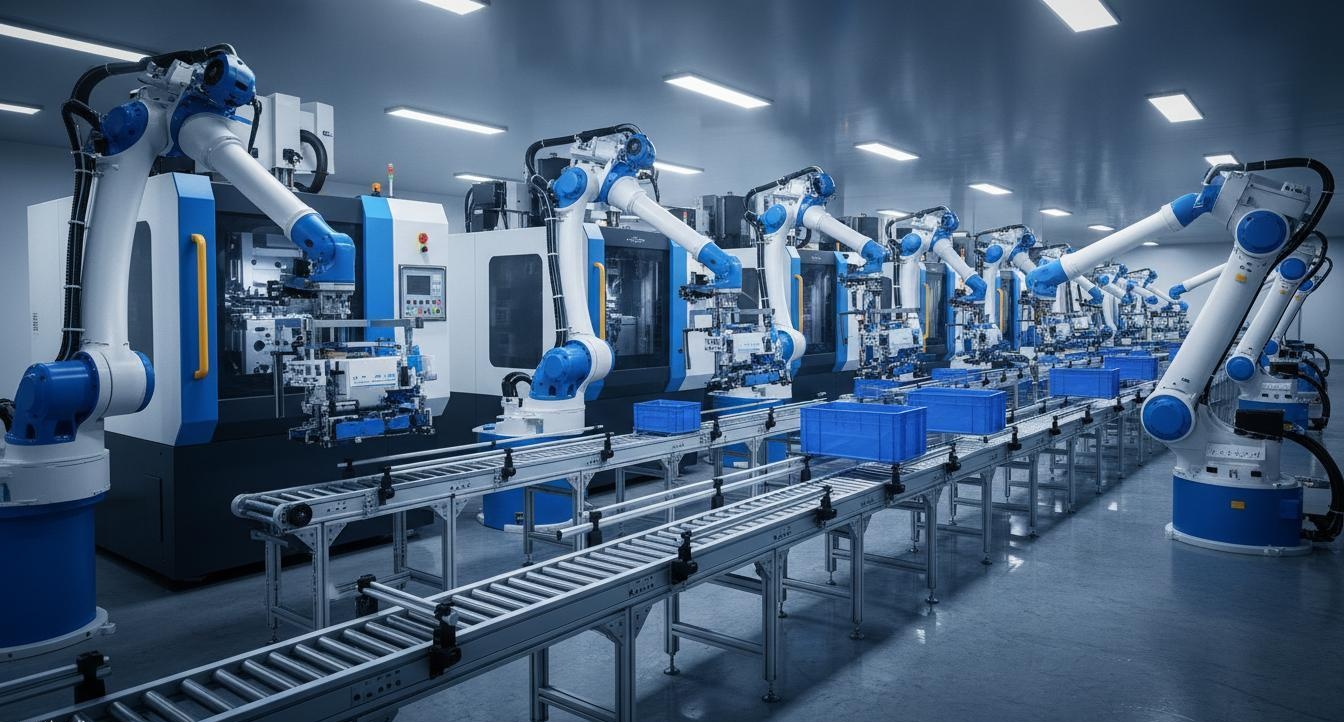
ROBOT (Ningbo) Intelligent Technology Co., Ltd. — established in 2004 and specializing in plastic injection molding automation equipment, from hopper dryers and auto loaders to servo robot arms and central conveying systems — provides field-proven automation solutions for factories running continuous production. Their experience across thousands of installed servo robot arm units provides the operational data underlying the ROI framework in this article.
The Labor Cost Context That Makes Automation ROI Urgent in 2026
Global manufacturing labor cost indices show manufacturing wages in Southeast Asia increasing at 5–7% annually; in China, manufacturing wages have increased 8–12% annually in tier-2 and tier-3 cities since 2019. A factory paying operators $2.50/hour in 2020 is now paying $3.20–$3.80/hour in 2026 — and the upward pressure continues. At the same time, servo robot arm pricing from Chinese manufacturers has stabilized at levels that make the automation investment pay back faster than the cost of continuing to employ manual operators on repetitive extraction cycles. The factories that acted in 2020–2023 to automate their molding operations are now running at lower per-part labor cost than their competitors who delayed — and the gap widens every year.
Understanding Servo Robot Arms in Injection Molding: What They Actually Do
A servo injection molding robot arm replaces the manual extraction of finished parts from the injection molding machine. In a manual operation, an operator opens the mold, extracts the part (often using compressed air to blow it out), trims any flash, and places the part in a tray or conveyor. A servo robot arm automates this sequence: it enters the open mold, extracts the part (using mechanical grippers or vacuum), performs any in-process actions (trim, degate, orient), and deposits the part in the designated location — all within the machine cycle time or a portion of it.
The key difference between a servo robot arm and a hydraulic robot arm in injection molding applications is the drive mechanism. A servo robot arm uses electric servo motors for each axis of motion, providing precise positional control, programmable speed and acceleration profiles, and significantly lower energy consumption. A hydraulic robot arm uses fluid power for motion — which is faster in some high-speed applications but consumes energy continuously and requires more maintenance. For most general-purpose injection molding automation, servo robot arms have become the default choice due to their energy efficiency, precision, and lower maintenance burden.
What a Servo Robot Arm Actually Replaces in the Production Cell
A servo injection molding robot arm replaces the following labor functions in a standard molding cell:
- Part extraction: The physical removal of the part from the open mold cavity — a repetitive, potentially hazardous operation that requires the operator to reach into the mold area
- Part handling and orientation: Positioning the part correctly for the next process step — trimming, inspection, packaging, or assembly
- Flash trimming: Some servo robot arm systems incorporate trimming stations that remove gate flash during the extraction sequence
- Part counting and tray stacking: Automated part counting and stacking into trays or bins reduces the operator’s involvement in part handling between cycles
- In-mold labeling (IML) integration: For applications requiring labels inside the mold cavity, servo robot arms handle label placement and part extraction in a single integrated cycle
The ROI Calculation Framework: Manual Extraction vs. Servo Robot Arm
Step 1: Establish the Baseline Labor Cost Per Part
The baseline for ROI calculation is the fully-loaded labor cost per part for the manual extraction operation. This is not simply the operator’s hourly wage divided by parts per hour — it is the total labor cost associated with the extraction function divided by the number of parts produced.
Labor Cost Per Part Calculation
Formula: Labor cost per part = (Operator hourly cost x hours per shift x number of shifts) / Parts produced per shift
Example: $3.80/hour operator x 3 shifts x 8 hours = $91.20/shift total labor cost. If one operator manages 2 molding machines at 180 parts/hour each (360 parts/shift total), the labor cost per part = $91.20 / 360 parts = $0.253/part.
The key variable in this calculation is the number of molding machines per operator — which is determined by the cycle time and the complexity of the part extraction. A 25-second cycle with a simple part extraction may allow one operator to manage 2 machines; a 60-second cycle with complex multi-cavity extraction may require one operator per machine. Reducing the operator’s involvement through automation changes this ratio.
Step 2: Model the Servo Robot Arm Contribution
A servo robot arm operating at full cycle integration (where the robot cycle time is equal to or shorter than the molding machine cycle time) effectively eliminates the extraction labor cost from the per-part calculation. The operator is freed from the extraction function and can instead supervise multiple machines — or focus on quality inspection, packaging, and material handling tasks that cannot be automated.
The ROI calculation for a servo robot arm investment:
| Cost / Benefit Component | Manual Extraction | With Servo Robot Arm |
|---|---|---|
| Labor cost per part (extraction function) | $0.20–$0.45/part | $0.02–$0.05/part (supervision + loading) |
| Operator machines managed per shift | 1–2 machines | 3–5 machines (with automation) |
| Part consistency / quality | Variable — operator fatigue affects extraction quality | Consistent — each cycle is identical |
| Scrap rate from extraction damage | 0.5–2.0% typical | 0.1–0.3% with servo extraction |
| Production continuity | Interrupted by shift changes, breaks | Continuous during molding cycle |
Step 3: Calculate the Payback Period
The payback period for a servo injection molding robot arm investment is calculated as:
Payback Period (Months)
= Robot arm installed cost / Monthly labor cost savings
Example: Robot arm installed cost = $18,000. Monthly labor cost savings = $1,840 (operator time freed from extraction across 3 shifts, enabling one less operator hire). Payback = 18,000 / 1,840 = 9.8 months.
The installed cost of a servo robot arm from a Chinese manufacturer typically ranges from $12,000–$28,000 depending on payload, reach, axes configuration, and included peripherals (grippers, trays, sensors). The installation cost (integration with the molding machine, commissioning, and operator training) typically adds $2,000–$5,000 to the total installed cost.
Step 4: Calculate the Total Cost of Automation vs. Continued Manual Operation
Over a 5-year operational horizon, the comparison between automation and manual extraction includes:
| Cost Component | Manual (5 years) | Automated (5 years) |
|---|---|---|
| Robot arm + installation | $0 | $20,000–$33,000 (installed) |
| Labor cost (extraction function) | $0.30/part x 50,000 parts/year x 5 years = $75,000 | $0.04/part x 50,000 parts/year x 5 years = $10,000 |
| Robot arm maintenance | $0 | $3,000–$6,000 over 5 years |
| Scrap cost (extraction damage) | 1% of parts = significant over 5 years | 0.2% = significantly lower |
| Total 5-year cost | $75,000+ labor + scrap | $33,000–$49,000 total |
The 24/7 Production Shift Context: Why Automation ROI Accelerates
The ROI for servo robot arm investment is most compelling in 24/7 production operations — and here is why: the manual extraction operator must be present for every shift, including night shifts, weekend shifts, and holiday shifts. In 24/7 operations, the actual fully-loaded cost of an operator includes the shift premiums, the recruitment and training costs for the additional headcount required to cover shift rotations, and the productivity loss from fatigue-related errors on long shifts.
Night Shift Labor Cost Premium
In most manufacturing regions, night shift operators earn a wage premium of 10–25% above day shift rates. For a 24/7 operation, the night shift labor cost represents 33–40% of total labor hours at this premium. A servo robot arm operates at identical performance on the night shift as on the day shift — no premium pay, no fatigue, no reduced productivity from overnight work.
Shift Change Downtime
Every shift change in a manual extraction operation creates approximately 10–20 minutes of reduced production as the incoming operator receives the handover, inspects the machine and part status, and resumes full production pace. Over a 24/7 operation running 3 eight-hour shifts, this represents approximately 1.5–3 hours per day of non-productive time attributable to shift transitions. A servo robot arm does not require handover — it continues producing through the shift transition with no productivity loss.
Consistent Part Quality Across All Shifts
Manual extraction quality varies with operator attention, fatigue, and experience level. Night shift operators with longer tenure on the job tend to have slightly higher extraction damage rates due to fatigue factors. A servo robot arm produces identical extraction quality on shift 1, shift 2, and shift 3 — which directly reduces the scrap rate and the associated cost of re-grinding, rework, and customer returns.
Evaluating Servo Robot Arm Specifications for Injection Molding ROI
Payload and Gripper Weight
The servo robot arm’s payload capacity must exceed the weight of the part plus the gripper mechanism. For small-to-medium injection molded parts (under 2kg finished weight), most standard servo robot arms provide adequate payload. For large parts or heavy molds, confirm the robot’s payload specification against the actual part weight plus gripper mass.
Cycle Time Integration
The critical specification for ROI optimization is whether the robot arm’s extraction cycle time integrates fully within the molding machine cycle time — meaning the robot completes its extraction, orientation, and deposit sequence within the time window available while the mold is open. If the robot cycle exceeds the molding cycle time, the robot becomes the bottleneck, and the injection molding machine must dwell (wait) for the robot, reducing overall productivity.
Axes Configuration: 3-Axis vs. 5-Axis vs. 6-Axis
The number of axes determines the robot’s freedom of movement in the extraction and deposit sequence:
- 3-axis servo robots: Horizontal extraction, vertical stroke, and tray deposit — adequate for simple parts with straightforward extraction paths
- 5-axis servo robots: Add articulation for parts requiring orientation during extraction — common for parts with unsymmetrical geometry or multi-cavity molds
- 6-axis servo robots: Full articulation for complex extraction paths, in-mold labeling integration, and multi-station deposit sequences
For most standard injection molding applications, a 3-axis or 5-axis servo robot arm provides the necessary functionality at a lower price point than a 6-axis arm. The additional axes of a 6-axis robot justify their cost when the extraction path requires complex articulation — which is relatively uncommon in standard injection molding applications.
ROBOT’s servo robot arm configurations span standard 3-axis extraction for simple parts through 5-axis articulated units for complex part geometries — with payloads ranging from 3kg to 50kg to serve the full range of injection molding applications.
Beyond Labor: Secondary Benefits of Servo Robot Arm Automation
The ROI model above focuses on the direct labor cost savings — but factories that have deployed servo robot arms consistently report secondary benefits that add meaningful value to the automation investment:
- Reduced part damage and scrap: Servo robot arm extraction is gentler and more consistent than manual extraction — the reduced scrap rate from extraction damage alone can justify the robot investment in high-value part applications
- Improved worker safety: Reaching into an open mold area is a pinch-point hazard. Automation removes operators from this hazardous zone — reducing injury risk and associated workers’ compensation costs
- Operator morale and retention: Repetitive manual extraction is one of the least desirable jobs in a molding factory. Automating this function allows existing operators to transition to quality inspection, machine tending, and material handling roles that are more engaging — reducing turnover and the associated recruitment and training costs
- Consistency of production records: Servo robot arms integrated with the molding machine controller generate consistent cycle-by-cycle data on extraction timing, part counts, and exception events — which supports SPC (statistical process control) and production tracking systems
Procurement Checklist: Servo Injection Molding Robot Arm Evaluation
- Confirm the robot payload exceeds your part weight plus gripper mass with a minimum 20% margin
- Verify the robot extraction cycle time is equal to or shorter than your molding machine cycle time — this is the primary throughput requirement
- Specify the number of axes based on your part geometry: 3-axis for simple extractions, 5-axis for parts requiring orientation, 6-axis only for genuinely complex extraction paths
- Request a cycle time study from the supplier using your actual part mold — this confirms integration feasibility before commitment
- Clarify what is included in the quoted price: robot arm only, or gripper + tray + integration? Gripper tooling is frequently quoted separately
- Evaluate the robot’s controller integration with your existing molding machine brands — some controllers have proprietary communication protocols that complicate integration
- Request the supplier’s field service support in your region — confirm whether they have an application engineer available for on-site commissioning and operator training
- Clarify the warranty period and what it covers (mechanical, electrical, software) — and what the hourly rate is for service visits after the warranty expires
- Request references from factories running the same robot model on similar part applications — not just a general customer list
- Calculate the payback period using your actual fully-loaded labor cost, not just the base hourly rate — the fully-loaded cost typically runs 1.4–1.8x the base hourly rate when benefits, taxes, and overhead are included
Need a Servo Robot Arm Supplier for Your Injection Molding Operation?
ROBOT (Ningbo) Intelligent Technology Co., Ltd. — established in 2004 — specializes in plastic injection molding automation equipment including servo robot arms, auto loaders, hopper dryers, and central conveying systems. Our servo robot arms are deployed in molding operations across Southeast Asia, Europe, North America, and South America, with field-proven performance data available for specific application categories. We provide cycle time studies, on-site commissioning, and operator training as part of our standard installation service. Browse our servo robot arm product range or contact our technical team for an automation ROI analysis using your specific production parameters.
Frequently Asked Questions
Q1: How do I calculate the realistic payback period for a servo robot arm on my specific injection molding machine?
Use this formula: Payback (months) = Total installed automation cost / Monthly labor cost savings. For the installed cost, include the robot arm, gripper tooling, integration, and commissioning. For the monthly labor cost savings, calculate: (current labor cost per hour for extraction function) x (hours per month) x (number of shifts). If the robot enables one operator to manage 3 machines instead of 1.5, the freed labor cost is real and calculable. Use your fully-loaded labor rate (base rate x 1.4–1.8x) for accuracy. For most 24/7 molding operations, the payback is between 12 and 24 months at current labor cost levels. If your payback calculation exceeds 30 months, either the labor savings are smaller than typical (fewer machines per operator than average) or the robot price quote is above market.
Q2: Can a servo robot arm keep up with a fast-cycle injection molding machine?
The key is to compare the robot’s total extraction cycle time against your molding machine’s open-time window (the time the mold is open between ejection and closing). For standard parts with cycle times of 20 seconds or more, most servo robot arms integrate fully. For fast-cycle machines (under 10-second cycles), specialized high-speed extraction robots are required — standard servo robot arms may not achieve the required speed. Request a cycle time demonstration with your actual part and mold before committing to a purchase.
Q3: What maintenance does a servo robot arm require, and what does it cost?
Servo robot arms require: (1) Monthly inspection of gripper mechanism and wear items — typically 30 minutes by the machine operator; (2) Quarterly inspection of servo motor brackets, cable routing, and lubrication points — typically 1–2 hours by a maintenance technician; (3) Annual calibration of the robot’s positional accuracy and repeatability — typically 2–4 hours by a service engineer. The annual maintenance cost for a servo robot arm is typically $600–$1,200 per year, depending on the manufacturer and whether a service contract is purchased. The maintenance cost is significantly lower than hydraulic robot arms, which require regular hydraulic oil changes, filter replacements, and cylinder inspections.
Q4: Does automating extraction with a servo robot arm really allow one operator to manage more molding machines?
Yes — this is the primary labor cost benefit. The operator’s role shifts from active extraction to supervisory monitoring and material handling. In most automation deployments, one operator managing 1.5 machines (due to cycle time constraints on manual extraction) transitions to managing 3–4 machines with a servo robot arm. The exact ratio depends on the part complexity, cycle time, and whether the operator also handles trimming, inspection, or packaging tasks. A conservative planning assumption is 2.5–3x the machines per operator compared to fully manual extraction.
Q5: How do I evaluate whether a servo robot arm is compatible with my existing injection molding machine?
The primary compatibility considerations are: (1) The robot arm’s mounting interface — whether it mounts on the machine’s rail system, the platen, or the floor; (2) The robot controller’s communication protocol — whether it supports the interface standard used by your machine’s PLC (Siemens, Mitsubishi, Allen-Bradley, etc.); (3) The mold opening stroke and the robot’s reach — whether the robot can extract the part from the deepest cavity position without colliding with the mold or machine frame. A reputable supplier will conduct a physical survey of your machine and mold before quoting — if they are not offering this, request it as a condition of the purchase.
Mr. Chen is Technical Director at ROBOT (Ningbo) Intelligent Technology Co., Ltd., established in 2004 and specializing in plastic injection molding automation equipment. From hopper dryers and auto loaders to servo robot arms, central conveying systems, and turnkey plant planning, ROBOT helps factories worldwide improve efficiency with field-proven automation solutions. As Technical Director, Mr. Chen focuses on the real-world performance of automation equipment — cycle time, uptime, and the specifications that actually matter on the production floor. Follow ROBOT Ningbo on Facebook.
Post time: May-26-2026