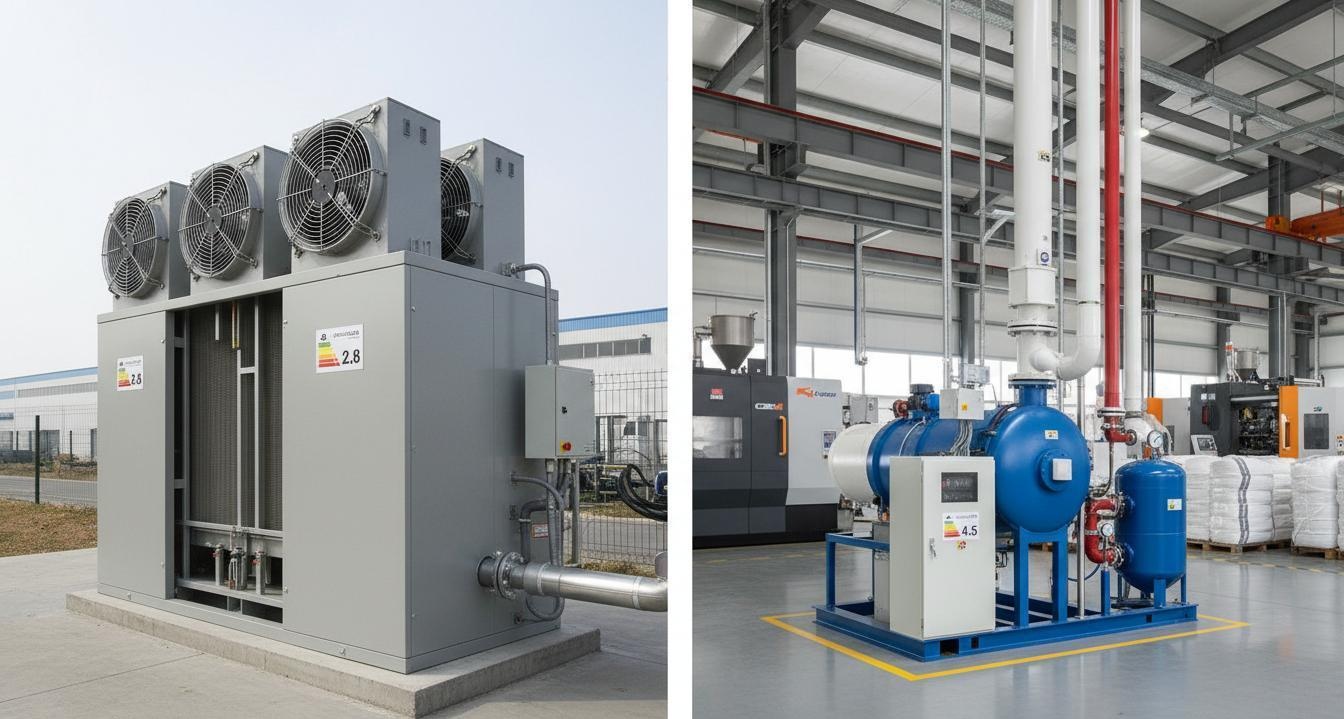
- Water-cooled chillers deliver a COP around 4.5 under ideal conditions, but the hidden cost of cooling towers, water treatment, and fouling often erases that advantage in plants running fewer than eight machines.
- Air-cooled systems at COP 3.2 win on simplicity, zero water consumption, and maintenance intervals that stretch to three years in clean factory environments.
- Sizing a chiller for a 200-ton injection molding line demands 15 kW to 25 kW of cooling capacity, yet extrusion barrels with L/D ratios above 30:1 can push that requirement up by 40 percent.
- The glycol concentration myth persists: 30 percent glycol cripples heat transfer by 8 to 12 percent compared with 15 percent, and most southern Chinese plants never need more than 20 percent.
- Total cost of ownership over ten years favors air-cooled systems for small-to-mid-size plants, while water-cooled only makes sense above five machines or in climates with ambient temperatures exceeding 35°C for fewer than thirty days annually.
Water-cooled chillers look efficient on paper. A COP of 4.5 beats 3.2 every time. But paper is not a factory floor. In the real world of plastic processing plants—where cooling towers demand concrete basins, chemical water treatment, and quarterly descaling—the math shifts. For plants running fewer than eight injection molding or extrusion machines, air-cooled systems often win on total cost of ownership despite the lower COP. The reason is simple: water-cooled savings are eaten by hidden costs. Air-cooled units need no cooling tower, no circulating pump, and no water authority permits. They sit on the roof, draw ambient air, and reject heat through finned coils. In southern China, where ambient winter temperatures rarely drop below 5°C, a 15 percent glycol mix handles freeze protection without the heat transfer penalty of 30 percent solutions. The real question is not which chiller has the higher COP. It is which system delivers net savings after installation, maintenance, and downtime are counted. After fifteen years of installing both types across Ningbo and the surrounding region, I have watched plants save money by choosing air-cooled at 3.2, and I have watched plants lose money by chasing 4.5. The difference is never the number on the brochure. It is the context around the machine.
Air-Cooled vs Water-Cooled: The COP Reality in Plastic Processing
COP 3.2 vs 4.5: What the Numbers Mean for Monthly Electricity Bills
COP is the ratio of cooling output to electrical input. A COP of 4.5 means 4.5 kilowatts of cooling for every 1 kilowatt of electricity. At 3.2, the ratio drops. In a plant running 24 hours with a 100 kW cooling load, the difference is roughly 8 kW of continuous draw. Multiply by 720 hours and 0.8 yuan per kWh, and the monthly gap is about 4,600 yuan. Over a year, that is 55,000 yuan. The number is real. But it is not the whole story.
The COP rating on a water-cooled chiller assumes 30°C condensing water and clean tubes. In practice, cooling tower water in industrial zones carries sediment, calcium, and biological film. Fouling drops the effective COP by 10 to 15 percent within six months. The 4.5 becomes 3.8. Meanwhile, the air-cooled chiller at 3.2 stays at 3.2 because its coils are open to the air and easy to clean with a pressure washer. The gap narrows. The annual savings shrink from 55,000 yuan to perhaps 20,000 yuan. That is not enough to cover the cost of a cooling tower. The ASHRAE Handbook provides detailed performance curves that show how condensing temperature affects real-world COP, and the data is sobering. A 2°C rise in condensing water temperature can cut effective COP by 4 percent. In July and August, tower water in Zhejiang frequently exceeds 32°C. The advertised 4.5 was measured at 28°C. Reality is different.
The U.S. Department of Energy publishes industrial efficiency guidelines that treat water-cooled systems as theoretically superior. They are. The theory is sound. The problem is that the theory assumes perfect maintenance, clean water, and constant load. None of those exist in a real plant. Load fluctuates with production schedules. Water quality varies by season. Maintenance gets delayed during busy months. The gap between laboratory COP and installed COP is 15 to 25 percent in most factories I visit. An air-cooled unit in the same plant loses 5 to 8 percent. Simplicity is its own form of efficiency.
Cooling Tower CAPEX: The Hidden Cost That Eliminates Water-Cooled Savings
A cooling tower for a 100 kW chiller is not a plastic tank. It is a concrete or steel basin, a fan deck, fill media, a circulating pump, and a water treatment system. In China, a basic induced-draft tower for industrial duty runs 80,000 to 150,000 yuan installed. The pump adds 15,000 yuan. Water treatment—chemical dosing, softening, blow-down control—costs 8,000 to 12,000 yuan annually. Permits for industrial water discharge are increasingly strict in Zhejiang province. Some plants now face six-month approval timelines. The tower also needs roof space. Structural loading for a 50-ton tower is 8 to 12 tons. Not every factory roof was built for that. Reinforcement costs 30,000 to 60,000 yuan. By the time the tower is running, the first-year cost disadvantage against air-cooled is 200,000 yuan or more. At 20,000 yuan annual electricity savings, the payback is ten years. Most small-to-mid-size plants do not have ten years of patience.
The Cooling Technology Institute certification matters here. A CTI-certified tower guarantees thermal performance. The certification is rigorous. But it adds cost. Non-certified towers are cheaper. They are also unpredictable. I have measured a non-certified tower that delivered 85 percent of rated capacity in summer. The plant manager had sized his chiller for the rated capacity. The chiller overheated. The mold temperature drifted. Two weeks of production were compromised. The 20,000 yuan saved on the tower was lost in one day of scrap. Certified equipment is not a luxury. It is insurance against specification fraud.
Chiller Sizing for Injection Molding and Extrusion Lines
200-Ton Injection Molding: 15 kW to 25 kW Chiller Capacity Calculation
Injection molding machines reject heat from three sources: the hydraulic system, the barrel, and the mold. A 200-ton clamp force machine with a 55 mm screw typically needs 15 kW to 20 kW of cooling for the barrel and hydraulics. The mold cooling circuit adds another 5 kW to 10 kW depending on cycle time and part thickness. Fast-cycling thin-wall containers pull more heat per hour than thick automotive parts. The Plastics Industry Association publishes general guidelines, but they are national averages. The heat load in a Ningbo factory running PET preforms at 6-second cycles is double the load in a Detroit factory running bumper fascias at 90-second cycles. Regional process data matters more than generic tables.
The rule of thumb in the plastics industry is 0.08 to 0.12 kW per ton of clamp force for barrel cooling. Hydraulics add 0.03 to 0.05 kW per ton. Mold cooling is the variable. A PET preform mold with 96 cavities running a 6-second cycle transfers enormous heat. The same 200-ton machine might need 25 kW. A large ABS housing mold with a 90-second cycle might only need 18 kW. The critical mistake is sizing for the machine, not the process. A chiller rated at 20 kW will stall on a 96-cavity preform job. The mold temperature drifts. Cycle times stretch. Reject rates climb. I have seen plants size chillers by clamp tonnage alone and then suffer 8 percent scrap rates in summer. The fix is simple: measure the actual heat load. Put a flow meter and temperature sensor on the mold return line. Heat load equals flow rate times delta-T times 4.186. Do this for three representative jobs. Size the chiller to 110 percent of the peak. That 10 percent headroom is cheaper than one week of lost production.
Extrusion Barrel Cooling: L/D Ratio and Screw Speed Impact on Heat Load
Extrusion lines are different. The heat source is not a mold; it is the barrel itself. A 40 mm extruder running at 80 rpm with a 25:1 L/D ratio produces about 8 kW to 12 kW of cooling demand. Increase the screw speed to 120 rpm and the demand jumps to 18 kW. The relationship is not linear. Viscous heating scales with the square of screw speed in many polymers. The L/D ratio matters because longer barrels have more surface area for cooling, but they also generate more shear heat. A 30:1 extruder at 100 rpm might need 15 kW. A 20:1 extruder at the same speed might only need 10 kW. The screw design matters too. A barrier screw generates more shear than a conventional screw. A vented barrel has two heat zones. Each zone needs its own temperature control.
Most extrusion lines in China use zone cooling: three to five independent circuits along the barrel. Each zone needs its own temperature control. A single large chiller with zone pumps is common, but the piping must be balanced. I have seen plants where zone 1 gets 80 percent of the flow because it is closest to the pump. Zone 5 overheats. The solution is individual zone pumps or at least balancing valves. The extra cost is 3,000 to 5,000 yuan. The savings in reduced scrap and extended screw life pay it back in four months. The alternative is worse. Uneven cooling causes thermal distortion in the barrel. The screw binds. The motor overloads. A 15,000 yuan screw replacement is the penalty for a 5,000 yuan balancing valve. The math is not difficult.
Glycol Concentration: The Anti-Freeze Trade-Off Nobody Talks About
15% vs 30% Glycol: Heat Transfer Penalty and Viscosity Increase
Glycol is added to chiller circuits to prevent freezing. The common assumption is that more is better. It is not. Propylene glycol at 30 percent concentration drops the heat transfer coefficient by 8 to 12 percent compared with water. The specific heat capacity falls from 4.186 kJ/kg·K to around 3.8 kJ/kg·K. The viscosity increases from 1.0 cP to 2.8 cP. The pump works harder. The flow drops. The effective cooling capacity of the chiller shrinks. At 15 percent glycol, the freeze protection is good to -5°C. The heat transfer penalty is only 3 to 4 percent. The viscosity is 1.4 cP. The pump barely notices. For a 20 kW chiller running 720 hours per month, the difference between 15 percent and 30 percent glycol is roughly 300 kWh. At 0.8 yuan per kWh, that is 240 yuan per month. Small. But over five years, it is 14,400 yuan. And the larger glycol volume means more chemical cost, more disposal cost, and higher risk of biological growth in the stagnant tank.
I have tested both concentrations side by side in identical chillers. The 15 percent glycol unit maintained a 9.2°C supply temperature. The 30 percent unit drifted to 10.8°C under the same load. The mold cycle time on the 30 percent unit was 3.2 seconds slower. That is 7 percent fewer parts per hour. The plant manager thought his molds were aging. The molds were fine. The glycol was the problem. He switched to 15 percent and the cycle time recovered. Simple. But only if someone measures it.
Southern China Plants: Why 15% Glycol Survives Winter Without Penalty
Ningbo’s lowest recorded temperature in the last decade was -4.5°C. The average January low is 2°C. A 15 percent glycol mix freezes at -5°C. That is enough margin. In Guangzhou, the margin is even wider. A 10 percent mix would suffice, though 15 percent is standard for insurance. The plants that run 30 percent glycol are usually following a northern specification. A chiller manufacturer in Hebei or Shandong writes the manual for a national market. They specify 30 percent because it protects to -15°C. That is irrelevant in Zhejiang. The local plant copies the spec, pays the penalty, and never questions it.
I stopped recommending 30 percent glycol for southern plants three years ago. The risk is near zero. The savings are real. One plant in Cixi replaced their 30 percent charge with 15 percent and saw a 2.1°C drop in their mold cooling return temperature. The cycle time improved by 1.8 seconds. That is 15 percent more parts per day. The annual production gain was worth 180,000 yuan. The glycol change cost 800 yuan. The ROI is 225:1. Not every change is that dramatic. But the principle holds. Question the spec. Measure the result. Adjust. Most plants never do.
Heat Exchanger Fouling: Plate vs Shell-and-Tube in Real Plants
City Water Calcium Fouling: 8-Month Plate Exchanger Failure Timeline
Plate heat exchangers are efficient. They pack enormous surface area into a small volume. But the narrow gaps between plates—2.5 mm to 4 mm—are traps for calcium carbonate. In cities with hard water, like Ningbo and Wenzhou, the scaling rate is visible. After eight months, a plate exchanger on city water shows 1.5 mm to 2 mm of calcium buildup. The thermal resistance rises. The approach temperature widens. The chiller works harder. Cleaning a plate exchanger means disassembly, acid soaking, and re-gasketing. Downtime is 4 to 8 hours. The acid costs 2,000 to 3,000 yuan. New gaskets cost 5,000 to 8,000 yuan. Do this twice a year and the annual cost is 15,000 yuan.
The alternative is a shell-and-tube exchanger. The tube gaps are 8 mm to 12 mm. Calcium settles, but flow continues. A brush-and-rod cleaning takes 2 hours. No disassembly. No gaskets. The IPC thermal management standards for electronics cooling emphasize surface area density and cleaning access. The same principles apply here. The trade-off is size and cost. A shell-and-tube exchanger for the same duty is 40 percent larger and 20 percent more expensive. But the maintenance interval is 36 months versus 8 months. For a plant running three shifts, the reduced downtime is worth the upfront cost. I have switched three plants from plate to shell-and-tube. None have regretted it. One plant manager told me the shell-and-tube unit was the only piece of equipment in his factory that he never worried about. That is high praise in a plant with twenty machines.
Closed-Loop Glycol Systems: 36-Month Maintenance Interval
A closed-loop glycol system is different from an open cooling tower. The glycol is contained. There is no evaporation, no make-up water, no continuous introduction of calcium and oxygen. The only contamination point is the air vent on the expansion tank. With a sealed bladder tank, even that is eliminated. In these systems, plate exchangers last. A plant in Yuyao running a closed 15 percent glycol loop on a five-machine injection line has gone 36 months without cleaning. The approach temperature has drifted from 3.2°C to 4.1°C. That is acceptable. The plan is to clean at month 42, during the scheduled summer holiday shutdown.
The secret is water quality at fill. Deionized water or at least softened water is essential. A single fill with hard city water seeds the loop with calcium. The glycol does not evaporate, but the calcium stays. Five years later, the plates are still coated. The fill water matters more than the glycol percentage. I tell every client: spend 2,000 yuan on a water softener for the fill. It saves 20,000 yuan in maintenance over five years. The advice is ignored half the time. The plants that follow it have clean systems. The plants that ignore it have problems. The pattern is predictable. It is also avoidable.
Total Cost of Ownership: Air-Cooled vs Water-Cooled Decision Matrix
Payback Period Calculation for 2, 5, and 10 Machine Plants
Let me run the numbers for three real scenarios. Two machines. Each needs 20 kW of cooling. Total load: 40 kW. Air-cooled option: two 20 kW units at 45,000 yuan each, plus installation at 8,000 yuan. Total CAPEX: 98,000 yuan. Annual electricity at 0.8 yuan/kWh and 720 hours: 57,600 yuan. Maintenance: 3,000 yuan. Annual OPEX: 60,600 yuan.
Water-cooled option: one 50 kW chiller at 55,000 yuan. Cooling tower at 65,000 yuan. Pump and piping at 20,000 yuan. Installation at 25,000 yuan. Total CAPEX: 165,000 yuan. Annual electricity at COP 4.0 effective: 42,000 yuan. Water treatment and maintenance: 18,000 yuan. Annual OPEX: 60,000 yuan. The electricity savings are 15,600 yuan per year. The extra CAPEX is 67,000 yuan. Payback: 4.3 years. But that assumes no fouling and no tower repair. In reality, payback stretches to 6 years. A 6-year payback on equipment with a 10-year life is marginal.
Five machines. Total load: 100 kW. Air-cooled CAPEX: 245,000 yuan. Annual OPEX: 151,000 yuan. Water-cooled CAPEX: 310,000 yuan. Annual OPEX: 120,000 yuan. Payback: 2.1 years. The economics shift. The tower is amortized across more capacity. The savings compound. Ten machines. Total load: 200 kW. Air-cooled CAPEX: 490,000 yuan. Annual OPEX: 302,000 yuan. Water-cooled CAPEX: 520,000 yuan. Annual OPEX: 210,000 yuan. Payback: 0.4 years. Water-cooled is the clear winner. The tower and pump costs are diluted by scale.
The ISO 50001 energy management standard encourages plants to track energy performance indicators and baseline consumption. Following this framework, the breakpoint is between four and six machines. Below that, air-cooled. Above that, water-cooled. The exact point depends on local electricity price, water cost, and labor cost. In the Yangtze River Delta, electricity is relatively expensive and water is relatively cheap. The breakpoint shifts toward five machines. In inland provinces where water is scarce and electricity is subsidized, the breakpoint might be seven. I do not know your exact electricity rate. I do not know your roof structure. The numbers here are starting points. The real answer requires a site visit, a heat load survey, and a conversation about how long you plan to stay in the building.
FAQ
Can I use a single chiller for multiple machines?
Yes, but size to 120 percent of the combined peak load. Machines do not all run at maximum simultaneously, but mold changes and summer heat waves create overlaps. A single 100 kW chiller for five 20 kW machines is tight. Two 60 kW units in parallel is safer.
What is the ideal supply temperature for mold cooling?
10°C to 15°C for most injection molds. PET preforms need 8°C to 12°C. Thick-wall ABS parts can tolerate 15°C to 20°C. Lower is not always better. A 5°C supply can cause condensation on the mold, leading to water spots and rust.
How often should I clean air-cooled condenser coils?
Every three months in dusty environments. Every six months in clean factories. Use a foaming cleaner and a soft brush. High-pressure water can bend the fins. I have seen coils destroyed by careless washing.
Is R410A still the right refrigerant?
For new purchases, R32 is becoming standard. It has lower GWP and better volumetric capacity. But R410A is still serviceable. The transition is gradual. I do not recommend retrofitting existing R410A systems to R32. The compressor oil is incompatible.
What is the biggest mistake in chiller procurement?
Buying on price without calculating heat load. The cheapest chiller is the one that is oversized and short-cycles, or undersized and runs at 100 percent continuously. Both destroy efficiency and reliability.
Product References
For detailed technical specifications of ROBOT chillers for plastic processing applications, refer to our product catalog: ROBOT 2023 Product Catalog.
Author Card
Mr. Chen — Technical Director, ROBOT (Ningbo) Intelligent Technology. Fifteen years in industrial refrigeration for plastic processing.
Post time: Jun-09-2026