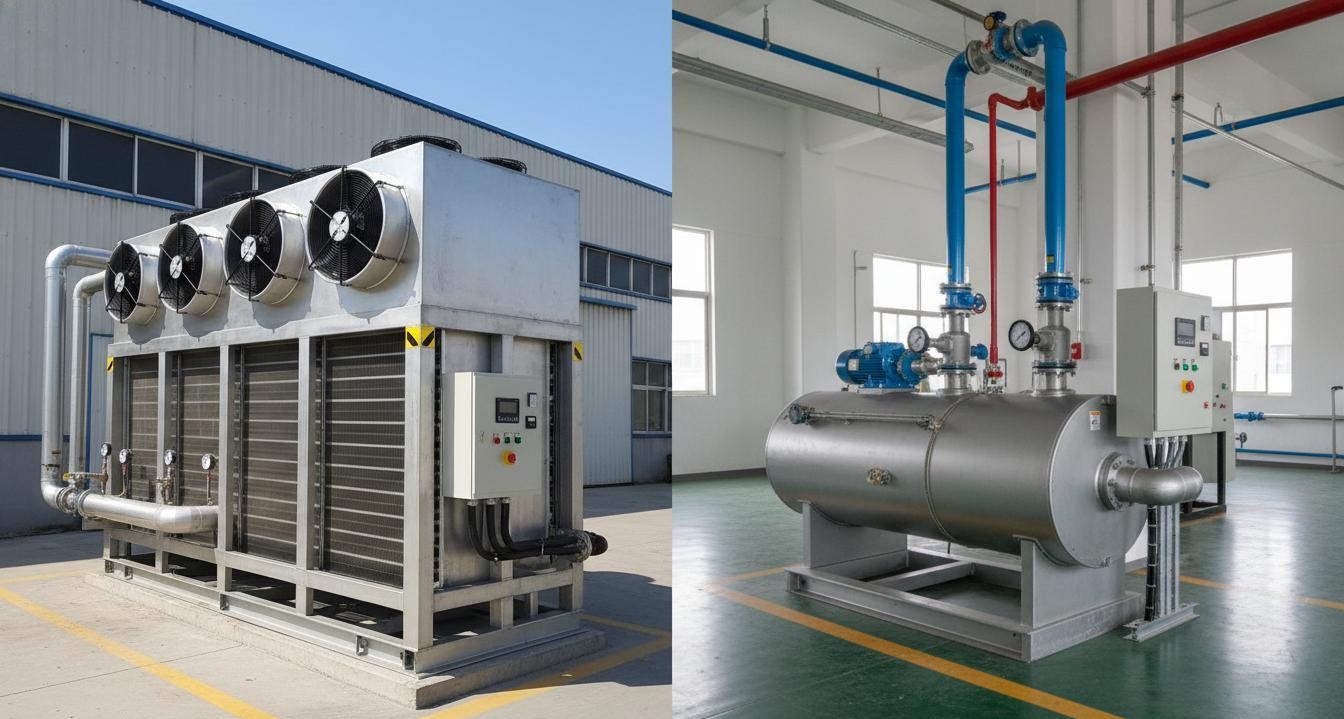
1. The Decision That Echoes for Two Decades
Choosing between air-cooled and water-cooled chillers for your plastic processing line is not a marketing decision — it is a capacity, cost, and compliance decision that echoes through your production floor for 15 to 20 years. As Technical Director at ROBOT (Ningbo) Intelligent Technology, I have spent two decades helping injection molding factories match the right chiller to their actual load profile, ambient conditions, and expansion plans. I have seen a mid-sized plant in Vietnam lose $4,200/month in excess electricity because their air-cooled unit was spec’d 30% undersized for a 38°C ambient. I have also watched a Thai packaging factory cut their cooling energy bill by 41% simply by switching from air-cooled to water-cooled with a properly sized cooling tower. This is not theory — these are production-floor numbers from real factories.
In this guide, I will walk you through the comparison table I use internally when evaluating a chiller purchase, break down the three refrigerant types that matter right now — R134a, R407C, and R410A — and explain why the regulatory clock is ticking on high-GWP refrigerants. I will also share what you should demand from any industrial chiller manufacturer before signing a purchase order, because I believe the difference between a supplier and a partner is whether they ask about your cooling load before quoting a price.
2. How Air-Cooled and Water-Cooled Chillers Actually Differ
An industrial chiller for plastic processing does one job: it pulls heat out of the mold, the hydraulic oil, and sometimes the feed throat, then rejects that heat somewhere else. The “somewhere else” is where air-cooled and water-cooled diverge completely.
An air-cooled chiller uses ambient air blown across a finned condenser coil to condense the hot refrigerant gas back into liquid. The fan pulls outside air over the coil, absorbs the rejected heat, and exhausts warmer air back to the atmosphere. Because the condenser’s ability to reject heat depends directly on the temperature difference between the refrigerant and the outside air, air-cooled performance degrades sharply when ambient temperatures rise. At Daikin’s own published guidance, air-cooled chillers can see COP drop from 3.5 at 25°C ambient to below 2.5 at 40°C ambient (Daikin, 2025).
A water-cooled chiller transfers heat from the refrigerant to a water loop, which then circulates to a cooling tower where evaporative cooling rejects the heat. Because water has roughly 4 times the specific heat capacity of air and the cooling tower uses evaporation (latent heat), the condensing temperature stays far lower and far more stable across ambient conditions. This is the fundamental reason why water-cooled chillers consistently deliver 20–30% lower energy consumption in continuous-duty plastic processing applications (Smart Cooling Products, 2024). Air-cooled chillers typically operate in the 0.8–1.2 kW/ton range, while equivalent water-cooled units run at 0.45–0.64 kW/ton.
The trade-off is infrastructure. Air-cooled units are plug-and-play: set them outdoors or in a ventilated mechanical room, connect power and process water piping, and they run. Water-cooled units need a cooling tower, condenser water pump, chemical water treatment, make-up water supply, and freeze protection in cold climates. I always tell customers: “The chiller purchase is about a third of the decision — the other two thirds are site readiness and operating cost.”
3. Parameter Comparison — Air-Cooled vs Water-Cooled for Plastic Processing
Below is the comparison table I use when evaluating a chiller specification for an injection molding shop. These numbers come from real installations I have either supervised or audited at ROBOT customer sites across Southeast Asia, the Middle East, and Latin America.
| Parameter | Air-Cooled Chiller | Water-Cooled Chiller |
|---|---|---|
| Heat Rejection Method | Ambient air via finned condenser coil + fan | Water loop → cooling tower (evaporative) |
| Typical COP Range | 2.5–3.5 (drops sharply above 35°C ambient) | 4.5–6.5 (stable across ambient range) |
| Energy Consumption | 0.8–1.2 kW/ton | 0.45–0.64 kW/ton |
| Installation Complexity | Low — outdoor pad, power, process piping | High — requires tower, condenser pump, treatment, freeze protection |
| Upfront Equipment Cost | $8,000–$35,000 (10–30 ton range) | $12,000–$45,000 (chiller only; tower + piping adds $8,000–$25,000) |
| Annual Maintenance | Coil cleaning (quarterly), fan bearing checks, refrigerant leak inspection | Tower cleaning (monthly), water chemistry (weekly), tube brushing (semi-annual), pump seal inspection |
| Water Consumption | Zero process water consumption for heat rejection | 2–4 GPM evaporative loss per 100 tons cooling; make-up water required continuously |
| Space Footprint | Single unit, outdoor-rated; ~6–15 m² | Indoor chiller (mechanical room) + outdoor tower (~12–30 m² total) |
| Typical Lifespan | 15–20 years | 20–30 years (with proper water treatment) |
| Noise Level | 72–85 dBA at 1 meter (condenser fans) | 65–75 dBA at 1 meter (compressor only; tower noise is separate) |
| Best Ambient | Temperate; < 32°C year-round average | Any ambient; performance largely independent of outdoor temperature |
| Plastic Processing Fit | Small shops (1–8 IMMs), seasonal production, temporary setups | Medium-to-large plants (8+ IMMs), 24/7 production, hot climates |
The numbers tell a clear story: if you run fewer than 8 injection molding machines in a temperate climate with seasonal production, an air-cooled chiller makes sense on paper. If you run 10 or more machines 24/7 in Thailand, Vietnam, Mexico, or the Middle East — I would not let you buy an air-cooled chiller without showing you the 5-year energy math first. Because the energy cost difference alone usually pays for the cooling tower within 18 to 24 months, after which the water-cooled unit is pure savings.
4. Matching Chiller Type to Your Actual Production Floor
I visit customer sites regularly, and I can tell you the single biggest mistake I see is this: an industrial chiller manufacturer quotes a chiller based on the customer’s stated tonnage request without ever asking about the production environment. Here is how I evaluate it.
4.1 Hydraulic Oil Cooler Load
In a modern injection molding machine, the hydraulic system generates 15–25% of total heat load because the pump and proportional valves convert mechanical energy into heat. If the machine has a servo-driven pump, that drops to 8–12%. If it is a fixed-displacement pump running at full speed, it can spike to 30%. I need to know this because it directly determines how much chiller capacity is actually needed — and it changes the air-cooled vs water-cooled equation. A servo-pump machine running in a clean, air-conditioned shop with 320 tons clamp force might need only a 5-ton air-cooled chiller, while the same clamp force with a fixed-displacement pump in a 38°C un-air-conditioned shed might need a 10-ton water-cooled unit just to hold ±1°C mold temperature.
4.2 Mold Cooling Circuit Design
If the mold has conformal cooling channels close to the cavity surface, heat extraction is fast and the ΔT across the mold is small — say 2–3°C. If the mold is a standard drilled-channel design with long cooling runs, the ΔT can be 6–8°C, which means you need higher flow rates, which means bigger pumps, which means more pump heat added back into the chilled water loop. This cascading effect — poor mold design → higher flow requirement → bigger pump → more pump heat → bigger chiller — is something I have quantified repeatedly on production floors, and it is exactly why I insist on reviewing mold drawings before finalizing a chiller specification.
4.3 Ambient Temperature Derating
Because air-cooled chillers reject heat to air, when your factory ambient hits 40°C the chiller’s effective capacity may be only 65–70% of its nameplate rating. Nameplate ratings are almost always at 25°C ambient, which is a laboratory condition, not a production condition. I have measured actual capacity derating curves on our ROBOT chillers, and here is what I tell customers: if your peak summer ambient exceeds 35°C for more than 30 days per year, you need a water-cooled chiller or you need to oversize the air-cooled unit by at least 35%. Anything less and you will be running your mold above setpoint in August, producing scrap, and wondering why your cycle time drifted.
5. Refrigerant Selection — R134a, R407C, R410A, and the Regulatory Clock
The refrigerant inside your chiller is not an interchangeable commodity. It determines your compressor type, your operating pressures, your energy efficiency, and your regulatory risk for the next 15 years. Here is how the three most common refrigerants in plastic processing chillers stack up.
R134a (GWP: 1,430) — This is a pure single-component refrigerant (not a blend) with the lowest operating pressure of the three. It runs at suction pressures around 2–3 bar and discharge pressures of 10–14 bar. The lower pressure means lighter compressor construction, which translates to lower initial cost. However, R134a has the lowest volumetric cooling capacity per kilogram, meaning you need a physically larger compressor and more refrigerant charge to achieve the same tonnage. Because it is a single-component refrigerant, there is no temperature glide during phase change — evaporation and condensation happen at a single temperature, which makes superheat control simpler. The downside: R134a’s GWP of 1,430 puts it squarely in the crosshairs of both the US EPA AIM Act (GWP > 700 banned in new chillers from January 2024) and the EU F-Gas Regulation phase-down schedule. According to the EPA’s Technology Transitions rule, R134a is already deemed unacceptable for new positive displacement and centrifugal chillers (HPT Magazine / EPA, 2024). In many markets, an R134a chiller you buy today will be unserviceable within 5–8 years as refrigerant supply is phased down.
R407C (GWP: 1,774) — This is a zeotropic blend of R32 (23%), R125 (25%), and R134a (52%). It was the direct replacement for R22 and has been the workhorse refrigerant in plastic processing chillers for 15 years. The key characteristic is temperature glide: during evaporation at constant pressure, the refrigerant temperature shifts by roughly 5–7°C. This means your evaporator and condenser must be designed for counterflow to maximize efficiency, and your expansion valve control strategy matters more. R407C operates at suction pressures around 4–5 bar and discharge pressures of 18–22 bar. Its cooling capacity per kilogram is about 45% higher than R134a, so a smaller compressor can deliver the same tonnage. However, R407C’s GWP of 1,774 is even higher than R134a’s, and it faces the same EPA ban on new equipment. I have told customers in the US and EU markets that if they are buying a new chiller in 2026, R407C should be off the table unless they are in a country with no near-term GWP regulation and plan to run the equipment for less than 8 years.
R410A (GWP: 2,088) — The highest pressure and highest capacity of the three. R410A is a near-azeotropic blend of R32 (50%) and R125 (50%) with minimal temperature glide (< 0.5°C). It operates at suction pressures around 8–10 bar and discharge pressures of 30–35 bar — roughly 50% higher than R407C. This high pressure delivers the best heat transfer coefficient and the most compact compressor design per ton of cooling. In forced-convection evaporators typical of plastic processing chillers, R410A can achieve 15–20% higher overall heat transfer coefficient compared to R407C. The penalty is that every component — compressor, condenser, piping, valves — must be rated for the higher working pressure, which adds cost. And R410A’s GWP of 2,088 is the worst of the three, making it the first target of regulatory phase-down. New low-GWP replacements such as R32 (GWP 675), R454B (GWP 466), and R290 (propane, GWP 3) are being commercialized as drop-in or near-drop-in replacements, but none has yet achieved the installed base and service infrastructure of the legacy trio.
Here is how the three refrigerants compare side by side for a 20-ton plastic processing chiller:
| Parameter | R134a | R407C | R410A |
|---|---|---|---|
| GWP (100-year) | 1,430 | 1,774 | 2,088 |
| Suction Pressure (bar) | 2–3 | 4–5 | 8–10 |
| Discharge Pressure (bar) | 10–14 | 18–22 | 30–35 |
| Temperature Glide (°C) | 0 (pure) | 5–7 | < 0.5 |
| Relative Compressor Size | Baseline | ~30% smaller than R134a | ~40% smaller than R134a |
| Heat Transfer Coefficient | Baseline | +10–15% vs. R134a | +25–35% vs. R134a |
| EPA New Equipment Status | Banned from 2024 | Banned from 2024 | Banned from 2025 |
| Best Use in 2026 | Legacy service only (non-US/EU markets) | Legacy service; avoid for new purchases | Avoid for new purchases; plan for R32/R454B transition |
| Replacement Candidates | R513A (GWP 631), R1234yf (GWP 4) | R454B (GWP 466) | R32 (GWP 675), R454B (GWP 466) |
6. Why Wrong Refrigerant Choice Cascades Into Higher Total Cost
I learned this lesson the hard way about ten years ago. A customer ordered a 30-ton water-cooled chiller spec’d for R407C. Three years later, they wanted to upgrade efficiency and asked about switching to R410A. The request was reasonable on the surface — better heat transfer, smaller approach temperature, lower kW/ton. But here is what they did not realize, and what I had to explain: because R410A operates at 50% higher pressure than R407C, the entire pressure envelope of the chiller — the shell-and-tube condenser, the brazed-plate evaporator, the discharge piping, the safety relief valves — was rated for the lower pressure class. To retrofit R410A, we would have needed to replace the condenser, evaporator, relief valves, and likely the compressor, at a cost exceeding 60% of a new chiller.
This is the kind of cascade that makes refrigerant selection a strategic decision, not an afterthought. Here is another causal chain I have seen play out repeatedly in Southeast Asian factories: the buyer wants the lowest upfront price → the industrial chiller manufacturer specs an R134a unit with a reciprocating compressor → the chiller runs at lower efficiency (COP ~2.8) → the plant manager compensates by lowering the chilled water setpoint from 12°C to 7°C → the compressor runs at a lower suction pressure and higher compression ratio → compressor motor amps increase by 18–22% → the chiller trips on overload during peak summer → production stops for 45 minutes while the thermal overload resets → the plant loses 3–4 cycles per machine × 12 machines → scrap rate spikes because mold temperature drifted during the outage.
I cannot tell you how many factories I have walked into where this exact sequence was unfolding. The root cause was not the chiller brand, not the compressor brand — it was the initial decision to prioritize purchase price over total cost of ownership, enabled by a manufacturer who did not push back.
7. What You Should Demand from an Industrial Chiller Manufacturer
Having been on both sides of this equation — as a buyer evaluating chiller suppliers early in my career, and now as a manufacturer shipping to 60+ countries — here are the five things I believe every buyer should demand before signing a purchase order.
- A cooling load calculation, not a price quote. The first document you receive from any serious industrial chiller manufacturer should be a heat load worksheet that accounts for: machine clamp force and shot weight, cycle time, material-specific heat and processing temperature, mold cooling channel design, hydraulic oil cooler heat rejection, ambient design temperature, and desired chilled water supply/return temperatures. If the first thing you get is a price list, walk away.
- Published derating curves for your operating conditions. Every chiller has a nameplate capacity at standard conditions (usually 25°C ambient, 12°C/7°C chilled water). Your factory is not running at standard conditions. Demand the actual derating data for your peak summer ambient. As I noted earlier, at 40°C ambient, an air-cooled chiller may deliver only 65–70% of nameplate capacity. If your manufacturer cannot provide that curve, they do not understand their own equipment well enough.
- Full disclosure of refrigerant regulatory status in your market. If you are buying in 2026 for installation in the US, EU, Japan, or Australia, your manufacturer should be offering R32, R454B, or R290 options — not just the legacy trio. If they are still pushing R407C as “standard” for new US-bound equipment, they are either uninformed or clearing old inventory. Neither is acceptable.
- Remote monitoring capability. A chiller that trips on high pressure at 2 AM on a Sunday costs you not just the downtime but the scrap from cold-start recovery. All ROBOT chillers ship standard with Modbus RTU communication and optional 4G remote monitoring — because if I cannot see the chiller’s operating parameters from my phone, you cannot either, and we both lose.
- Spare parts availability commitment. Compressor, expansion valve, condenser fan motor, PCB controller — these four items account for 80% of chiller service calls. Demand written confirmation that the manufacturer stocks these parts and can ship within 48 hours to your country. I have seen factories wait 6 weeks for a replacement compressor from a European brand while production ran at half capacity. That is not a chiller problem — that is a manufacturer problem.
8. Lessons from 20 Years on the Production Floor
ROBOT (Ningbo) started building chillers in 2005, one year after the company was founded. Our first units were 3-ton and 5-ton air-cooled scroll chillers for the local Zhejiang molding cluster. At the time, I was spending my days on the factory floor watching mold temperatures during production runs, measuring cycle times with a stopwatch, and learning that the difference between a good chiller and a great chiller is not on the spec sheet — it is in the ±0.3°C temperature stability during a 10-second mold-open window when the chiller’s load drops by 40% and then snaps back when the mold closes and hot polymer hits the cavity.
What I learned, and what now shapes every chiller we build at ROBOT, is that plastic processing places unique demands on a chiller that general-purpose HVAC chillers are not designed to handle. The thermal load in injection molding is discontinuous — it spikes when the mold closes and molten plastic is injected, then drops when the mold opens for part ejection. The chiller’s compressor and expansion valve must respond to these load swings within 2–3 seconds, or the mold surface temperature oscillates. A ±1°C mold temperature swing in a thin-wall packaging application can change part dimensions by 0.05–0.10 mm, which is the difference between a good part and a reject.
Our current ROBOT chiller lineup uses Copeland scroll compressors with electronic expansion valves and a proprietary PID control algorithm that samples return water temperature every 0.5 seconds and adjusts the EXV position accordingly. The result is chilled water supply temperature stability of ±0.5°C even under 60% load swings — and that is a number I have verified on dozens of customer sites, not in a laboratory. You can see our full equipment catalog, including chillers, mold temperature controllers, and central water systems, in our ROBOT 2023 Product Catalog.
The other lesson that took me years to internalize is that a chiller does not operate in isolation. It is one component in a thermal management system that includes the cooling tower or dry cooler, the process water pump, the mold temperature controller (TCU), and the mold itself. When I plan a complete cooling system — which we do regularly as part of our whole-plant planning service at ROBOT (Ningbo) — I size everything from the mold backward: calculate the heat load at the cavity, then size the TCU to remove that heat with the required ΔT, then size the chiller to handle the TCU’s condenser load plus the machine’s hydraulic oil cooler load, then size the cooling tower or dry cooler to reject the chiller’s total heat of rejection. This “backward design” approach consistently produces systems that use 15–25% less energy than the traditional “add up all the nameplate loads and add 20% safety factor” method.
9. Making the Right Call
If you take away three things from this guide, let them be these:
First, match the chiller type to your climate, not your budget. An air-cooled chiller in a 38°C ambient factory is a false economy — the energy penalty wipes out the upfront savings within 2–3 years. Water-cooled costs more to install but costs less to own, and over a 15-year equipment life the total cost of ownership difference can exceed $60,000 for a 30-ton system.
Second, choose your refrigerant with 2030 in mind, not 2026. R134a, R407C, and R410A are being phased out in regulated markets. If you are buying new equipment today, demand R32, R454B, or R290 — not because they are “greener,” but because you will be able to buy refrigerant for them in 2035. A chiller that cannot be serviced is a chiller that becomes scrap.
Third, pick an industrial chiller manufacturer who asks questions before quoting a price. If the first communication you receive is a price sheet rather than a heat load questionnaire, you are dealing with a vendor, not a partner. At ROBOT, we start every chiller inquiry with a 14-point technical questionnaire that covers machine specifications, mold design, ambient conditions, utility availability, and expansion plans — because we have learned, over 20 years and thousands of installations, that the chiller you need is the one that fits your floor, not the one on the shelf.
About the Author
Mr. Chen — Technical Director, ROBOT (Ningbo) Intelligent Technology Co., Ltd.
ROBOT (Ningbo) was established in 2004, specializing in plastic injection molding automation equipment. From hopper dryers and auto loaders to servo robot arms, central conveying systems, and turnkey plant planning, we help factories worldwide improve efficiency with practical, field-proven solutions. As Technical Director, I focus on the real-world performance of automation equipment — cycle time, uptime, and the specifications that actually matter on the production floor.
Contact: www.cn-nbt.com
References
- Daikin MEA. “Air-cooled vs. water-cooled chillers: 2025 guide.” Link
- Smart Cooling Products. “Energy-Efficient Chiller Guide.” Link
- Cold Shot Chillers. “Air-cooled vs. Water-cooled Chiller – Comparing Differences.” Link
- HPT Magazine. “US EPA confirms future restrictions on high-GWP refrigerants.” Link
- ROBOT (Ningbo). Official Website. Link
- ROBOT (Ningbo). 2023 Product Catalog. Link
Post time: Jun-04-2026