In the injection molding production process, the recycling of sprues, defective parts, and edge trimmings directly affects production costs and workshop management efficiency. As an important piece of auxiliary equipment for injection molding, the beside-the-press granulator (Granulator) enables immediate crushing and rapid recovery of waste materials, improving raw material utilization and reducing production costs.
However, different products, production volumes, and plastic materials have varying requirements for granulators. Choosing the right beside-the-press granulator has become a key concern for many injection molding factories.
I. Clarify the Crushing Target
Before purchasing a granulator, first determine the type of material to be crushed.
1. Sprues (Runners)
Suitable for:
PP
PE
ABS
PS
Characteristics:
Small volume
Moderate hardness
Low crushing load
Recommended Configurations:
Beside-the-press silent granulators
Small powerful granulators
2. Defective Parts and Large Moldings
Suitable for:
Home appliance housings
Automotive parts
Storage boxes
Plastic buckets
Characteristics:
Large volume
Thicker walls
Require higher torque
Recommended Configurations:
Heavy-duty granulators
Low-speed, high-torque models
3. Engineering Plastics
Suitable for:
PA
PC
PET
PBT
Characteristics:
High hardness
Strong toughness
Recommended Configurations:
High-strength blades
High-power motors
Reinforced crushing chamber
II. Selection Based on Injection Molding Machine Tonnage
Beside-the-press granulators should generally match the production capacity of the injection molding machine.
Recommended Granulator Specifications by Tonnage:
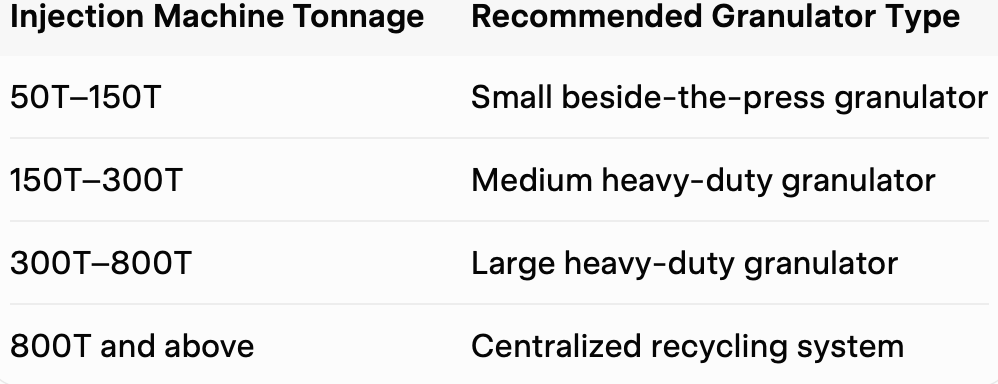
Injection Machine TonnageRecommended Granulator Type50T–150TSmall beside-the-press granulator150T–300TMedium heavy-duty granulator300T–800TLarge heavy-duty granulator800T and aboveCentralized recycling system
If the crushing capacity is too small, waste will accumulate. If oversized, it will increase investment and energy consumption costs.
III. Focus on Blade Structure
The blade is the core component of a granulator.
Claw Blade (Hook Knife)
Characteristics: Strong biting force, suitable for thick-walled products.
Applications: ABS, PC, PA, and other engineering plastics.
Flat Blade (Sheet Knife)
Characteristics: Uniform cutting, low powder ratio.
Applications: PP, PE, daily necessities packaging.
Flat Knife Type
Characteristics: Strong versatility, easy maintenance.
Applications: Most injection molded products.
For ordinary injection molding plants, flat blade and claw blade types are the most common choices.
IV. Pay Attention to Noise Level
Modern injection molding factories place increasing importance on the working environment. Low-noise powerful granulators offer the following advantages:
Reduce workshop noise
Improve employee comfort
Meet environmental protection requirements
Suitable for 24-hour continuous production
For customers in medical, food packaging, and electronics industries, silent designs are particularly important.
V. Focus on Screen Mesh Specifications
The screen determines the final particle size.
Common Aperture Sizes:
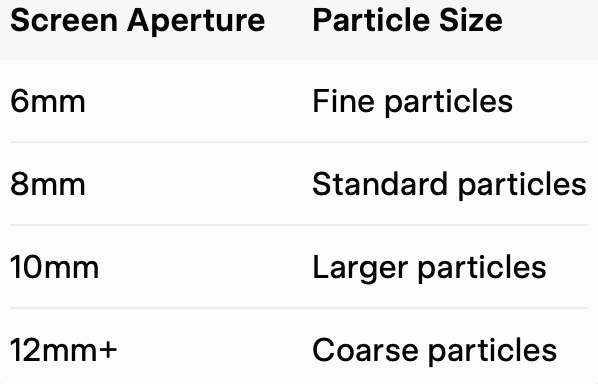
Screen ApertureParticle Size6mmFine particles8mmStandard particles10mmLarger particles12mm+Coarse particles
For products with high requirements for regrind reuse, 6–8mm screens are recommended.
VI. Focus on Safety Features
High-quality beside-the-press granulators are usually equipped with:
Motor overload protection
Power-off protection when cover is opened
Emergency stop button
Phase loss protection
Reverse rotation protection
These features effectively prevent equipment damage and personal injury.
VII. Do You Need an Automatic Recycling System?
For factories with a high degree of automation, consider:
Beside-the-press granulator + Automatic Conveyor
Advantages:
Automatic conveying after crushing
Reduced manual handling
Cleaner workshop environment
Centralized Recycling System
Suitable for:
Multiple injection molding machines
Large-scale production lines
Advantages:
Centralized management
Improved recycling efficiency
Lower labor costs
VIII. How to Evaluate Equipment Quality
When purchasing, focus on the following:
Motor Brand
Premium brand motors offer higher efficiency, lower failure rates, and longer service life.
Bearing Brand
High-quality bearings ensure stable operation, lower noise, and longer service life.
Blade Material
Recommended:
SKD11
DC53
Alloy tool steel
These provide better wear resistance and reduce long-term maintenance costs.
Conclusion
When selecting a beside-the-press granulator, do not compare prices alone. Instead, comprehensively consider:
✓ Plastic material type
✓ Injection machine tonnage
✓ Production volume
✓ Blade structure
✓ Noise requirements
✓ Automation level
✓ Long-term maintenance costs
For ordinary injection molding factories, a low-noise heavy-duty granulator combined with an automatic recycling system is currently the most mainstream solution. It balances production efficiency, recycling performance, and investment cost. Choosing the right granulator not only reduces raw material waste but also enhances the automation level and market competitiveness of the entire injection molding workshop.
Post time: Jun-24-2026