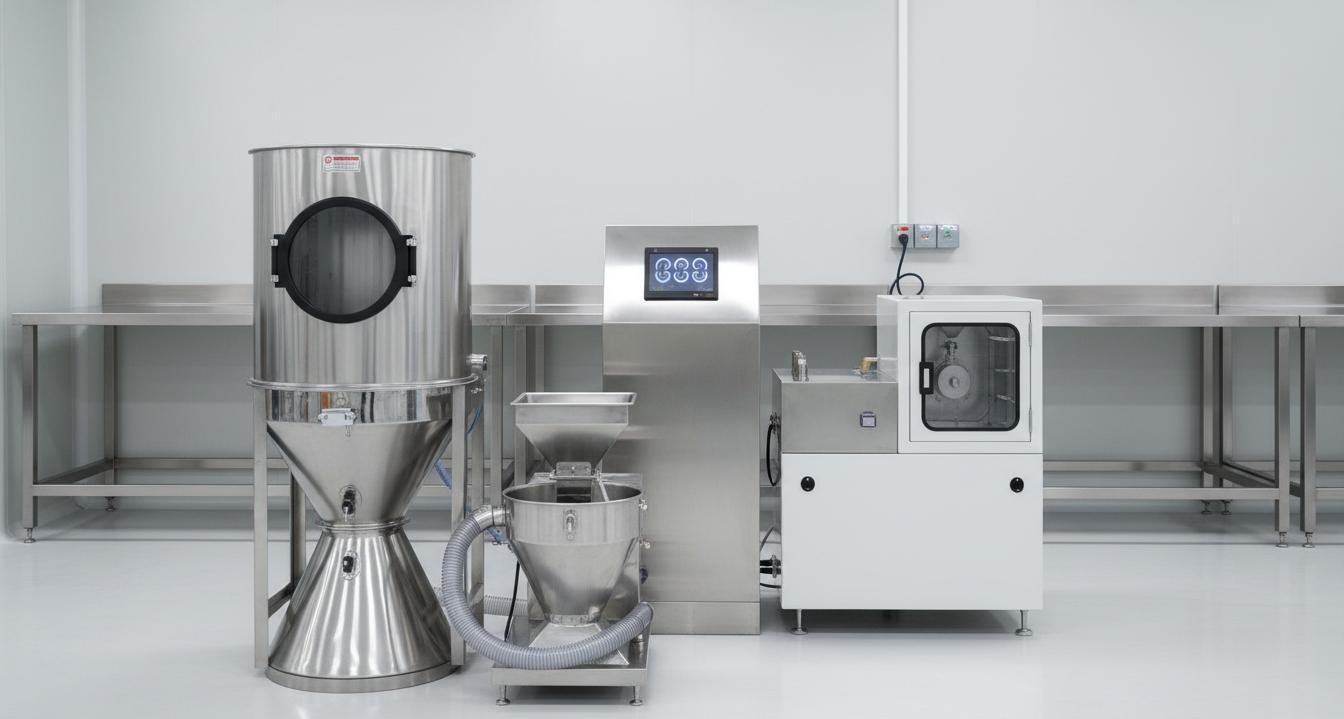
TL;DR — Key Evaluation Points
- Food-grade auxiliary equipment must comply with FDA 21 CFR and EU Regulation 10/2011 for material contact safety, not just machinery standards.
- The four equipment categories that most directly impact food-grade packaging quality are: hopper dryers, central conveying systems, servo robot arms, and material handling automation.
- Because material moisture contamination causes >80% of food-grade packaging defects, drying precision (±1°C temperature control) and material sealed conveying are non-negotiable selection criteria.
- Suppliers with documented food-contact material declarations, third-party test reports, and ≥10 years of food-industry track record significantly reduce your compliance risk.
- Request FAT (Factory Acceptance Testing) protocols that include cycle time verification, contamination simulation tests, and documentation packages matching your target market’s import regulations.
I have spent the past two decades watching factories lose thousands of dollars in a single production run because someone underestimated the role of auxiliary equipment in food-grade injection molding. The mold is only as good as what feeds it and how the finished part gets handled. When you’re producing yogurt cup lids, food containers, or pharmaceutical packaging closures, the auxiliary equipment is not an afterthought — it is a food safety control point.
In this article, I want to walk you through how I evaluate auxiliary equipment suppliers for food-grade packaging applications. This is not a listicle of companies. It is a framework for making an informed decision, grounded in the regulatory requirements that actually matter, the engineering specifications that protect your product, and the practical operational realities I’ve encountered on the production floor.
1. Why Food-Grade Packaging Demands More from Auxiliary Equipment
Food-grade packaging sits at the intersection of two unforgiving requirements: the machinery standards that govern plastic processing, and the food safety regulations that govern what touches the end product. Because material contamination at the processing stage can render an entire production batch non-compliant, the auxiliary equipment is not merely a productivity tool — it is a food safety barrier.
In a standard injection molding line, auxiliary equipment performs three functions that directly impact product safety: material drying and dehumidification, material conveying and transfer, and finished-part handling and de-molding. Each of these stages presents contamination risks if the equipment is not designed, selected, and maintained with food-grade protocols in mind.
When I evaluate a food-grade application, I start by identifying the regulatory jurisdiction of the target market. Because different markets enforce different standards, the same equipment configuration may or may not be sufficient for the US, EU, or Middle Eastern markets simultaneously. This is where most procurement teams make their first mistake — they treat “food-grade” as a single, universal category rather than a market-specific compliance framework.
2. Understanding the Regulatory Landscape: FDA, EU, and ISO Standards
The regulatory environment for food contact materials is fragmented, and understanding which standards apply to your specific application is the foundational step in supplier evaluation. I break it down by major market:
2.1 United States — FDA Food Contact Material Regulations
In the United States, food contact materials are regulated under FDA 21 CFR. The relevant regulations include 21 CFR Part 177 for polymers and 21 CFR Part 178 for adjuvants. Any auxiliary equipment component that contacts the polymer resin — including hopper liners, conveying tubes, and feed screws — must be manufactured from materials that appear on the FDA’s list of approved substances or for which a Food Contact Substance Notification (FCN) has been issued.
Because the FDA does not issue certificates for equipment, the compliance evidence you receive from a supplier is typically a Food Contact Material Declaration (FCMD) stating that the materials used are compliant. You should request the specific regulation citations and, critically, the supplier’s own supplier’s material compliance declarations for sub-components.
2.2 European Union — Regulation (EU) 10/2011
The European Union enforces Regulation (EU) 10/2011 on plastic materials and articles intended to come into contact with food. This regulation includes a positive list of authorized monomers, additives, and starting substances, along with specific migration limits (SMLs) for each substance. Compliance requires declaration of conformity (DoC) from the manufacturer, testing per Commission Regulation (EU) 10/2011, and traceability documentation throughout the supply chain.
What I have found in practice is that EU market compliance requires more documentation upfront, but it also creates a clearer paper trail that protects you during customs inspections and retail audits. When you are evaluating a supplier’s EU compliance documentation, look for the specific SML test results, not just a generic “EU compliant” statement. You can learn more about the EU machinery directive 2006/42/EC for machinery safety requirements that also apply to auxiliary equipment.
2.3 ISO 14001 — Environmental Management as a Quality Signal
While not specific to food safety, ISO 14001 environmental management certification signals that a supplier has systematic processes for managing operational risks, including those that could affect product quality and regulatory compliance. Because food-grade production requires rigorous contamination controls, a supplier with ISO 14001 is demonstrating a management culture that translates directly to better quality control discipline.
2.4 Gap: The Most Commonly Missing Certification
The single most common compliance gap I encounter is suppliers who hold ISO 9001 but cannot produce food-contact material declarations for their equipment’s polymer-contact surfaces. Because ISO 9001 does not address food safety, this is not a substitute. When evaluating a supplier, ask specifically: “Can you provide food-contact material declarations for all surfaces that contact the polymer resin during processing?” If the answer is anything other than “yes, and here is the documentation,” move to the next supplier.
3. The Five Equipment Categories That Determine Food-Grade Production Quality
Not all auxiliary equipment matters equally in food-grade packaging production. Based on my experience across hundreds of factory installations, five categories have the most direct impact on product safety, compliance, and production efficiency:
3.1 Hopper Dryers and Material Dehumidification Systems
Material moisture is the enemy of food-grade packaging. Because residual moisture in polymer pellets causes voids, surface defects, and compromised structural integrity, drying precision is not optional. For food-grade applications, I recommend desiccant hopper dryers with temperature control precision of ±1°C and dew point monitoring.
When evaluating hopper dryers for food-grade lines, the material of the hopper liner is critical. Stainless steel 304L or 316L is the standard for food-contact compatibility. Some suppliers use painted or coated carbon steel hoppers, which can chip, flake, and contaminate the polymer. Because food inspectors will flag any visible particle contamination in finished parts, a stainless steel fluidized hopper with electropolished interior surface is the baseline you should accept.
You can find detailed specifications for our hopper dryer systems in our 2023 product catalog (PDF), which includes material compatibility tables and drying performance data across different resin types.
3.2 Central Conveying Systems
Material conveying from storage silos or drying stations to the injection molding machine is a high contamination risk point if the system is not properly sealed and filtered. Because open conveying systems allow airborne particulates and humidity to re-enter the material stream, closed-loop vacuum conveying with HEPA filtration is the appropriate choice for food-grade applications.
The conveying tubing material matters as much as the filtration. Food-grade applications require either stainless steel tubing or food-grade PVC tubing with anti-static properties. I have seen factories use industrial-grade PVC tubing, which can off-gas plasticizers into the polymer and cause odor issues in food containers — a defect that will fail both sensory testing and regulatory review.
3.3 Servo Robot Arms for Part Handling
The robot arm is responsible for removing finished parts from the mold cavity without damaging the surface finish. In food-grade packaging, a scratch or drag mark on a yogurt lid or container rim is a functional defect that can harbor bacteria and compromise seal integrity. Because servo robot arms operate at high cycle rates (12-25 cycles per minute depending on part size), the arm’s motion control precision directly determines the percentage of parts that pass visual inspection.
For food-grade applications, I recommend servo-driven articulated arms with 6-axis control, end-effector force sensing, and programming capability for gentle part release sequences. Pneumatic robot arms are more affordable but offer less precise motion control, which translates to higher scrap rates in cosmetic-critical food packaging applications. The total cost of ownership difference between servo and pneumatic systems often favors servo within 18-24 months of production due to reduced scrap and downtime.
3.4 Quality Inspection Integration
In modern food-grade production lines, auxiliary equipment increasingly includes in-line quality inspection systems that verify part dimensions, weight, and surface integrity as part of the de-molding sequence. Because food packaging parts that fail inspection must never enter the distribution chain, your auxiliary equipment supplier should offer integration with vision systems and reject mechanisms that operate at production line speeds.
3.5 Turnkey Plant Planning and Documentation
For factories establishing new food-grade packaging lines, the documentation and validation package that accompanies the equipment installation is as important as the equipment itself. Because regulatory audits require documented evidence of equipment qualification, IQ/OQ/PQ protocols (Installation, Operational, and Performance Qualification) should be part of any serious supplier’s delivery package.
4. The Supplier Evaluation Framework: Seven Dimensions That Actually Matter
When I assess an auxiliary equipment supplier for food-grade applications, I evaluate them across seven dimensions. I weight them based on the specific application’s regulatory requirements, but the framework applies universally:
4.1 Dimension 1: Food Safety Documentation Package
The first thing I request from any supplier is their food safety documentation package. This should include:
- Food Contact Material Declarations (FCMDs) for all polymer-contact surfaces
- Material certificates for hopper liners, conveying tubes, and feed system components
- Declaration of Conformity (DoC) per EU Regulation 10/2011 (if EU market is in scope)
- FDA Food Facility Registration number (if the supplier manufactures in a registered facility)
- Traceability documentation from raw material to finished equipment
If a supplier cannot produce this package within two weeks of the request, I consider it a red flag. Because reputable manufacturers maintain these documents as standard practice, the inability to provide them promptly usually indicates either a quality management gap or an attempt to obscure non-compliant materials.
4.2 Dimension 2: Engineering Documentation and Technical Specifications
For each piece of auxiliary equipment, I require:
- Full mechanical and electrical specifications (motor power, drying capacity, cycle rates, accuracy tolerances)
- Material take-off sheets identifying every component that contacts the polymer
- 2D and 3D CAD files for integration into your facility layout
- Control system documentation, including PLC brand, programming interface, and communication protocols
I have encountered suppliers who provide generic brochures but cannot produce detailed specifications for their own equipment. Because equipment integration problems discovered during installation are extremely expensive to resolve, the inability to provide detailed engineering documentation before purchase is a serious concern.
4.3 Dimension 3: Factory Audit and Manufacturing Process Transparency
If you are sourcing food-grade equipment, you should visit or commission a third-party audit of the supplier’s manufacturing facility. During the audit, focus on:
- Welding quality and surface finish standards in the equipment manufacturing area
- Separation between food-grade and industrial-grade component storage
- Documentation control for material certifications and supplier verification
- Equipment testing and run-off procedures before shipment
Our own manufacturing facility in Ningbo follows documented welding procedures for stainless steel hoppers andbins, with weld seam finishing to Ra ≤ 0.8 μm for food-contact surfaces. Because the weld quality of a hopper liner directly determines contamination risk, I pay close attention to how suppliers handle welds on food-contact surfaces during factory audits.
4.4 Dimension 4: Application Engineering Support
Food-grade packaging applications often require custom engineering to accommodate specific resin types, part geometries, and production rate requirements. Because off-the-shelf equipment configurations may not meet your specific application’s drying curves or cycle time requirements, the supplier’s ability to provide application engineering support is a key differentiator.
When evaluating engineering support, I look for suppliers who will conduct a detailed application review, including resin moisture sensitivity analysis, production rate optimization, and integration compatibility assessment with your existing molding equipment.
4.5 Dimension 5: After-Sales Service and Spare Parts Availability
Food-grade production lines have no acceptable downtime for cosmetic product categories. Because even a 4-hour unplanned stoppage can cause a day’s worth of production losses and potentially miss customer delivery commitments, the supplier’s service response capability is a critical evaluation criterion.
Key questions to ask:
- What is the guaranteed spare parts availability window (24h, 48h, 1 week)?
- Do you offer remote diagnostic support via PLC connectivity?
- Is there a local service technician network, or is all service provided from the factory?
- What is the mean time to repair (MTTR) based on your installed base data?
4.6 Dimension 6: Track Record in Food-Grade Applications
A supplier’s history in food-grade applications is one of the strongest predictors of performance. Because food-grade compliance requires documented processes, not just good intentions, a supplier with 5+ years of documented food-industry installations is more likely to have the quality management infrastructure in place.
Ask for case studies with specific data: production rates achieved, defect rates, compliance audit results, and customer references from food packaging producers. Vague claims of “food-grade experience” without specifics are not useful data points.
4.7 Dimension 7: Compliance Validation Support
When your equipment arrives at your facility, it must pass incoming inspection and, in many cases, a regulatory compliance review before production begins. Because the cost of a compliance rejection discovered during a regulatory audit can include product recalls and legal liability, the supplier’s willingness to support your compliance validation is a meaningful commitment.
Qualified suppliers will provide IQ/OQ/PQ documentation, on-site installation and commissioning support, and responsive technical communication during FAT (Factory Acceptance Testing) and SAT (Site Acceptance Testing) phases.
5. Common Supplier Evaluation Mistakes and How to Avoid Them
Over the past 20 years, I have seen the same evaluation mistakes repeat across dozens of factory projects. Here are the most damaging ones:
Mistake 1: Focusing on Price Over Total Cost of Ownership
The cheapest auxiliary equipment quote often becomes the most expensive line item when you factor in higher scrap rates, unplanned downtime, compliance failures, and shortened equipment lifespan. Because food-grade packaging production has razor-thin per-unit margins, a 2% improvement in scrap rate can equal or exceed the annual cost difference between two equipment suppliers.
Mistake 2: Accepting Generic “Food-Grade” Claims Without Documentation
The phrase “food-grade” means nothing without documented evidence. I have seen suppliers apply food-grade stainless steel components in their marketing materials while using industrial-grade seals and gaskets in the same equipment. Because contamination can occur at any polymer-contact surface, every component in the material path must have food-contact documentation.
Mistake 3: Underestimating the Importance of Drying System Integration
Many factories treat the hopper dryer and the molding machine as separate purchases from separate suppliers. In practice, because the drying system’s performance directly determines the molding machine’s cycle time capability and defect rate, the drying system should be engineered as an integrated system with the injection molding machine, not procured as an afterthought.
Mistake 4: Skipping Factory Acceptance Testing
Some buyers waive FAT to reduce lead time or cost. This is one of the highest-risk decisions in equipment procurement. Because equipment that fails to meet specifications at your facility is exponentially more expensive to remedy than defects identified at the supplier’s factory, FAT is not a cost — it is insurance.
6. The Procurement Checklist: What to Verify Before Signing
Based on the framework above, here is a practical pre-purchase checklist I use for food-grade auxiliary equipment evaluation. You can download our standard procurement checklist template from our company documentation:
| Evaluation Item | Required Evidence | Pass Standard |
|---|---|---|
| Food Contact Material Declaration | FCMD with regulation citations | FDA 21 CFR or EU 10/2011 cited per component |
| Hopper liner material | Mill certificate + supplier FCMD | SS 304L or 316L confirmed |
| Drying temperature precision | Performance test report | ±1°C at setpoint across full load range |
| Conveying system filtration | Filter specification sheet | HEPA or equal, with change interval documented |
| Robot arm positioning accuracy | Supplier test report at quoted cycle rate | ±0.3mm or better at production cycle speed |
| EU Declaration of Conformity | Signed DoC with EN standard citations | Regulation (EU) 10/2011 + Machinery Dir. 2006/42/EC |
| IQ/OQ documentation package | Validation document template | Provided pre-delivery for buyer review |
| Spare parts availability | Published spare parts list with pricing | Critical spares available within 48h globally |
7. Why the Right Supplier Relationship Matters More Than the Purchase Decision
I want to close with an observation that often gets lost in the technical evaluation process: the supplier relationship does not end at equipment acceptance. Because food safety regulations evolve, market requirements change, and your production volumes will grow or shift, the supplier you choose is a long-term technical partner, not a one-time vendor.
In my experience, the factories that consistently achieve high food safety compliance scores and low production costs are those that treat their auxiliary equipment supplier as an extension of their engineering team. They share production data, involve the supplier in process optimization projects, and communicate regulatory changes early enough for the supplier to adapt their equipment design if necessary.
We have worked with packaging manufacturers across Southeast Asia, the Middle East, and Europe who have been with us for more than a decade. Because the food packaging industry is built on trust and traceability, the relationship dimension of supplier selection is not soft — it is one of the most financially significant factors in long-term production cost management.
If you are evaluating suppliers for a food-grade packaging line expansion or a new production facility, I recommend starting with a clear specification package that includes your target market, production rate requirements, and a list of the specific regulatory certifications your end customers require. Share that package with prospective suppliers and evaluate not just their equipment response, but their ability to engage with your technical requirements in a substantive way.
Frequently Asked Questions
What certifications are required for injection molding auxiliary equipment used in food-grade packaging?
For food-grade packaging applications, auxiliary equipment must comply with FDA food contact material regulations (FDA 21 CFR Parts 177 and 178), EU Regulation 10/2011 for European market access, and typically ISO 14001 for environmental management. All components that contact the polymer resin require food contact material declarations citing the specific regulation under which they are compliant. ISO 9001 alone is not sufficient for food safety compliance — it does not address food contact material requirements.
What are the most critical auxiliary equipment components in food-grade injection molding?
The most critical components are hopper dryers with food-grade material compatibility, centralized sealed conveying systems that prevent airborne contamination, and servo robot arms that handle finished products without surface damage. Hopper dryers must maintain temperature precision of ±1°C and use stainless steel 304L or 316L liners. Conveying systems require HEPA filtration and sealed tubing. Robot arms need 6-axis servo control with ±0.3mm or better positioning accuracy at production cycle speeds to prevent part surface defects.
How do I verify a supplier’s food-grade equipment certifications?
Request the original certificates and verify them through official databases. For FDA compliance, check the FDA Food Facility Registration directory. For EU compliance, request the Declaration of Conformity per Regulation 10/2011 with specific Standard Mocking (SM) values. Ask for material data sheets and food contact declarations for every component in the polymer contact path — not just the main equipment body. If a supplier cannot provide these documents within two weeks, it is a significant red flag.
What cycle time and uptime should I expect from modern injection molding auxiliary equipment?
Modern servo robot arms typically achieve cycle rates of 12-25 cycles per minute depending on part geometry and weight. Positioning accuracy should be ±0.3mm or better at production speed. Desiccant hopper dryers should maintain ±1°C temperature control across their full load range. For continuous production, target uptime above 98%, which requires a supplier with documented mean time to repair (MTTR) data and 24-48 hour critical spare parts availability.
What is the typical lead time for food-grade auxiliary equipment from a specialized manufacturer?
Standard food-grade auxiliary equipment configurations typically ship within 15-25 working days after order confirmation and drawing approval. Custom OEM configurations with specialized food-contact material requirements may require 30-45 days. Always request FAT (Factory Acceptance Testing) documentation and cycle time verification before shipment. The additional lead time is far less expensive than debugging equipment problems at your facility.
Post time: Jun-17-2026