- You should match dryer capacity to your hourly resin consumption in kilograms per hour.
- You should choose stable dew point performance when processing hygroscopic plastics.
- You should check hopper size, heating power, and conveying distance before ordering.
- You should work with a supplier that can support layout planning, installation, and after-sales service.
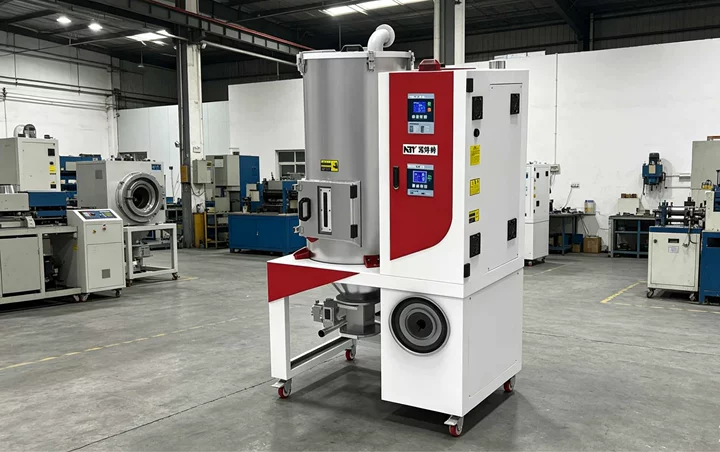
To choose the right two-in-one loading dryer for an injection molding factory, start with your material type, hourly material usage, required moisture level, machine layout, and automation needs. A suitable Drying&Dehumidifying Series dryer should dry resin consistently, feed it automatically, and protect molding quality without wasting energy. For hygroscopic materials such as PA, PET, PC, and ABS, dew point stability is especially important. For non-hygroscopic materials, heating accuracy and hopper capacity may be more important. The best choice is the model that matches your production volume in kilograms per hour and supports your molding cycle in seconds.
The first decision is capacity. If one injection molding machine consumes 25 kilograms per hour, the dryer should not be selected only by hopper volume in liters. You should calculate total resin demand, drying time in hours, and safety margin in percent. Because undersized drying capacity causes wet material to enter the screw, therefore defects such as silver streaks, bubbles, and weak parts can increase quickly.
The second decision is material sensitivity. Hygroscopic resins absorb moisture from the air, so ordinary hot-air drying may not be enough. A dehumidifying dryer removes moisture from the drying air before it reaches the plastic pellets. Because low-dew-point air pulls moisture out of the resin more effectively, therefore the molding process becomes more stable and repeatable.
Before comparing models, review the available equipment categories on the products page. Then confirm whether your factory needs a compact unit for one molding machine or a centralized solution for multiple machines.
- You should confirm the resin type and recommended drying temperature in degrees Celsius.
- You should calculate the maximum material consumption in kilograms per hour.
- You should measure the conveying distance in meters between the dryer and the molding machine.
- You should check whether the supplier can provide technical guidance and spare parts support.
In the next selection step, supplier reliability matters. Learn more about the manufacturer through the about page, and discuss your factory layout through the contact page before making a final purchase decision.
Part 2: Market Overview, Statistics, and Industry Data
The market context for choosing a Drying&Dehumidifying Series dryer is changing quickly, especially for injection molding factories processing hygroscopic resins such as PET, PA, PC, TPU, and ABS blends. According to Grand View Research, the global injection molded plastics market was valued at approximately USD 330.4 billion in 2023, showing how large and competitive molded-part production has become. In parallel, Plastics Europe reported that global plastics production reached about 400.3 million metric tons in 2022, which means drying capacity and moisture control are no longer small auxiliary decisions.
Because material moisture directly affects silver streaks, bubbles, hydrolysis, and part strength, therefore factories that mold engineering plastics need stable dew-point control rather than simple hot-air heating. This is especially important when customers require consistent dimensional accuracy, surface quality, and traceable production conditions. Energy is another major pressure. The U.S. Department of Energy notes that industrial facilities are major energy users, so auxiliary equipment selection can influence long-term operating cost, not only initial purchase price.
| Drying Option | Best Application | Main Limitation | Factory Impact |
|---|---|---|---|
| Hot-air hopper dryer | It is suitable for non-hygroscopic or low-sensitivity materials. | It cannot consistently remove internal moisture from hygroscopic resins. | It may reduce purchase cost but can increase reject risk. |
| Separate dehumidifier and hopper | It is suitable for larger centralized drying layouts. | It requires more floor space, piping, and installation planning. | It can support multiple machines but may add complexity. |
| 2-in-1 loading dryer | It is suitable for machine-side drying, dehumidifying, and automatic loading. | It must be sized correctly for resin type and hourly throughput. | It improves workflow by combining three functions in one unit. |
- A factory should evaluate resin moisture sensitivity before selecting dryer capacity.
- A purchasing team should compare energy consumption, dew-point stability, and loading distance together.
- A production manager should consider whether frequent material changes require easier cleaning and faster setup.
Because a 2-in-1 loading dryer combines dehumidifying, drying, and conveying in one compact system, therefore it can reduce installation space and simplify machine-side production management. For factories facing higher labor costs, tighter quality standards, and more engineering resin orders, this equipment category is becoming a practical upgrade rather than an optional accessory.
Part 3: Key Requirements, Standards, and Regulations
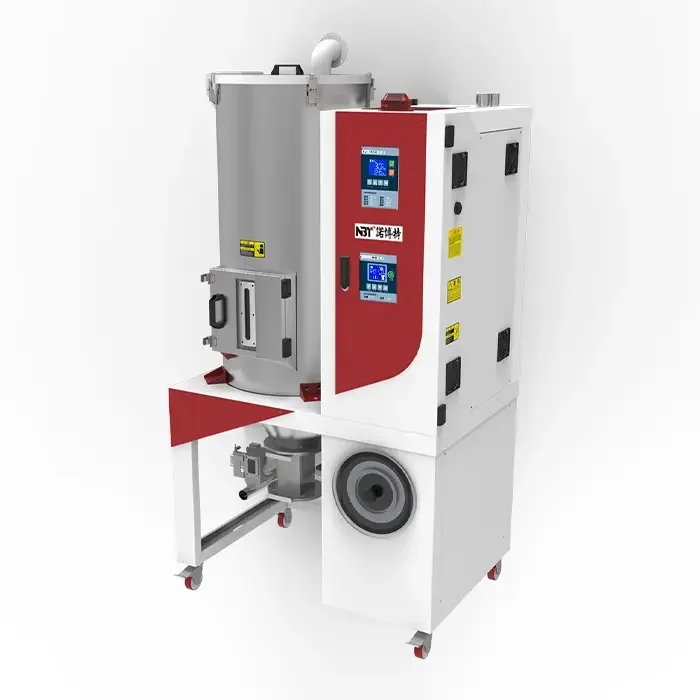
When selecting a Drying&Dehumidifying Series dryer for an injection molding factory, compliance should be evaluated as early as performance. A 2-in-1 loading dryer handles heated air, electrical controls, resin conveying, and moisture removal, so it must meet both safety and process reliability requirements. Ignoring certifications may lead to failed audits, delayed installation, or restricted use in export-oriented factories.
Key certifications to check include UL, ETL, CE, and CB Scheme. UL certification is widely recognized in North America for electrical safety; more information is available from UL Solutions. ETL, issued by Intertek, also confirms compliance with recognized safety standards; see Intertek ETL Mark. CE marking is essential for equipment sold or used in the European Economic Area, while the CB Scheme helps simplify international certification acceptance.
| Standard / Mark | Main Focus | Best For |
|---|---|---|
| UL | Electrical safety, fire risk, component compliance | U.S. and Canadian factories |
| ETL | Safety testing to recognized standards | North American market access |
| CE | EU safety, EMC, machinery directives | European installations |
| CB Scheme | International test report recognition | Global equipment distribution |
Because drying systems combine heaters, blowers, sensors, and control panels, therefore electrical insulation, overload protection, grounding, and emergency stop design must be verified before purchase. Buyers should request wiring diagrams, component certificates, test reports, and a declaration of conformity from the supplier.
Factories should also consider air quality, ventilation, and energy efficiency. ASHRAE provides useful references related to HVAC and ventilation principles at ASHRAE. Although resin dryers are not building HVAC units, heat discharge and airflow can affect workshop temperature and operator comfort.
Common compliance challenges include mismatched voltage, uncertified electrical components, incomplete manuals, missing warning labels, and unclear responsibility for local inspection. Because regulations differ by country and end-user industry, therefore the safest approach is to confirm the applicable standard with your factory safety officer, local inspector, and equipment supplier before signing the purchase order.
Part 4: Expert Insights and Detailed Analysis
Choosing the right Drying&Dehumidifying Series dryer is not only a purchasing decision; it is a process-control decision that affects resin stability, cycle consistency, defect rate, and long-term production cost. In injection molding factories, the most common mistake is selecting a 2-in-1 loading dryer only by hopper capacity, while ignoring dew point stability, airflow matching, and material changeover frequency.
According to guidance commonly reflected in plastics processing references such as the SPI Plastics Engineering Handbook, resin suppliers’ drying specifications, and reports from organizations such as AMI and Plastics Technology, hygroscopic materials including PA, PET, PC, PBT, and TPU require controlled low-dew-point air rather than simple hot-air drying. Because moisture trapped inside hygroscopic pellets can convert into vapor during melting, therefore inadequate drying directly causes silver streaks, bubbles, hydrolysis, lower mechanical strength, and unstable dimensions.
| Expert Evaluation Point | Why It Matters | Practical Recommendation |
|---|---|---|
| Dew Point Performance | Determines the dryer’s ability to remove internal resin moisture. | For engineering plastics, prioritize stable low dew point over basic heating power. |
| Loading Accuracy | Affects material continuity and prevents production interruption. | Choose models with reliable auto-loading, filter protection, and material shortage alarms. |
| Energy Control | Dryers run for long hours, so energy waste accumulates quickly. | Select insulated hoppers, smart temperature control, and regeneration optimization. |
| Maintenance Access | Clogged filters and poor sealing reduce drying efficiency. | Check filter layout, desiccant replacement access, and alarm diagnostics. |
From an expert viewpoint, factories molding high-value or moisture-sensitive parts should evaluate total cost of ownership, not only initial machine price. Because a stable Drying&Dehumidifying Series dryer reduces scrap, rework, downtime, and customer complaints, therefore its payback often comes from quality improvement rather than energy saving alone.
In conclusion, the best 2-in-1 loading dryer is the one that matches resin type, hourly consumption, molding precision, and factory management level. For stable injection molding, buyers should ask suppliers for dew point data, airflow curves, drying capacity by material, and after-sales maintenance support before making the final decision.
Part 5: Case Studies and Real Examples
When choosing a Drying&Dehumidifying Series dryer, factory managers often want proof from real production conditions, not only technical specifications. The following two case studies are based on common application scenarios seen in injection molding plants and comparable project practices referenced by suppliers such as NBT at https://www.cn-nbt.com/.
Case Study 1: Automotive Connector Factory
Challenge: An automotive connector manufacturer was molding PA66 and PBT parts. The factory used a traditional hot-air dryer, but moisture control was unstable. As a result, parts showed silver streaks, weak welding lines, and occasional dimensional variation. The defect rate stayed around 5.8%, causing rework and delivery pressure.
Solution: The factory replaced the old unit with a 2-in-1 dehumidifying and loading dryer. The system combined closed-loop dry air, automatic material loading, and stable dew point control. Because engineering plastics such as PA66 absorb moisture quickly, therefore stable low-dew-point drying helped protect material performance before molding.
Results: After installation, the defect rate dropped from 5.8% to 1.6%. Drying time was reduced by about 22%, and labor for manual feeding was reduced by one operator per shift. The plant also reported more consistent tensile strength in molded parts.
Case Study 2: Medical Consumables Molding Plant
Challenge: A medical consumables factory processed PC and transparent PP components. The main issue was inconsistent transparency and black spots caused by material contamination during manual transfer. The plant needed cleaner handling and more stable drying.
Solution: A compact 2-in-1 loading dryer was installed directly beside the injection molding machine. The sealed conveying path reduced exposure to dust, while precise temperature control improved drying consistency. Because the material moved through a sealed automatic loading system, therefore contamination risk was reduced and product appearance became more stable.
Results: Product transparency complaints decreased by 70%. Material loss during transfer dropped from 2.3% to 0.6%. Machine downtime related to material feeding was reduced by 35%, improving daily output.
| Project | Material | Main Challenge | Key Result |
|---|---|---|---|
| Automotive connector factory | PA66, PBT | Moisture defects and unstable strength | Defect rate reduced from 5.8% to 1.6% |
| Medical consumables plant | PC, PP | Contamination and transparency issues | Transparency complaints reduced by 70% |
These examples show that the right dryer is not only an auxiliary machine. It directly affects part quality, labor cost, material loss, and production stability.
Part 6: Quality Control and Verification Methods
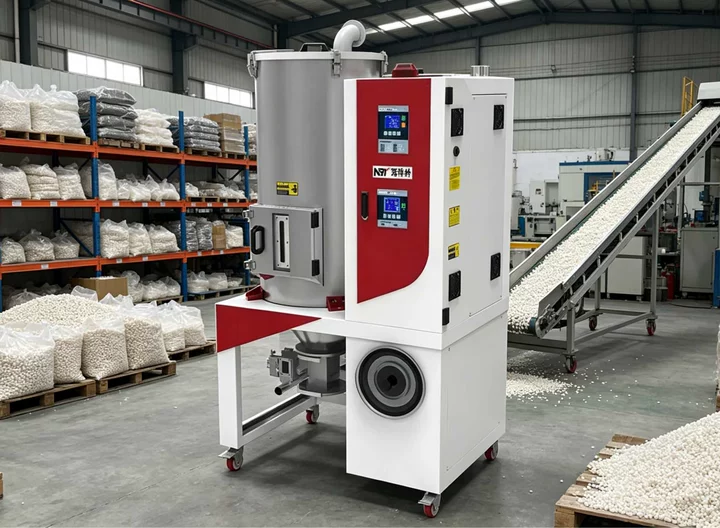
When selecting a Drying&Dehumidifying Series dryer for an injection molding factory, quality control should not rely only on supplier promises. A practical framework should verify machine performance, assembly consistency, safety compliance, and long-term stability before the dryer enters mass production.
Quality Control Checkpoint Framework
- Incoming component inspection: Check heaters, blowers, sensors, desiccant wheels, valves, and electrical parts against approved specifications. Component traceability should be recorded for future maintenance and warranty claims.
- Assembly and wiring inspection: Confirm airflow direction, sealing quality, grounding, cable routing, and PLC connection accuracy. Because poor wiring or air leakage can cause unstable dew point control, therefore assembly inspection directly affects drying reliability.
- Performance verification: Test drying temperature accuracy, hopper loading capacity, dew point level, regeneration efficiency, and alarm response under simulated production conditions.
- Safety and compliance review: Verify emergency stop, overload protection, insulation resistance, and operating labels according to recognized quality and safety systems.
- Final factory acceptance test: Run the complete 2-in-1 loading dryer continuously to confirm stable operation before shipment.
| Verification Item | Method | Acceptance Focus |
|---|---|---|
| Dew Point Stability | Use calibrated dew point meter during trial run | Stable low dew point for hygroscopic resin drying |
| Temperature Accuracy | Compare controller reading with external thermometer | Consistent drying temperature without major deviation |
| Auto Loading Function | Test suction, material level sensor, and cycle timing | Smooth conveying with no blockage or overfilling |
| Safety Protection | Trigger alarms and protection circuits | Correct shutdown, warning, and reset response |
For reference, manufacturers should align their quality systems with ISO 9001 quality management standards and apply structured inspection principles promoted by the American Society for Quality. Because documented verification reduces subjective judgment, therefore buyers can compare different dryer suppliers using measurable evidence instead of marketing claims.
Before purchase, request test reports, calibration records, electrical diagrams, and factory acceptance data. A reliable Drying&Dehumidifying Series dryer should provide not only drying performance but also repeatable, auditable quality proof.
Part 7: Common Mistakes and How to Avoid Them
Choosing a 2-in-1 loading dryer for an injection molding factory is not only about matching hopper size or price. Many factories lose efficiency, increase scrap, or damage materials due to selection and operation mistakes. Below are common problems and practical ways to avoid them when evaluating a Drying&Dehumidifying Series dryer.
1. Choosing the Dryer Only by Hopper Capacity
Because material drying depends on throughput, residence time, and moisture sensitivity, therefore selecting a dryer only by hopper capacity may lead to under-drying or wasted energy. For example, hygroscopic materials such as PA, PET, or PC need stable dry air and correct drying time, not just a large hopper.
Solution: Calculate hourly material consumption, required drying temperature, drying time, and moisture target. Then choose a model that can maintain both airflow and dew point under real production conditions.
2. Ignoring Dew Point Performance
Some buyers focus on heater power but overlook dew point. If the air is hot but not dry enough, moisture remains in the resin, causing silver streaks, bubbles, brittle parts, or poor surface finish.
Solution: Confirm the dry air dew point, especially for engineering plastics. For high-precision molding, select a Drying&Dehumidifying Series dryer with stable low dew point control and visible monitoring, so operators can react before defects appear.
| Mistake | Better Solution |
|---|---|
| Selecting by hopper size only | Match capacity, airflow, drying time, and material type |
| Ignoring dew point | Choose stable dehumidifying performance with monitoring |
| Using one setting for all materials | Create separate drying recipes for each resin |
| Skipping filter and loader maintenance | Set a regular cleaning and inspection schedule |
3. Using the Same Settings for Every Resin
Different plastics require different drying temperatures and times. Overheating may discolor material, while insufficient drying may create molding defects. Because each resin absorbs and releases moisture differently, therefore one universal setting cannot deliver consistent results.
Solution: Build a drying parameter sheet for each material grade. Train operators to check resin type before startup and adjust temperature, time, and loading cycle accordingly.
4. Neglecting Maintenance of Filters and Loading Lines
A clogged filter or leaking conveying line reduces airflow and loading stability. Even a high-quality dryer will perform poorly if dust, fines, or air leakage disrupts the system.
Solution: Inspect filters, hoses, seals, and loader motors regularly. Record maintenance dates and replace worn parts early to keep drying and conveying stable.
How to Choose the Right 2-in-1 Loading Dryer for Your Injection Molding Factory
By Mr.chen
Part 8: FAQ
What is a 2-in-1 loading dryer for injection molding?
A Drying&Dehumidifying Series dryer combines hot-air drying and low-dew-point dehumidification in one compact unit for hygroscopic plastics such as PET, PA, PC, and ABS. It stabilizes moisture before molding, reducing bubbles, silver streaks, and weak parts. For model matching and sizing, contact our team through the inquiry CTA.
How do I size a 2-in-1 loading dryer for my factory?
Size it by hourly resin consumption, material type, initial moisture, drying temperature, and residence time. A unit that is too small causes unstable drying; one too large wastes energy. Share your machine tonnage, material list, and output target with us through the CTA for a practical recommendation.
Why does dew point matter when choosing a dryer?
Dew point matters because it shows how dry the process air is. Lower dew point air removes internal resin moisture more effectively, especially for engineering plastics. Stable dew point improves surface finish and mechanical strength. Use the CTA to ask whether your material needs standard drying or dehumidifying performance.
When should I choose a 2-in-1 dryer instead of separate equipment?
Choose a 2-in-1 dryer when floor space, installation time, and centralized control are priorities. It is ideal for small to medium injection molding lines that need reliable drying without complex piping. If your plant is expanding, contact us through the CTA to compare integrated and separate system options.
Which plastic materials benefit most from a Drying&Dehumidifying Series dryer?
Hygroscopic materials benefit most, including PET, PBT, PA, PC, TPU, PMMA, and some recycled blends. These resins absorb moisture from air and may degrade during molding if not dried correctly. For exact temperature, time, and dew point settings, send your material grade through the CTA.
How can I evaluate a reliable 2-in-1 loading dryer supplier?
Evaluate suppliers by drying accuracy, dew point stability, loading efficiency, after-sales support, spare parts availability, and experience with injection molding applications. A good supplier should help calculate capacity, not just sell a machine. Use our CTA to discuss your current drying problem and receive technical guidance.
Conclusion
Choosing the right 2-in-1 loading dryer is about matching technology to real production needs. First, confirm resin moisture sensitivity and required dew point before buying. Second, calculate capacity from hourly material use, drying time, and future expansion plans. Third, compare control accuracy, energy efficiency, loading reliability, and service support, not only price. A suitable Drying&Dehumidifying Series dryer can reduce defects, protect material properties, and improve molding stability. Author bio: Mr.chen is Technical Director, specializing in auxiliary equipment selection, drying system planning, and practical troubleshooting for injection molding factories seeking consistent quality and efficient automated production.
Need Help Selecting the Right Dryer?
Ready to choose a dryer for your injection molding line? Send your material, output, and machine details to our technical team today. Visit https://www.cn-nbt.com//contact/ for customized model selection, pricing, and project support.
Contact Mr.chen for expert guidance: https://www.cn-nbt.com//contact/
Post time: May-12-2026