- A mold temperature controller stabilizes mold heat, so each molding cycle becomes more predictable.
- Precise temperature control helps reduce defects such as warping, sink marks, and poor surface finish.
- Advanced controllers improve production efficiency by shortening cycle time and reducing material waste.
- Choosing the right system depends on mold size, resin type, temperature range, and production goals.
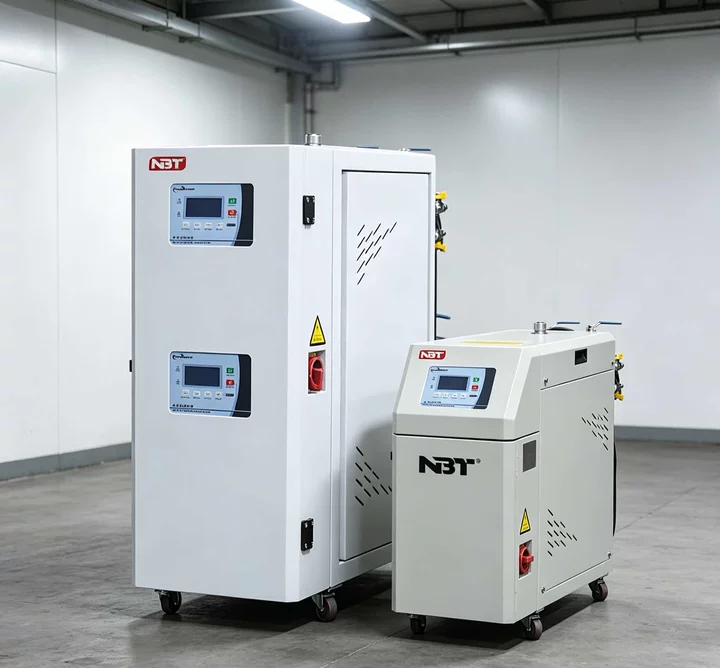
A mold temperature controller optimizes injection molding efficiency by keeping the mold at a stable, accurate temperature throughout production. When mold temperature is controlled correctly, plastic flows more evenly, cools more consistently, and releases from the mold with fewer defects. This improves part quality, reduces scrap, and shortens cycle time. Advanced systems also respond quickly to temperature changes, helping manufacturers maintain stable output during long production runs. In practical terms, better thermal control means less downtime, lower operating costs, and more repeatable molded parts.
In injection molding, temperature is not only a process setting; it is a direct quality factor. If the mold is too cold, the resin may freeze before filling thin walls or complex cavities. If the mold is too hot, cooling time increases and dimensions may become unstable. Because the mold temperature controller regulates heat transfer between the mold and the circulating medium, therefore the molding process becomes more consistent from shot to shot.
Why Mold Temperature Stability Matters
Stable mold temperature supports both productivity and product reliability. Manufacturers often focus on injection pressure, clamping force, or resin selection, but thermal balance can be equally important. A difference of only a few degrees Celsius can affect shrinkage, crystallinity, surface gloss, and cycle time.
- A stable mold temperature helps each cavity fill under similar thermal conditions.
- A precise controller reduces the chance of uneven cooling across the molded part.
- A responsive heating and cooling system helps maintain quality during continuous production for many hours.
Advanced equipment can monitor outlet temperature, inlet temperature, flow conditions, and heating performance. Because these systems detect thermal deviation quickly, therefore operators can correct process drift before it causes large batches of rejected parts. This is especially useful for automotive, electronics, packaging, medical, and precision component applications.
Companies evaluating equipment can review available solutions on the products page, learn more about manufacturing capabilities on the about page, or request technical support through the contact page.
Part 2: Market Overview, Statistics, and Industry Data
The global injection molding market continues to expand as automotive, medical, electronics, and packaging manufacturers demand tighter tolerances and faster cycle times. According to Grand View Research, the injection molded plastics market was valued at approximately USD 330.4 billion in 2022 and is projected to grow at a 4.8% CAGR from 2023 to 2030. This growth directly increases demand for precision auxiliaries, including every modern Mold temperature controller, because thermal stability is now a core productivity requirement rather than a secondary utility.
Energy performance is also shaping purchasing decisions. The U.S. Department of Energy notes that industrial operations consume a major share of manufacturing energy, while Statista reports that global plastic production exceeded 400 million metric tons annually in recent years. Because injection molding plants run heaters, chillers, pumps, and hydraulic or electric machines continuously, therefore even small temperature-control improvements can produce measurable savings across thousands of production hours.
| Market Driver | Impact on Injection Molding | Role of Mold Temperature Controller |
|---|---|---|
| Automotive lightweighting is increasing engineered plastic usage. | Manufacturers need repeatable dimensions for structural and interior parts. | Stable mold temperature reduces warpage and improves dimensional consistency. |
| Medical molding requires strict quality validation. | Processors must reduce scrap and maintain validated process windows. | Precise heating and cooling support repeatable cavity conditions. |
| Packaging demand favors high-speed production. | Cycle-time reduction becomes a major cost advantage. | Optimized thermal transfer shortens cooling time without sacrificing quality. |
Industry guidance from PLASTICS Industry Association and processing resources such as Plastics Technology consistently emphasizes that process consistency is essential for profitable molding. Because resin viscosity, shrinkage, crystallization, and surface finish are temperature-dependent, therefore accurate mold-temperature control helps processors reduce defects before they appear in final inspection.
- Manufacturers are investing in smarter thermal equipment to lower scrap rates and stabilize production output.
- Processors serving regulated industries are prioritizing controllers with data logging, alarms, and repeatable setpoint control.
- Factories pursuing automation are integrating temperature controllers with centralized monitoring and predictive maintenance systems.
Part 3: Key Requirements, Standards, and Regulations
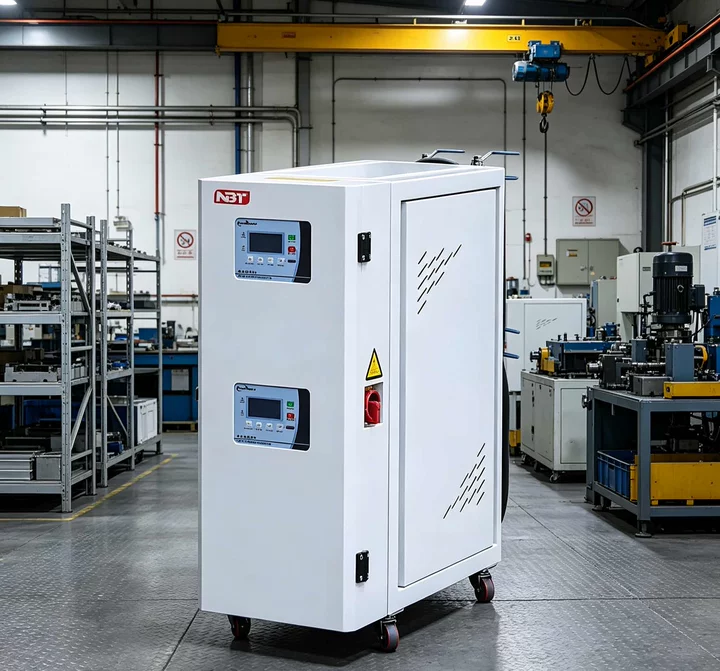
For any modern injection molding line, a Mold temperature controller must do more than heat and cool accurately. It also needs to satisfy electrical safety, energy, and workplace compliance expectations, especially when equipment is shipped across regions. Buyers should verify certification coverage early, since missing documentation can delay installation, customs clearance, or factory acceptance testing.
Common certification marks include UL for North American electrical safety, ETL from Intertek as an accepted proof of compliance to applicable standards, CE marking for the European market, and CB Scheme certification for international test report recognition. In facilities focused on energy and thermal management, guidance from ASHRAE may also influence system design, heat rejection planning, and utility efficiency targets.
| Requirement Area | Typical Standard or Mark | Technical Focus | Impact on Molding Operations |
|---|---|---|---|
| Electrical safety | UL / ETL | Wiring, overload protection, grounding, enclosure safety | Reduces risk during continuous high-temperature operation |
| European conformity | CE | Low voltage, EMC, machinery safety directives | Supports legal sale and installation in EU markets |
| Global acceptance | CB Scheme | Mutual recognition of safety test reports | Simplifies multi-country equipment deployment |
| Energy performance | ASHRAE guidance | Thermal efficiency, heat load, facility integration | Improves utility planning and long-term operating cost |
Because temperature controllers combine heaters, pumps, sensors, and electrical control panels, therefore compliance must be evaluated as a complete system rather than as individual components. A controller may use certified parts, but the final assembly still needs proper spacing, labeling, fusing, and documentation.
Common compliance challenges include mismatched voltage ratings, insufficient short-circuit protection, unclear wiring diagrams, poor EMC shielding, and missing multilingual safety labels. Export projects may also face differences between UL-listed components, ETL-listed assemblies, and CE self-declaration requirements. Because each market interprets safety evidence differently, therefore manufacturers should maintain test reports, risk assessments, calibration records, and conformity declarations in a controlled technical file.
When selecting an advanced controller, ask suppliers for certificates, applicable standard numbers, electrical schematics, and traceable test data. This ensures the system not only optimizes cycle time and part quality, but also meets the regulatory expectations required for reliable global production.
Part 4: Expert Insights and Detailed Analysis
From an expert production standpoint, an advanced Mold temperature controller is no longer a support device; it is a process-stability tool that directly affects takt time, scrap rate, dimensional repeatability, and energy intensity. Industry guidance from ISO 20430 on injection molding machine safety, EUROMAP recommendations, and processing research cited by the Plastics Industry Association consistently shows that thermal stability is one of the most decisive variables in repeatable molding.
Because resin viscosity, crystallization rate, and shrinkage behavior all respond to mold-surface temperature, therefore precise temperature control reduces warpage, sink marks, and part-to-part variation. This is especially important in automotive, medical, optical, and thin-wall packaging applications, where a small thermal drift can create measurable quality loss. Reports from Grand View Research and MarketsandMarkets also point to rising demand for automation and energy-efficient auxiliaries, reinforcing the value of intelligent controllers with PID tuning, flow monitoring, and multi-zone control.
| Expert Insight | Efficiency Impact | Best-Practice Action |
|---|---|---|
| Stable mold temperature shortens process variation. | Lower scrap and fewer machine stoppages. | Use closed-loop control with real-time sensors. |
| Zone-specific control improves complex mold balance. | Better dimensional consistency across cavities. | Map hot spots using thermal imaging and flow data. |
| Energy optimization depends on accurate heat transfer. | Reduced utility cost per molded part. | Match controller capacity to mold size and resin type. |
Because uncontrolled thermal fluctuation forces operators to compensate with longer cooling times, therefore advanced controllers can improve efficiency by stabilizing the mold instead of extending the cycle. In practice, this means processors should evaluate controller performance not only by set-point accuracy, but also by recovery speed, pump efficiency, heat-transfer consistency, and integration with the injection molding machine’s data system.
“For process stability, temperature control must be treated as a core molding parameter, not an auxiliary setting.”
The expert conclusion is clear: the best Mold temperature controller improves efficiency by aligning material science, mold design, and machine automation into one controlled thermal system.
Part 5: Case Studies and Real Examples
Advanced Mold temperature controller systems deliver the clearest value when real production problems are measured before and after installation. The following two examples are based on common application scenarios seen in injection molding plants using precision temperature control equipment, including project-style solutions similar to those supplied by Ningbo Beilun NBT Machinery at cn-nbt.com.
Case Study 1: Automotive Interior Trim Parts
Challenge: An automotive parts manufacturer was producing large ABS dashboard trim components. The main issues were visible flow marks, unstable gloss, and long cooling time. Mold surface temperature varied by up to ±8°C between cavities, causing inconsistent appearance and a 6.5% rejection rate.
Solution: The plant replaced a basic water heater with a high-precision Mold temperature controller using PID control, separate mold circuit monitoring, and automatic temperature correction. The controller maintained mold temperature at 85°C with fluctuation controlled within ±1°C.
Results: Scrap rate dropped from 6.5% to 2.1%, average cycle time decreased from 52 seconds to 45 seconds, and monthly qualified output increased by 14%. Because the mold surface temperature became stable, therefore resin flow and cooling shrinkage became more predictable, improving both appearance consistency and dimensional accuracy.
Case Study 2: Medical Syringe Barrel Production
Challenge: A medical consumables factory needed tighter dimensional control for transparent PP syringe barrels. The previous cooling setup caused uneven crystallization, resulting in ovality defects and frequent manual inspection. The defect rate was 4.2%, and production efficiency was limited by a 13-second cycle.
Solution: The factory installed an advanced water-type Mold temperature controller with fast heating, closed-loop temperature feedback, and alarm protection for low flow and abnormal temperature. The mold temperature was stabilized at 45°C across multiple cavities.
Results: Defect rate was reduced to 1.3%, cycle time improved from 13 seconds to 11.6 seconds, and inspection workload decreased by about 30%. Because the controller reduced temperature deviation between cavities, therefore each syringe barrel cooled at a more uniform rate, improving transparency, roundness, and production repeatability.
| Application | Main Challenge | Controller Solution | Measured Results |
|---|---|---|---|
| Automotive ABS trim | Flow marks, gloss variation, long cycle | PID mold temperature control at 85°C | Scrap reduced 6.5% to 2.1%; cycle time cut 13.5% |
| Medical PP syringe barrels | Ovality defects and uneven cooling | Water-type controller at 45°C with flow alarms | Defects reduced 4.2% to 1.3%; cycle time cut 10.8% |
These cases show that efficiency gains do not come only from faster machines. They come from controlled thermal conditions. A reliable Mold temperature controller improves process stability, reduces waste, and helps injection molding plants achieve repeatable quality at lower unit cost.
Part 6: Quality Control and Verification Methods
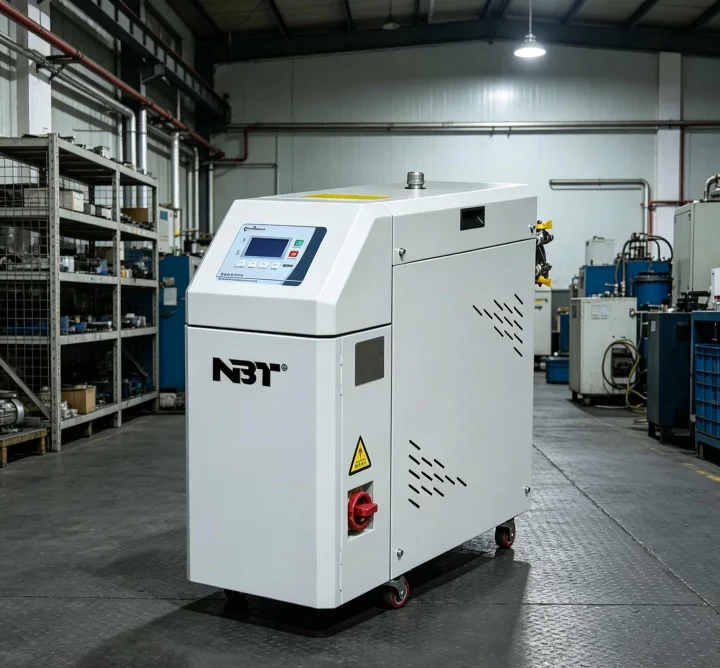
For any advanced Mold temperature controller, efficiency gains must be proven through disciplined quality control. In injection molding, temperature stability affects shrinkage, surface finish, cycle time, and dimensional repeatability. A practical verification system should align shop-floor checks with recognized guidance from ISO and quality improvement principles promoted by the ASQ.
Quality Control Checkpoint Framework
- Controller Calibration Check: Verify sensor accuracy, display readings, and control response against calibrated reference instruments before production starts.
- Process Temperature Stability: Monitor actual mold inlet and outlet temperatures during steady-state production to confirm the controller maintains the approved process window.
- Part Quality Inspection: Measure molded parts for warpage, sink marks, gloss variation, flash, and key dimensional tolerances.
- Cycle Time Verification: Compare actual cooling and total cycle time against validated baseline data to confirm efficiency improvement without quality loss.
- Documentation and Traceability: Record temperature profiles, alarms, corrective actions, and inspection results for audit readiness and continuous improvement.
Because mold temperature variation directly changes resin cooling behavior, therefore consistent controller performance reduces dimensional drift and lowers scrap risk. This is especially important for tight-tolerance components, optical parts, medical housings, and automotive connectors.
| Verification Item | Method | Acceptance Criteria | Frequency |
|---|---|---|---|
| Temperature accuracy | Compare controller reading with calibrated thermometer | Within approved tolerance range | Before production or after maintenance |
| Thermal stability | Review live inlet/outlet temperature trend | No abnormal fluctuation during steady cycle | Every production shift |
| Part dimensions | Use CMM, caliper, or gauge inspection | Meets drawing and control plan limits | First article and scheduled sampling |
| Process capability | Analyze Cp/Cpk data | Meets internal or customer requirement | After validation and periodic review |
Manufacturers commonly reference ISO 9001 quality management practices and ASQ statistical process control concepts when building mold temperature verification plans. Because documented evidence supports repeatability and accountability, therefore recorded temperature data helps teams identify root causes faster during audits, customer complaints, or process deviations.
In practice, quality teams should treat the controller as a critical process device, not just an auxiliary machine. When calibration, monitoring, inspection, and traceability are combined, the molding operation gains a reliable foundation for lower scrap, stable production, and verified efficiency.
Part 7: Common Mistakes and How to Avoid Them
Even an advanced Mold temperature controller can underperform if it is selected, installed, or maintained incorrectly. The following mistakes often reduce injection molding efficiency, but each can be avoided with practical process controls.
1. Choosing the Wrong Controller Capacity
A common mistake is selecting a controller based only on machine size instead of heat load, mold design, resin type, and cycle requirements. If the unit is undersized, it cannot remove or supply heat quickly enough, causing long cycle times and unstable part quality. Because the controller cannot maintain the required thermal balance, therefore the mold temperature fluctuates and defects become more frequent.
解决方案: Calculate required heating and cooling capacity before purchase. Consider mold weight, number of cavities, flow channel layout, resin processing temperature, and expected cycle time. When in doubt, choose a controller with sufficient reserve capacity rather than operating at its limit.
2. Ignoring Water Quality and Flow Conditions
Poor water quality leads to scale, rust, and blocked channels. Low flow rates also create uneven mold temperatures, especially in multi-cavity tools. This mistake often appears gradually, making it harder to detect until scrap rates rise.
Solution: Use filtered or treated water, inspect hoses regularly, and monitor flow rate and pressure. Clean mold channels on a scheduled basis. Install flow meters where possible so operators can quickly identify restrictions before they affect production.
| Mistake | Better Solution |
|---|---|
| Selecting a controller by machine tonnage only | Size the unit based on mold heat load and resin requirements |
| Running untreated water through the system | Use filtration, water treatment, and regular channel cleaning |
| Using one fixed temperature for all products | Create validated temperature recipes for each mold and material |
3. Using Incorrect Temperature Settings
Some operators copy settings from previous jobs without checking the current material, part thickness, or surface finish requirements. This can cause warpage, sink marks, poor gloss, or incomplete filling. Because each resin responds differently to mold temperature, therefore a single universal setting cannot deliver consistent results.
Solution: Establish process windows through trial runs and document approved settings. Use recipe storage on the controller to prevent manual input errors and support faster mold changes.
4. Neglecting Preventive Maintenance
Skipping maintenance may save minutes today but can cause heater failure, pump wear, sensor drift, and unplanned downtime later.
Solution: Create a maintenance checklist covering pumps, heaters, filters, valves, sensors, hoses, and alarms. Calibrate temperature sensors regularly and train operators to respond immediately to abnormal readings.
Part 8: FAQ
What is a mold temperature controller in injection molding?
A mold temperature controller is equipment that regulates mold heat using water or oil circulation. It keeps cavity temperature stable, improving part consistency, surface finish, and cycle control. For better sizing and system selection, contact our team through the CTA link below.
How does an advanced mold temperature controller improve efficiency?
An advanced mold temperature controller improves efficiency by reducing warm-up time, stabilizing heat transfer, and preventing temperature fluctuation during production. This helps shorten cycle times and reduce scrap rates. To identify the right controller for your process, use the CTA contact link.
Why is precise mold temperature control important for product quality?
Precise temperature control is important because uneven mold heat can cause warpage, shrinkage, flow marks, and dimensional variation. A stable mold temperature controller supports repeatable molding conditions and better finished parts. For quality-focused recommendations, reach out through the CTA contact page.
When should manufacturers upgrade their mold temperature controller?
Manufacturers should upgrade when cycle times increase, scrap rates rise, temperature readings fluctuate, or old units consume excessive energy. Modern controllers offer smarter monitoring and more reliable heat regulation. If these signs appear in your plant, follow the CTA to request guidance.
Which industries benefit most from advanced mold temperature controllers?
Automotive, medical, packaging, electronics, and precision plastic industries benefit most because they require stable dimensions and consistent surface quality. A high-performance mold temperature controller helps maintain strict processing windows. For industry-specific configuration support, connect with our specialists via the CTA link.
Can a mold temperature controller reduce injection molding costs?
Yes, a mold temperature controller can reduce costs by lowering defect rates, minimizing downtime, improving energy use, and supporting faster production cycles. Over time, these gains improve overall equipment effectiveness. To explore cost-saving options for your facility, use the CTA contact link.
Conclusion
Advanced mold temperature controllers are essential for efficient, stable, and high-quality injection molding. The first key takeaway is that precise temperature regulation improves part consistency and reduces defects. The second is that optimized heat transfer can shorten cycle times and lower production costs. The third is that intelligent monitoring helps manufacturers maintain reliable, repeatable performance. Choosing the right mold temperature controller depends on material, mold design, process demands, and production goals. Mr.chen, Technical Director, provides practical expertise in industrial temperature control solutions.
Ready to Optimize Your Injection Molding Efficiency?
Improve cycle stability, product quality, and energy performance with a suitable mold temperature controller. Contact our technical team today for expert recommendations and customized support: https://www.cn-nbt.com//contact/
Contact Mr.chen for expert guidance: https://www.cn-nbt.com//contact/
Post time: Apr-28-2026