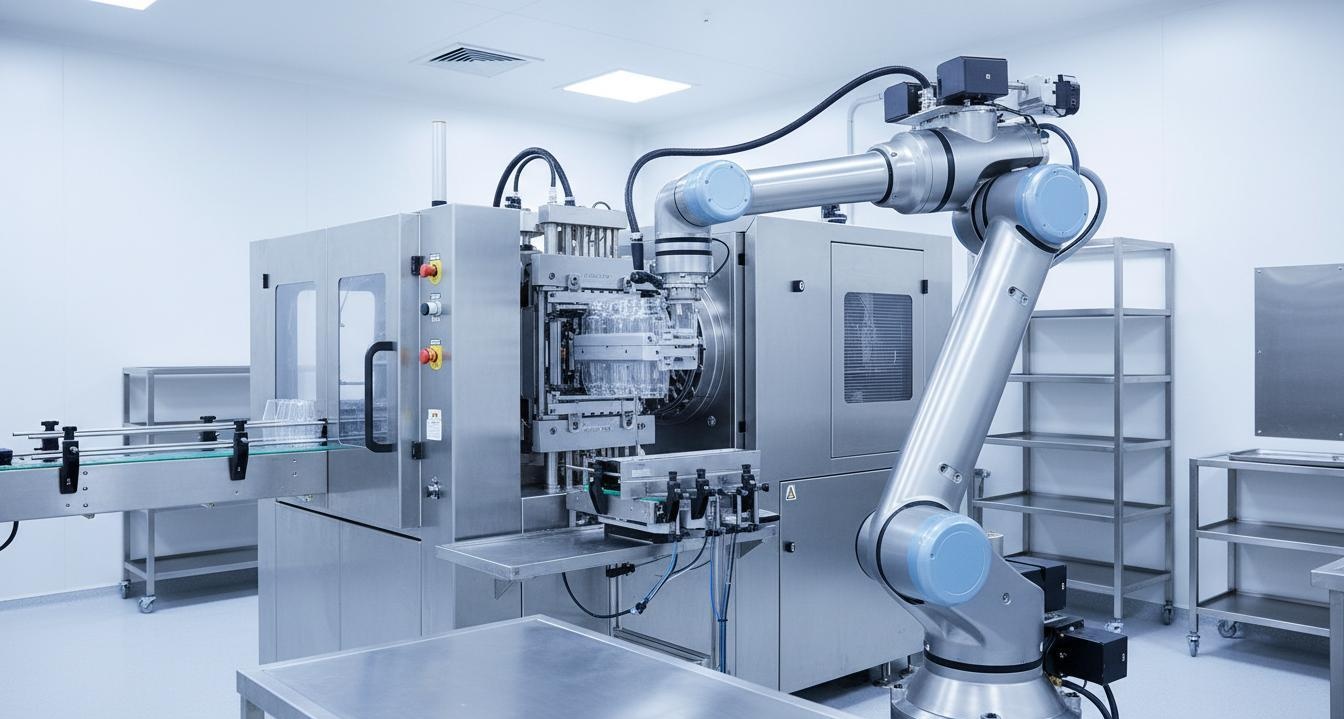
When I started my career in injection molding automation, I thought food-grade equipment was mostly about appearances — a nicer finish, a cleaner data sheet, a premium price. It took me three facility audits, two near-contamination incidents at customer sites, and one very expensive product recall to understand that food-grade automation is an entirely different engineering discipline. The difference between a robot arm that tolerates washdown and one that is designed for it shows up in the maintenance logs within six months, and it shows up in the audit report even faster.
In this article, I want to share what I have learned about specifying, sourcing, and maintaining food-grade servo robot arms for dairy packaging injection molding. This is the information I give to customers who are building new dairy packaging lines or upgrading existing ones, and it reflects what I have seen work — and fail — in real production environments over the past two decades.
Why Food-Grade Automation Demands a Different Design Philosophy
Dairy processing environments are uniquely demanding on equipment, and I learned this the hard way early in my career. I was supporting a yogurt cup molding line in Thailand where the production team was using a standard industrial servo robot arm. It worked fine for the first three months. Then the chlorine-based sanitation protocol — standard in that facility — started attacking the standard润滑脂 seals on the robot’s telescopic channels. Within five months, the robot was showing condensation inside its electrical enclosure, the IP rating was effectively void, and the facility’s food safety auditor flagged it as a contamination risk. We ended up replacing the entire robot arm instead of just the seals, because the structural fasteners had started corroding too.
The lesson I took from that experience was simple: a standard industrial servo robot arm is not a food-grade robot arm, no matter how thoroughly you clean it. The design philosophy has to be different from the ground up. When we at ROBOT (Ningbo) developed our food-grade configurations for the SPRT3S series, we approached it as a separate engineering track, not a parts swap on the standard model.
What Dairy Environments Actually Demand
When I evaluate a facility’s food safety requirements, I look at four specific stress factors that dairy environments impose on automation equipment:
- Chemical cleaning agents: Alkaline detergents, acid-based descaling agents, and chloride sanitizers are routine in dairy CIP (clean-in-place) protocols. Standard industrial seals and fasteners are designed for machine shop conditions, not this chemical exposure profile. I have seen standard Buna-N rubber seals degrade within weeks in high-pH alkaline washdown environments. Food-grade configurations use FDA-compliant lubricant compounds that maintain their integrity across the chemical exposure range typical of dairy sanitation.
- High-pressure washdown: Hose-end washdown sprayers commonly operate at 800–1500 psi. A robot arm enclosure that is not rated for water jet ingress will fail. Our food-grade SPRT3S units are built with IP65-rated electrical enclosures as standard, which means they are engineered to withstand water jet exposure from any direction without ingress.
- Humidity and condensation: The air inside a dairy processing facility is consistently humid, often exceeding 70% RH. When warm, humid air meets the cold surface of a robot’s electrical enclosure (which is typically cooler due to thermal regulation inside), you get condensation on the inside of the enclosure. IP65 sealing prevents this. Standard industrial enclosures without IP ratings will eventually show moisture damage.
- Food safety audit requirements: In my experience supporting BRCGS and FSSC 22000 audits at customer facilities, auditors are specifically trained to look at automation equipment design. They want to see smooth surfaces (no residue traps), horizontal surfaces minimized (no pooling), sealed cable entry points, and maintenance schedules that include sanitation-critical components. If your robot arm does not have documentation supporting these design features, you will receive an observation or non-conformance during the audit.
Stainless Steel Construction: What It Actually Means and Why It Matters
The term “stainless steel” is used loosely in the automation industry, and I want to be direct about what to look for and what to reject. I have toured factories where the manufacturer called their product “food-grade” with a stainless-looking exterior finish, and when I examined the structural frame, it was carbon steel with a decorative coating. That coating chips. In a washdown environment with alkaline cleaners, exposed carbon steel corrodes within weeks. That is not a food-grade product.
304 Stainless Steel: The Baseline for Food-Grade Equipment
Type 304 stainless steel is the standard for food-grade equipment surfaces in the industry, and I consider it the minimum acceptable material for any food-grade robot arm structural component. It contains 18–20% chromium and 8–10.5% nickel, which gives it excellent corrosion resistance against the cleaning agents typically used in dairy washdown. Type 304 is non-magnetic, easy to clean, and readily available — which makes it practical for structural components in the robot’s frame and arm sections that are not directly in food contact but are in the splash zone.
316 Stainless Steel: For Chloride-Rich Environments
Type 316 adds 2–3% molybdenum to the 304 composition, which significantly improves resistance to chloride-induced pitting. This is the detail I emphasize when I work with coastal dairy facilities or plants using chloride-based sanitation protocols. I have seen 304 stainless steel show stress cracking in chloride environments after extended exposure. If your facility uses chloride sanitizers — and many do because they are highly effective against bacterial biofilms — the premium for 316 stainless steel is worth it. It is the difference between equipment that lasts five years and equipment that starts showing pitting within eighteen months.
What to Reject: Coated Carbon Steel and Decorative Finishes
In my product evaluation work, I apply a simple test: I ask the manufacturer what the structural frame is made of, and I ask for the material test report. If they cannot provide it, or if the report says “carbon steel with coating,” I move on. I have seen too many facilities burn through equipment budgets because they bought based on appearance rather than material specification. We at ROBOT specify solid 304 or 316 stainless steel for all food-grade structural components in the SPRT3S series, and we provide material traceability documentation as standard.
Understanding IP65 Washdown Ratings for Food-Grade Robot Arms
The IP rating system (Ingress Protection, defined by IEC 60529) is something I explain to customers regularly, and I find that there is significant confusion about what IP65 actually means. Let me be specific about what it covers and what it does not.
IP65 Explained
The first digit, “6,” means the enclosure is dust-tight — no solid particles can enter. In a dairy processing environment, where powdered milk ingredients and ambient flour dust can be present, this is essential.
The second digit, “5,” means the enclosure is protected against water jets directed at the enclosure from any direction. I want to be very clear that this is NOT the same as being waterproof for submersion. An IP65-rated robot arm can withstand high-pressure washdown from a hose or cleaning lance — which is the relevant test for dairy CIP procedures — but it will sustain damage if submerged in liquid.
For dairy packaging operations, IP65 is the minimum rating I recommend. In facilities with especially aggressive washdown procedures — high-pressure, high-temperature — I have seen customers specify IP67 or IP69K, where IP69K covers high-pressure, high-temperature washdown scenarios typical of dairy clean-in-place cycles. When I help a customer specify a robot for a new dairy line, I ask about their washdown temperature and pressure as standard practice.
Where IP Ratings Actually Fail in Practice
I have seen IP65-rated equipment fail prematurely in ways that surprised the maintenance teams involved. The failure is almost never at the main enclosure body — it is at the cable entry points. Specifically:
- Cable glands: The connectors where signal and power cables pass through the electrical enclosure are the most common IP failure point I encounter in the field. If the cable glands are not rated to the same IP level as the enclosure, and if they are not installed to the manufacturer’s specified torque, water will find the path of least resistance directly into the enclosure. I always instruct our customers to verify gland ratings during installation and to include cable gland inspection in their weekly maintenance checklist.
- Ventilation membranes: Some robot controllers use breathable membrane vents to equalize pressure and prevent condensation. These are an IP vulnerability if they are not specifically rated for the same IP level as the enclosure. We specify sealed enclosures with no active venting on our IP65-rated food-grade units, which eliminates this failure mode entirely.
- Seal aging: The IP rating of any telescopic robot arm degrades over time as seal compounds age and joint surfaces wear. On standard industrial robots, this is a maintenance item. On food-grade robots, it is a food safety item. We use FDA-compliant food-safe lubricants on joint seals in our food-grade SPRT3S units, and we publish a specific maintenance interval for seal inspection and replacement that reflects the accelerated wear from washdown chemical exposure.
The Connection Between Robot Arm Design and Dairy Safety Compliance
When I am helping a customer prepare for a BRCGS or FSSC 22000 audit, I walk them through what the auditor is actually evaluating. It is not about whether the robot looks clean. It is about whether the design prevents contamination through documented, verifiable mechanisms. From what I have seen in audits, the following features are the ones that auditors verify:
Sealed Telescopic Channels
The telescopic arm design used in injection molding take-out robots creates a sanitation challenge that I consider one of the most critical design decisions in food-grade automation: the sliding surfaces of telescopic channels can trap product residue, moisture, and cleaning agents if they are not sealed. In a genuinely food-grade design, the telescopic channels are sealed to prevent ingress into the channel interior, and the exterior surfaces are finished to Ra ≤ 0.8μm, which prevents residue adhesion and enables complete cleaning. When I look at a robot arm for food-grade use, this is one of the first things I check by feel — if the telescopic channel surfaces are rough or unsealed, I flag it immediately.
End-of-Arm Tooling and Gripper Design
The gripper and any part-contact surfaces of a food-grade robot arm must be designed for direct food contact or isolated from food contact zones by validated barrier design. In our work with dairy packaging customers, we typically specify grippers with FDA-compliant silicone or polyurethane contact pads that can be removed, disassembled, and sanitized separately from the robot arm structure. If your application involves direct food contact — which most dairy packaging applications do — I recommend confirming the gripper material compliance with FDA 21 CFR regulations for food-contact surfaces before you finalize your robot configuration. This is not something to assume or take on faith.
Surface Finish and Drainability
Food safety auditors pay very close attention to horizontal surfaces, crevices, and hard-to-clean pockets. I have seen auditors reject equipment that looked fine during a visual inspection but had design flaws that became apparent under flashlight examination — sharp corners, unseen crevices, pooling zones where washdown liquid would collect against a mechanical joint. A genuinely food-grade robot arm minimizes horizontal surfaces, uses rounded corners and transitions rather than sharp recesses, and is designed so that washdown liquids drain away from the robot’s internal spaces rather than pooling against electrical or mechanical components. When I evaluate our own SPRT3S food-grade designs, this is the checklist I use.
Servo Drive Performance in Food-Grade Applications
A question I am asked regularly by customers who are new to servo automation for food-grade applications is whether food-grade robots sacrifice performance for sanitation compliance. In my direct experience: no, they do not. The best food-grade robot arms for injection molding use the same X, Y, Z AC servo drive architecture as their industrial counterparts — the difference is in the materials, sealing, and surface finish, not the fundamental drive technology.
When we at ROBOT (Ningbo) built the food-grade configuration of the SPRT3S series, we kept the servo drive system identical to the industrial version. A dairy packaging operation running thin-wall yogurt cups on a 320–530T press needs the same 0.7-second take-out time at 6kg payload as an industrial operation running the same mold dimensions. Food safety compliance does not require slower cycling. It requires better sealing.
What I Look For When Specifying Servo Performance for Dairy Applications
- Minimum take-out time at your actual payload rating: For dairy packaging applications — yogurt lids, milk caps, small cheese containers — the payload is typically modest, 3kg to 6kg. A servo robot with a published 0.7-second minimum take-out time at 3kg payload will deliver excellent cycle performance for these applications. I always verify the published take-out time at the load condition that matches the customer’s actual application, not at the robot’s maximum rated payload.
- Servo motor enclosure rating: The servo motors themselves should be rated to at least IP65 with properly sealed connectors and feedback devices. I specifically ask whether the encoder and power connectors meet the same IP rating as the motor body. This is where some manufacturers save cost — they use an IP65 motor body with IP20 connectors, and the connector becomes the failure point.
- Positional repeatability: In high-cycle dairy packaging operations — I commonly see 8–16 second cycle times with multi-cavity molds — the servo robot’s positional repeatability directly affects part quality. A robot with ±0.2mm positional repeatability produces more consistent parts than one rated at ±1.0mm, and that consistency translates into lower scrap rates on thin-wall dairy packaging. This is not a minor point — on a 12-second cycle with an eight-cavity mold, a ±1.0mm repeatability variation across cycles means some parts are consistently getting the robot arm’s gripper pressure in slightly different positions, which can cause gate blush, part deformation, or flash that a ±0.2mm robot simply does not produce.
Matching the Robot to Your Injection Molding Machine in Dairy Applications
I have found that food-grade dairy packaging applications fall into roughly three tonnage ranges that correspond to the most common dairy packaging formats. When I am helping a customer select a robot for a dairy line, I use these ranges as a starting point:
- 160–320T presses: Milk lid preforms, small yogurt cup lids, dairy garnish dispensers — typically requiring 3kg payload robots with compact reach envelopes. The SPRT3S1000W and SPRT3S1200W cover this range.
- 320–530T presses: Standard yogurt cups, butter churn containers, small cheese molds — I typically recommend 6kg payload configurations. The SPRT3S1100W and SPRT3S1300W are built for this window.
- 530–900T presses: Large dairy tubs, multi-cavity cheese containers, industrial butter packs — 25kg payload range. The SPRT3S1600W and SPRT3S1800W are the models I recommend for this segment.
When you review the SPRT3S series specifications, I recommend confirming that the model you are evaluating is available in a food-grade configuration — stainless steel structural components, IP65-rated enclosures, and food-safe lubricants — not just the standard industrial version of the same model. These are distinct product configurations that share the same core mechanical design but differ in material and sealing specifications.
Maintenance Considerations for Food-Grade Robot Arms
One of the most significant long-term cost differences between standard industrial robots and food-grade robots is maintenance philosophy. Standard industrial robots are maintained on intervals that assume a relatively stable operating environment. Food-grade robots in dairy environments require more rigorous maintenance protocols because washdown chemical exposure accelerates seal degradation and surface wear in ways that standard industrial maintenance schedules do not account for. I always tell new food-grade customers to budget for more frequent maintenance in their first year — not because the equipment is unreliable, but because the operating environment is more demanding than standard industrial use.
Daily or Per-Shift Checks
- Visual inspection of gripper and end-of-arm tooling for product residue buildup — I have seen residue accumulation on gripper pads cause part contamination events that were traced back to inadequate daily wipe-downs
- Confirmation that gripper contact pads are intact and properly seated — loose pads can shed particles
- Quick wipe-down of external arm surfaces to prevent residue drying, which makes the next washdown more difficult and creates a biofilm risk
Weekly Maintenance
- Inspection of cable glands and electrical enclosure entry points for signs of moisture ingress — this takes two minutes and can prevent a catastrophic enclosure failure
- Verification of cable connector security — vibration from the molding machine can loosen connectors over time
- Check telescopic arm channels for residue accumulation — if found, schedule a deep clean before the next production shift
Quarterly Maintenance
- Full seal inspection and replacement of any degraded seals with manufacturer-specified food-grade replacements — use only approved compounds; the wrong lubricant in a food-grade application is a contamination event waiting to happen
- Full IP integrity test of all electrical enclosures — we provide this as a standard service for our food-grade customers, but it can be done in-house with the right equipment
- Calibration verification of all three servo axes — positional drift in any axis can cause part quality issues that are difficult to diagnose without direct measurement
Why I Recommend ROBOT (Ningbo)’s Food-Grade SPRT3S Series
Having evaluated automation equipment from dozens of manufacturers for dairy packaging applications, and having designed and built our own SPRT3S food-grade configurations at ROBOT (Ningbo), I have a direct perspective on what works and what I would steer customers away from. What I have found most practical about our own food-grade approach is that we did not start with a standard industrial product and try to make it food-safe. We started with the sanitation requirements and worked backward to the mechanical design.
The SPRT3S series — from the SPRT3S1000W (160–320T, 3kg payload, 0.7-second take-out) through the heavy-payload SPRT3S4200W (3000–4500T, 100kg payload) — all share the same X, Y, Z AC servo drive architecture that delivers the consistent cycle performance dairy molders need. For food-grade configurations, we build them with solid 304 stainless steel structural components, IP65-rated electrical enclosures, FDA-compliant lubricants, and sealed telescopic channel designs. I am direct about this because I believe transparency in material specifications is what separates a genuine food-grade manufacturer from one that uses the term as a marketing label.
You can review the available models and specifications in detail on our product page, which includes full dimension drawings and specification tables for each model in the series. For customers with specialized food-grade requirements — custom gripper angles, IP69K washdown rating, or 316 stainless steel for chloride-rich environments — I recommend reaching out to our technical team directly, because some configurations are built to order and require application-specific consultation.
Conclusion: Choosing a Food-Grade Robot Arm Built for Dairy Packaging
Dairy packaging injection molding demands automation equipment that treats food safety as a primary design requirement, not a secondary consideration. When I evaluate equipment for a dairy application, I look past the marketing language of “stainless finish” and verify the actual material specifications, the IP rating with documented test conditions, and the design features that address the sanitation challenges specific to dairy environments.
A genuine food-grade robot arm with stainless steel construction, IP65 or higher washdown rating, sealed telescopic channels, and food-safe lubricants will cost more upfront than a standard industrial robot with a clean-looking finish. But in a dairy processing environment, that cost premium is a fraction of what a single food safety incident — a product recall, a failed audit, a line shutdown — can cost in lost production, regulatory penalties, and brand damage. I have seen that math play out in real dollars, and I have never seen a facility regret investing in genuine food-grade automation after they understood the full cost comparison.
If you are spec’ing a new dairy packaging line or upgrading an existing operation, I recommend starting with the SPRT3S series specification page and engaging directly with our technical team to confirm the food-grade configuration that matches your specific press tonnage, part geometry, and sanitation protocol requirements. I have found that the specification conversation — where we walk through the actual operating conditions together — is the most valuable step before placing an order.
Author Card
Mr. Chen — Technical Director, ROBOT (Ningbo) Intelligent Technology Co., Ltd.
ROBOT (Ningbo) was established in 2004, specializing in plastic injection molding automation equipment. From hopper dryers and auto loaders to servo robot arms, central conveying systems, and turnkey plant planning, we help factories worldwide improve efficiency with practical, field-proven solutions. As Technical Director, I focus on the real-world performance of automation equipment — cycle time, uptime, and the specifications that actually matter on the production floor.
Social: 田田 | Facebook
Post time: May-29-2026