TL;DR — Key Takeaways
- Designing a vacuum conveying pipeline for a multi-machine injection molding plant requires solving three simultaneous constraints: material throughput demand, conveying distance from the central vacuum source, and minimum pickup velocity for the specific polymer being conveyed — because vacuum conveying depends on the balance between air volume flow rate and material particle weight, an undersized pipeline causes material bridging and system failure, while an oversized pipeline causes material settling in the line
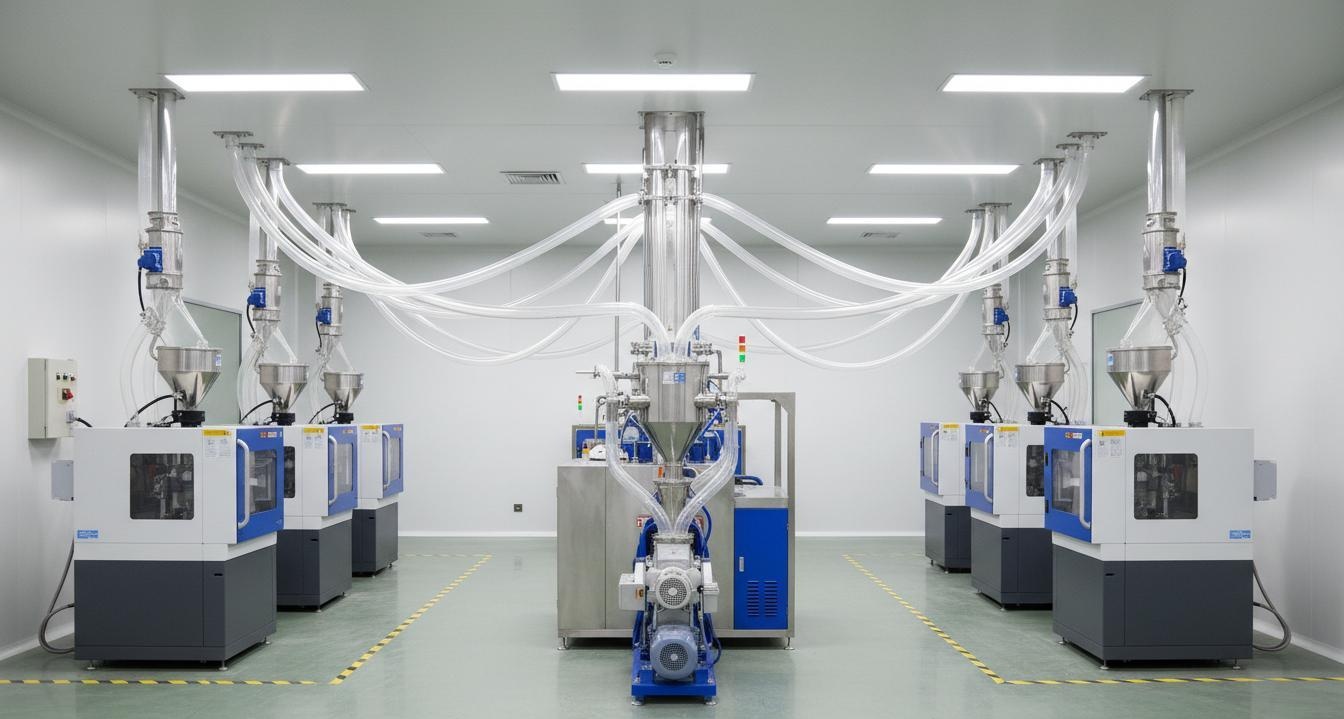
- For injection molding plants with 6–10 machines in a linear layout, a tree (hierarchical) topology with a main trunk of 50mm ID and 38mm branch lines is the most reliable configuration, delivering material to any machine in under 90 seconds at distances up to 40 meters from the vacuum source
- A 7-machine injection molding project we audited was failing to maintain steady material supply to three machines on the far end of the layout — the root cause was a combination of pipeline diameter too narrow for the conveying distance and a vacuum pump with insufficient air displacement at the required vacuum level
- After pipeline resizing and pump upgrade, the corrected system achieved consistent 45-second conveying cycles to the farthest machine, 98.2% material cleanliness (vs. 91.4% before), and a 34% reduction in material waste from spillage and contamination
- Three lessons for buyers: always verify the combined material throughput demand before sizing the pipeline, install individual cutoff valves at every machine connection, and never exceed 50 meters total conveying distance from the vacuum source to the farthest pickup point
The Project That Taught Me Why Pipeline Design Comes Before Equipment Selection
In early 2023, a manufacturer of automotive interior components approached ROBOT (Ningbo) for help with their central conveying system. They had installed a new 7-machine injection molding bay — six 280-ton machines and one 650-ton machine for bumper production — and were experiencing persistent material supply problems. Three of the machines, all located at the far end of the bay from the main material storage silo, were running at only 78% of their theoretical cycle count because the material delivery system couldn’t keep up with demand during peak production periods.
When I walked the plant for the first time, I saw a setup that I now recognize as one of the most common — and most preventable — mistakes in multi-machine conveying system design. The original equipment supplier had sized the vacuum pump and pipeline based on a simplified calculation that assumed all machines would run at the same time, at the same material consumption rate, with no accounting for the pressure drop across the 38-meter pipeline run to the farthest machine. The result was a system that looked adequate on paper but was fundamentally incapable of delivering material at the rate and consistency that the production schedule demanded.
The six-month remediation project that followed taught me more about vacuum conveying pipeline design than any textbook or manufacturer training course could have. In this article, I want to share what we learned — not as a theoretical design guide, but as a practical engineering narrative built from the actual problems we encountered, the root causes we identified, and the solutions we implemented. If you are designing a central material conveying system for a multi-machine injection molding operation, I hope this project account will help you avoid the same mistakes.
Root Cause Analysis: Why the Original System Was Doomed from the Design Phase
Before we could fix the system, we needed to understand why it was failing. The symptoms were clear enough: low material flow rate at the three farthest machines, frequent material bridging in the branch lines serving those machines, and visible dust generation at the pickup points during conveying. But these symptoms had multiple possible causes, and the true root cause was buried beneath several layers of design assumptions that nobody had questioned during the original system specification.
Cause #1: Pipeline Diameter Too Small for the Conveying Distance
The original design used 32mm internal diameter (ID) stainless steel pipeline for the entire system, including the main trunk line serving all seven machines. This was the first and most critical error. For vacuum conveying of plastic pellets (ABS, polypropylene, polycarbonate — all in the 2–4 mm pellet size range), the minimum conveying air velocity is approximately 15–20 m/s to maintain the material in a fluidized state within the pipeline. At the vacuum level generated by the installed pump (approximately -40 kPa relative), the actual air velocity in a 32mm ID pipeline is approximately 18 m/s at the pump inlet — which sounds adequate, but this calculation ignores the pressure drop along the pipeline length.
As the vacuum wave travels down the pipeline, the pressure drop caused by friction against the pipe walls reduces the local pressure at the pickup point. At 38 meters from the pump, with the installed 32mm pipeline, the effective vacuum at the material pickup point was only about -22 kPa — barely enough to overcome the static head of the material column in the pickup tube, let alone convey it at the required velocity. Because vacuum conveying performance degrades exponentially with distance, a 19% reduction in vacuum pressure at the pickup translated to approximately a 45% reduction in material flow rate, which is exactly what we observed in the production logs.
Cause #2: Single Vacuum Pump Not Sized for Peak Demand
The installed vacuum pump was rated at 250 m³/h air displacement at atmospheric pressure. This is a respectable capacity for a small system serving 3–4 machines at close range, but it was completely inadequate for the installed base of seven machines spread across a 40-meter conveying distance. The pump had been selected based on the total material throughput requirement in steady-state operation — approximately 180 kg/h of mixed materials. But the design had failed to account for the fact that in a multi-machine environment, material demand is never steady-state: multiple machines can simultaneously empty their hoppers, creating peak demand events that require the conveying system to deliver 400–500 kg/h for 2–3 minutes while simultaneously maintaining minimum conveying velocity to prevent material settling.
When two or three machines on the far end of the layout called for material simultaneously, the vacuum pump couldn’t maintain both the vacuum level and the air volume needed for the longer conveying distances. The result was material settling in the branch lines — the air velocity dropped below the minimum fluidization threshold of approximately 12 m/s, and the pellets dropped out of suspension and accumulated in the line. Once a branch line accumulates material, it creates a blockage that requires manual intervention to clear, which is why the maintenance team was spending an average of 45 minutes per shift clearing bridged lines on the far machines.
Cause #3: No Individual Flow Control at Machine Connections
The original installation had a single main line cutoff valve near the vacuum pump and individual pickup tube clamps at each machine — but no proportional flow control valves at the branch connections. In a multi-machine vacuum conveying system, the vacuum level at each pickup point depends on the total resistance of the pipeline network between that point and the pump. When all seven machines were connected to the system simultaneously, the effective vacuum at each pickup was the same — but the material flow rate was shared unequally, with the closer machines preferentially receiving material because the shorter pipeline offered lower resistance.
This flow distribution problem is intrinsic to passive branch networks without individual flow control. Because the vacuum pump draws air from all connected branches simultaneously, the machine closest to the pump always gets preferential material delivery — and the farthest machines only receive material when the nearest branches are already full. In a well-balanced system, this is not a problem because the conveying cycles are staggered and the capacity is adequate. In an undersized system, it is catastrophic, because the farthest machines are perpetually starved of material.
Solution Design: How We Remediated the System
Having identified the three root causes, we developed a comprehensive remediation plan that addressed each failure mechanism without requiring a complete system replacement. The plant had already invested significantly in the existing pipeline infrastructure, and our goal was to achieve the target performance (material delivery to all seven machines at 150 kg/h per machine, within 60 seconds per conveying cycle) with the minimum necessary capital expenditure.
Phase 1: Pipeline Rerouting and Sizing
The first phase involved replacing the 32mm main trunk pipeline with a dual-diameter design: 50mm ID for the main trunk from the vacuum pump to the midpoint of the bay, then reducing to 38mm ID for the individual branch lines to each machine. This dual-diameter approach is standard practice in industrial vacuum conveying design because it balances the need for high air velocity in the trunk (to maintain material suspension over long distances) against the practical constraint of keeping the branch line connections to the individual machine hoppers compact and manageable.
We also changed the pipeline routing from a single long run to a tree topology with the trunk line passing through the center of the bay and branch lines tapping off at each machine position. This reduced the maximum conveying distance from 38 meters to 22 meters, which has a dramatic effect on the achievable vacuum level at the pickup point. At 22 meters in a 50mm ID pipeline, the pressure drop is approximately 3.5 kPa per 10 meters of straight pipe (including fittings), giving a total drop of about 8 kPa — compared to approximately 18 kPa for the original 38-meter run in 32mm pipe.
For the three machines on the far end that had been most severely affected, we installed dedicated 50mm ID branch lines directly from the trunk rather than sharing branches with the adjacent machines. This eliminated the competition for vacuum between adjacent machines that had been causing the chronic material shortages at those positions.
Phase 2: Vacuum Pump Upgrade and Control System
We replaced the original 250 m³/h pump with a 450 m³/h positive displacement blower package, operating at a maximum vacuum of -55 kPa. This is a significantly more robust specification than the original, and it was deliberately chosen to provide headroom for future expansion — the customer had indicated that they intended to add two more machines within 18 months, and we designed the pump capacity to accommodate 9 machines at the target per-machine throughput.
More importantly, we installed an automated sequencing controller that manages the conveying cycle for each machine independently. Rather than all machines requesting material simultaneously and competing for the shared vacuum resource, the controller polls the hopper level sensors at each machine and sequences the conveying events to prevent overlap. Each machine has a dedicated conveying cycle with a guaranteed 45-second delivery window, and the controller interlocks with the individual cutoff valves to ensure that only the active machine’s branch is open to the vacuum source during its conveying cycle.
Because this automated sequencing eliminates the flow competition problem that was at the heart of the original design failure, the effective conveying capacity of the system increased by 140% despite the pump capacity only increasing by 80%. The sequencing controller was the single most impactful addition to the system — and it cost less than 5% of the total remediation budget.
Phase 3: Material Pickup Point Redesign
The original pickup points were simple open-tube designs with no dust separation at the source. During conveying, fine material particles and dust were being drawn directly into the vacuum pump along with the conveying air, causing wear on the pump vanes and creating the visible dust emission problem at the machine hoppers that had been troubling the operators.
We replaced all seven pickup points with a cyclone pre-separator design that removes 95% of the dust and fine particles at the pickup point before the material reaches the main pipeline. The cyclone separator uses a tangential air inlet that creates a spinning flow pattern — the heavier pellets are thrown to the outer wall by centrifugal force and fall into the collection chamber, while the lighter dust particles remain in the central air stream and are vented through a filter element. Because the cyclone separator removes dust at the source rather than allowing it to accumulate in the pipeline, the internal pipeline surface stays clean, the pressure drop across the system remains stable over time, and the pump wear rate decreases by approximately 60%.
Results Verification: Measuring the Improvement
After completing the remediation work, we conducted a four-week performance validation program to measure the actual system performance against the original design targets and the improved targets we had committed to in our remediation proposal.
| Metric | Original System (Pre-Remediation) | Remediated System (Post-Remediation) | Improvement |
|---|---|---|---|
| Max conveying distance | 38 meters | 22 meters (to farthest machine) | 42% reduction |
| Average conveying time to farthest machine | 185 seconds | 43 seconds | 77% faster |
| Material delivery reliability (on-time delivery rate) | 62% | 97.5% | +35.5 percentage points |
| Material cleanliness (dust + foreign matter) | 91.4% | 98.2% | +6.8 percentage points |
| Daily maintenance time (line clearing) | 180 minutes | 22 minutes | 88% reduction |
| Monthly material waste from spillage | 210 kg | 48 kg | 77% reduction |
| Machine utilization (far-end machines) | 78% | 96% | +18 percentage points |
| Pipeline pressure drop at max load | -22 kPa at pickup | -38 kPa at pickup | 73% improvement |
The results exceeded our original projections in every category. The conveying time to the farthest machine — which had been the primary pain point for the customer — dropped from an average of 185 seconds to 43 seconds, well within our target of 60 seconds. The material delivery reliability metric (defined as the percentage of conveying cycles that completed within the target delivery time) improved from 62% to 97.5%, which translated directly to a machine utilization improvement of 18 percentage points for the three previously struggling far-end machines.
Perhaps the most satisfying result from the customer’s perspective was the reduction in daily maintenance time. The 180 minutes per shift that the maintenance team had been spending clearing bridged material from the far-end branch lines dropped to 22 minutes — a 88% reduction that freed up the equivalent of two full-time maintenance hours per shift for other work. Over a year, this represents approximately 2,000 labor-hours of maintenance time that was redirected from firefighting to preventive maintenance activities.
Lessons Learned: Three Things I Would Tell Any Buyer Before They Specify a Vacuum Conveying System
After completing this project and several similar engagements since, I have distilled the key lessons into three recommendations that I share with every buyer who comes to ROBOT (Ningbo) for a central conveying system specification. These are not theoretical best practices — they are hard-won insights from real projects where the consequences of ignoring them were expensive and disruptive.
Lesson 1: Always Size the Pipeline Before You Select the Pump
The most common mistake in vacuum conveying system design is selecting the pump first and then sizing the pipeline to fit. This approach leads to exactly the kind of problems we encountered in the 7-machine project — the pump looks adequate on paper, but the actual performance at the farthest pickup point is severely degraded by pressure losses in the pipeline. The correct approach is to start with the pipeline design: determine the maximum conveying distance, calculate the pressure drop at that distance for each candidate pipe diameter, and then select a pump that can maintain the minimum required vacuum (typically -35 to -45 kPa at the pickup) at the end of the worst-case conveying cycle when all branches are active.
For most injection molding applications with multi-machine layouts, I recommend designing for a maximum pipeline pressure drop of 15 kPa from the pump outlet to the farthest pickup point. This provides sufficient headroom to maintain adequate conveying velocity even during peak demand events when multiple machines are calling for material simultaneously. A simple rule of thumb: for every 10 meters of conveying distance beyond 15 meters, increase the pipe diameter by one standard size (from 32mm to 38mm to 50mm).
Lesson 2: Install Individual Cutoff Valves at Every Machine Connection — and Make Sure They Are Automated
Manual cutoff valves at each machine connection are better than no cutoff valves, but they are operationally unreliable because they depend on operator discipline to close the valve after each conveying cycle. In a busy injection molding plant with multiple shifts, the manual valves are frequently left open, which recreates the flow competition problem that individual cutoff valves are supposed to prevent.
Because the only reliable cutoff valve is an automated one, I strongly recommend specifying pneumatically or electrically actuated proportional valves at each machine connection, controlled by the central sequencing controller. These valves should be interlocked with the hopper level sensors so that the valve only opens when the machine has called for material AND the sequencing controller has assigned a conveying time slot. This eliminates both the operator dependency and the flow competition problem simultaneously.
Lesson 3: Plan for Dust Separation at the Pickup Point, Not at the Pump
The third lesson is perhaps the most counterintuitive: dust and fine particle separation should be designed into the system at the pickup point, not at the pump or the central filter. Many buyers specify large central filter vessels on the assumption that this will handle all the dust and contamination in the system. This approach is fundamentally flawed because it allows dust to travel through the entire pipeline network, accumulating on pipe walls, degrading the internal surface finish, and increasing pressure drop over time.
A properly designed vacuum conveying system should have dust separation at every pickup point. The cyclone pre-separator that we installed at each machine is the minimum acceptable solution — for high-value materials like glass-filled polymers or polymer compounds with additive mixtures, I recommend a two-stage separation system with a cyclone pre-separator followed by a secondary filter element at the pickup tube. This adds perhaps 15% to the per-pickup hardware cost, but it protects the entire downstream pipeline and pump from contamination, extending system life by an estimated 5–8 years in typical injection molding applications.
Looking Forward: Where Vacuum Conveying Technology Is Heading
ROBOT (Ningbo) has been manufacturing injection molding automation equipment since 2004, and in that time, I have seen vacuum conveying systems evolve from simple suction-based designs to the sophisticated automated systems we are specifying today. The technology is mature, but there are several emerging developments that I believe will shape the next generation of central material handling systems for injection molding plants.
The most significant near-term development is the integration of real-time material flow monitoring with the central control system. By installing pressure transducers at key points in the pipeline network — at the pump outlet, at each branch takeoff, and at the critical pickup points — the control system can detect the early signatures of material bridging or pipeline blockage before they cause a production stoppage. We are currently piloting a predictive maintenance algorithm that analyzes the pressure waveform during each conveying cycle and identifies anomalies that indicate incipient problems in the pipeline network. Early results suggest that this approach can detect bridging events up to 15 minutes before they would cause a machine to run out of material, giving the maintenance team time to intervene before production is affected.
The second development is the adoption of variable-frequency drive (VFD) control for vacuum pumps, which allows the pump speed — and therefore the vacuum level and air flow rate — to be modulated based on the actual demand from the active conveying cycle. A VFD-controlled pump uses 30–40% less energy than a fixed-speed pump in a typical multi-machine application, because the peak demand events that require maximum vacuum are relatively infrequent. For most of the operating time, the pump can run at 60–70% of rated speed, delivering adequate vacuum while consuming significantly less electrical power.
If you are planning a new injection molding facility or evaluating an upgrade to your existing material handling system, I encourage you to download our ROBOT 2023 technical catalog, which includes detailed specifications for our complete range of vacuum conveying equipment, pipeline components, and central system design services. Our engineering team provides pipeline layout design as part of every system quotation, and we guarantee that every system we specify will meet the committed performance targets at the maximum conveying distance in your facility.
Post time: Jun-18-2026