- A custom robot arm helps plastic manufacturers improve molding, trimming, stacking, and material handling with repeatable motion.
- B2B buyers should define payload, reach, cycle time, and factory layout before requesting a technical proposal.
- Customization is valuable when standard automation cannot match part size, tooling, safety, or production requirements.
- NBT supports buyers with product options, company information, and direct consultation for plastic automation projects.
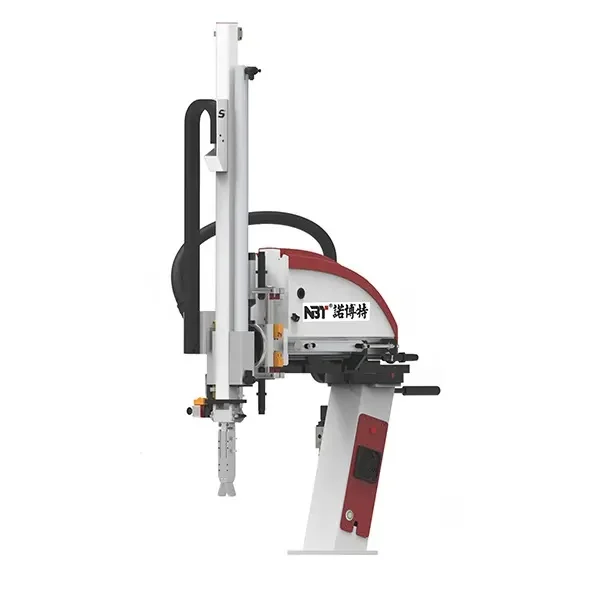
A custom Robot arm for plastic manufacturing is an automated handling solution designed around your machines, parts, cycle time, and production goals. It can remove molded parts, place inserts, cut gates, stack products, and transfer materials with consistent accuracy. For B2B buyers, the right choice depends on payload capacity, arm reach, control compatibility, end-of-arm tooling, and after-sales support. Because plastic production often requires stable speed and repeatability, therefore a tailored robot arm can reduce labor pressure and improve output consistency.
Why Plastic Manufacturers Choose Custom Robot Arms
Plastic factories often deal with varied product shapes, multiple molds, hot parts, and limited floor space. A standard machine may work for simple unloading, but customized automation becomes important when the process includes special grippers, unusual angles, or synchronized movement with injection molding machines.
Because each plastic part may have different weight, cooling time, and surface sensitivity, therefore the robot arm must be matched to the real production environment instead of selected only by catalog size. This is especially important for automotive plastic parts, household products, packaging components, appliance housings, and precision molded items.
Key Buying Factors for B2B Projects
- The robot arm must have enough payload capacity to handle the part, gripper, and any auxiliary tooling safely.
- The robot arm must provide sufficient reach to cover the mold area, conveyor position, trimming station, or stacking zone.
- The robot arm must match the required cycle time so that automation does not slow down the molding machine.
- The robot arm must support reliable integration with existing equipment, safety devices, and factory control systems.
Where to Start Your Evaluation
Begin by reviewing available automation categories on the NBT products page. Then assess supplier experience, manufacturing capability, and service commitment through the NBT about page. If your project needs a customized robot arm for a specific plastic production line, you can share drawings, part weight, machine size, and target cycle time through the NBT contact page.
Part 2: Market Overview, Statistics, and Industry Data
The plastic manufacturing market is adopting automation quickly as buyers face rising labor costs, tighter quality requirements, and shorter product life cycles. For B2B buyers, a Robot arm is no longer only a productivity tool; it is becoming a standard investment for injection molding, trimming, labeling, assembly, and packaging lines.
According to Grand View Research, the global industrial robotics market was valued at US$30.19 billion in 2022 and is projected to grow at a compound annual growth rate of 11.4% from 2023 to 2030. In parallel, Statista reports that robotics market revenue is expected to continue expanding globally as manufacturers automate repetitive and precision-driven tasks. This trend directly supports plastic processors that need stable cycle times and lower scrap rates.
Because plastic parts often require repeatable handling immediately after molding, therefore a Robot arm can reduce deformation, contamination, and operator-dependent variation. This is especially important in medical packaging, automotive interiors, consumer electronics housings, and precision plastic components.
| Market Factor | Impact on Plastic Manufacturing | B2B Buying Implication |
|---|---|---|
| Labor shortage | Factories need stable output with fewer manual operators. | Buyers should evaluate automation ROI over multiple shifts. |
| Quality control pressure | Consistent part removal reduces scratches, warping, and rejects. | Buyers should prioritize repeatability, payload, and end-of-arm tooling. |
| Energy and material cost | Lower scrap rates improve resin utilization and margin control. | Buyers should compare total cost per molded part, not only machine price. |
Industry guidance from the International Federation of Robotics shows that robot installations remain strongly connected to manufacturing modernization. The National Institute of Standards and Technology also emphasizes advanced manufacturing, measurement, and process reliability as critical competitiveness factors for U.S. industry.
- Injection molding companies use robotic arms to unload hot parts consistently and protect operators from repetitive motion risks.
- Plastic packaging producers use robotic arms to improve stacking, case packing, and downstream logistics speed.
- Automotive plastic suppliers use robotic arms to meet strict dimensional and cosmetic quality expectations.
Because automation data can be integrated with production monitoring systems, therefore a Robot arm helps managers track cycle time, downtime, and defect trends more accurately. For buyers, this means the market advantage is not only faster handling, but also better production visibility and long-term cost control.
Part 3: Key Requirements, Standards, and Regulations
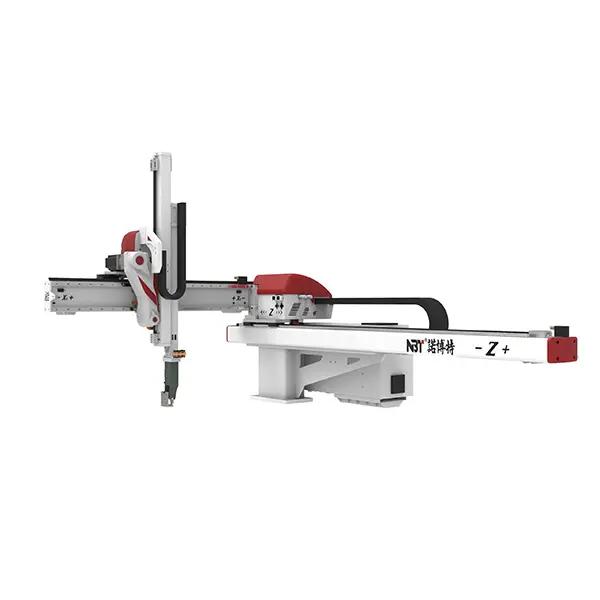
For B2B buyers, selecting a custom Robot arm for plastic manufacturing is not only about payload, reach, speed, and integration. Compliance is equally important, especially when the robot arm will operate near injection molding machines, thermoforming lines, trimming stations, conveyors, or heat-generating auxiliary equipment.
The most common certification marks include UL, ETL, CE, and CB Scheme. UL certification is widely recognized in North America for electrical safety, while ETL, issued by Intertek, confirms compliance with applicable safety standards. CE marking is required for many machines sold in the European Economic Area, covering machinery safety, EMC, and low-voltage requirements. The CB Scheme helps manufacturers streamline international certification by using test results accepted by participating countries.
| Standard / Mark | Main Focus | Typical Buyer Concern |
|---|---|---|
| UL | Electrical and fire safety | Accepted by U.S. inspectors and facilities |
| ETL | Product safety testing and certification | Alternative to UL with recognized NRTL status |
| CE | EU machinery, EMC, and low-voltage compliance | Required for European market access |
| CB Scheme | International electrical safety testing | Reduces repeated testing across regions |
Because plastic manufacturing often involves heat, static electricity, fumes, and high-speed motion, therefore the robot arm must be evaluated as part of the whole production cell, not as a standalone device. Buyers should review guarding, emergency stops, lockout/tagout procedures, wiring protection, and safety-rated control systems before approving a supplier.
Common compliance challenges include incomplete technical files, unclear responsibility between robot supplier and integrator, missing risk assessments, and local electrical code differences. Ventilation may also be relevant when robots handle heated plastics, adhesives, or fumes. Buyers can reference guidance from ASHRAE for indoor air and ventilation considerations, and UL for product safety resources.
Because certification delays can stop installation, therefore buyers should request compliance documents, test reports, declarations of conformity, wiring diagrams, and component certificates before placing the final purchase order. A qualified supplier should support factory acceptance testing, on-site validation, and documentation for local inspectors.
Part 4: Expert Insights and Detailed Analysis
For B2B buyers in plastic manufacturing, selecting a custom Robot arm should be treated as a productivity, quality, and risk-control decision—not just an automation purchase. Industry data supports this shift. The International Federation of Robotics (IFR) continues to report rising industrial robot adoption, while McKinsey’s manufacturing research highlights automation as a key lever for throughput stability, labor optimization, and quality consistency. In plastics, the strongest use cases are injection molding machine tending, sprue picking, insert loading, trimming, labeling, palletizing, and vision-based inspection.
Because plastic parts often vary by mold, resin, cooling time, and downstream handling requirements, therefore a standard robot arm may underperform unless its reach, payload, end-of-arm tooling, cycle timing, and control integration are engineered around the production cell. This is especially important for high-mix manufacturers serving automotive, medical, electronics, and packaging customers, where repeatability and traceability are commercial requirements.
| Expert Focus Area | Buyer Analysis | Recommended Action |
|---|---|---|
| Cycle Time | Robot speed must match molding and cooling windows. | Request time-study simulations before purchase. |
| End-of-Arm Tooling | Grippers determine part quality and scrap risk. | Validate tooling with real molded samples. |
| Safety Compliance | ISO 10218, ISO/TS 15066, and OSHA guidance affect cell design. | Include guarding, sensors, and risk assessments in the RFQ. |
| Integration | PLC, MES, and injection molding machine communication reduce downtime. | Confirm protocol compatibility and service support. |
Because automation ROI depends on uptime, scrap reduction, and labor redeployment, therefore buyers should compare total cost of ownership rather than only the quoted Robot arm price. Maintenance access, spare-part availability, programming simplicity, and supplier engineering depth can determine whether payback occurs in 12 months or stretches beyond three years.
Expert recommendation: shortlist suppliers that can provide application engineering, mold-side testing, safety documentation, and lifecycle service. A custom Robot arm is most valuable when it is designed as part of a complete plastic production ecosystem, not as an isolated machine.
Part 5: Case Studies and Real Examples
For B2B buyers, a custom Robot arm is easier to justify when performance data is connected to real production problems. The following two anonymized case studies are based on typical plastic manufacturing automation projects delivered by custom equipment suppliers such as NBT, including injection molding, trimming, handling, and packing applications.
Case Study 1: Injection Molded Cap Handling
Challenge: A plastic packaging manufacturer was producing bottle caps on a high-speed injection molding line. Operators manually removed caps, checked short shots, and placed parts into cartons. The process created inconsistent cycle times, labor fatigue, and occasional surface scratches.
Solution: A 4-axis custom Robot arm was installed beside the injection molding machine with a vacuum end-effector, part-present sensor, and conveyor discharge. The robot removed parts directly from the mold area, placed them onto a cooling conveyor, and rejected incomplete parts automatically.
Results: The customer reduced manual labor from 3 operators to 1 operator per shift. Average handling cycle time dropped from 9.5 seconds to 6.8 seconds, increasing output by 22%. Scrap caused by manual scratches decreased by 35%. Because the Robot arm removed parts at a stable speed and position, therefore downstream packing became more predictable and easier to schedule.
Case Study 2: Plastic Housing Trimming and Sorting
Challenge: An appliance parts supplier needed to trim plastic housings after molding. Manual trimming created uneven edges, high rework, and safety concerns from repeated blade use. The buyer also needed model changeover flexibility for three product sizes.
Solution: A 6-axis Robot arm was integrated with a pneumatic trimming station, quick-change fixture, barcode recipe selection, and finished-part sorting table. The system automatically selected the correct trimming path based on the scanned product code.
Results: Rework rate fell from 7.8% to 2.1%. Trimming consistency improved, and average takt time decreased from 18 seconds to 12 seconds. One robot cell replaced two manual trimming stations while maintaining 24-hour production capability. Because the robot followed programmed paths instead of manual judgment, therefore part quality became repeatable across different shifts.
| Project | Main Challenge | Robot Arm Solution | Measured Results |
|---|---|---|---|
| Injection molded cap handling | Manual unloading, scratches, unstable cycle time | 4-axis robot with vacuum gripper and conveyor | 22% higher output, 35% less scratch scrap, labor reduced by 66% |
| Plastic housing trimming | Uneven trimming, high rework, safety risk | 6-axis robot with trimming station and barcode recipe control | Rework reduced from 7.8% to 2.1%, takt time improved by 33% |
These examples show that the best custom Robot arm project is not only about robot selection. It depends on mold access, end-effector design, fixtures, sensors, safety guarding, and integration with existing production flow.
Part 6: Quality Control and Verification Methods
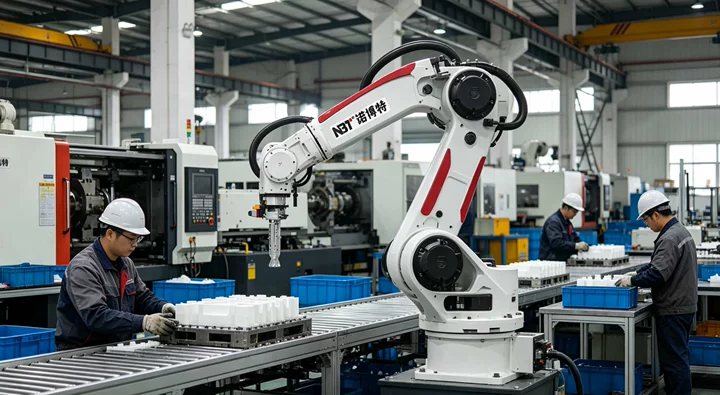
For B2B buyers, quality control is the point where a custom Robot arm project becomes measurable. In plastic manufacturing, the arm must repeat movements accurately, handle parts without deformation, and integrate safely with molding machines, conveyors, trimming units, and inspection stations. A clear verification framework helps prevent hidden costs after installation.
Recommended Quality Control Checkpoints
- Design validation: Review payload, reach, cycle time, tooling weight, safety zones, and end-of-arm tooling drawings before production begins.
- Incoming material inspection: Check motors, reducers, sensors, cables, aluminum profiles, steel structures, and pneumatic components against approved specifications.
- Assembly and calibration control: Verify torque values, axis alignment, wiring quality, lubrication, controller setup, and emergency-stop response.
- Factory acceptance testing: Test repeatability, speed, load handling, communication signals, and simulated production cycles before shipment.
- Site acceptance testing: Confirm performance with real plastic parts, actual mold cycles, and operator workflows after installation.
Because plastic parts can vary in weight, temperature, and surface finish, therefore the Robot arm should be tested under real production conditions rather than only in an unloaded demonstration. Buyers should request documented test data, not only videos or verbal confirmation.
| Verification Item | Method | Acceptance Criteria |
|---|---|---|
| Repeatability | Run multiple pick-and-place cycles with measured positioning data | Meets agreed tolerance for molded part handling |
| Payload Capacity | Test with maximum part and tooling weight | No vibration, overload alarm, or speed instability |
| Cycle Time | Compare robot movement time with molding machine cycle | Does not delay production output |
| Safety Function | Test emergency stop, guarding signals, and interlocks | Complies with documented safety requirements |
International standards provide a useful benchmark. Buyers can refer to ISO quality management principles, especially ISO 9001 for supplier quality systems, and quality tools promoted by the American Society for Quality. For certification verification, buyers may also check recognized bodies such as TÜV Rheinland or SGS.
Because documented inspection records reduce uncertainty, therefore procurement teams can compare suppliers objectively and avoid choosing a Robot arm based only on price. A reliable supplier should provide inspection reports, calibration records, test videos, electrical diagrams, spare parts lists, and final acceptance documents before delivery.
Part 7: Common Mistakes and How to Avoid Them
Choosing a custom Robot arm for plastic manufacturing can improve cycle time, consistency, and labor efficiency. However, many B2B buyers lose value because of poor planning before purchase. Below are the most common mistakes and practical ways to avoid them.
1. Focusing Only on the Robot Price
Problem: Some buyers compare only the purchase price of the robot arm and ignore grippers, safety systems, programming, installation, training, spare parts, and future maintenance.
Solution: Calculate the total cost of ownership. Ask suppliers to provide a complete quotation, including end-of-arm tooling, controller, guarding, integration, testing, and after-sales support. Because hidden integration costs can exceed the robot price, therefore buyers should evaluate the full project budget before signing a contract.
2. Choosing the Wrong Payload or Reach
Problem: A robot arm with insufficient payload may fail to handle heavy plastic parts, while too little reach can limit mold unloading, trimming, stacking, or conveyor placement.
Solution: Measure the heaviest part, gripper weight, and required movement distance. Add a safety margin of at least 20% to payload and verify the working envelope with a layout drawing or simulation.
3. Ignoring End-of-Arm Tooling Design
Problem: In plastic manufacturing, the gripper is often more critical than the robot itself. Poor suction cups, weak clamps, or unsuitable materials can cause dropped parts, scratches, deformation, or unstable cycle times.
Solution: Share part drawings, material type, surface finish, temperature, and demolding requirements with the supplier. Request tooling tests using real samples before mass production. Because plastic parts vary in shape, cooling time, and surface texture, therefore customized tooling is necessary for stable automation.
4. Underestimating Operator Training
Problem: Even a high-quality robot arm can perform poorly if operators do not understand programming, alarm handling, basic maintenance, and safety procedures.
Solution: Include training in the purchasing agreement. Train production staff, maintenance teams, and supervisors. Prepare simple operation manuals, troubleshooting guides, and preventive maintenance checklists.
| Mistake | Better Solution |
|---|---|
| Buying based only on low price | Compare total project cost and long-term service value |
| Selecting incorrect payload or reach | Confirm load, gripper weight, and movement range before ordering |
| Using generic grippers | Design tooling based on real plastic parts and production conditions |
| Skipping staff training | Provide hands-on training and clear maintenance procedures |
Part 8: FAQ for Custom Robot Arm Buyers in Plastic Manufacturing
FAQ
1. What is a custom Robot arm for plastic manufacturing?
A custom Robot arm is an automation system designed around your plastic production process, such as injection molding, trimming, picking, placing, or assembly. Unlike standard models, it matches your payload, reach, cycle time, and tooling needs. To confirm the right configuration, contact our team for a project review.
2. How does a Robot arm improve plastic production efficiency?
A Robot arm improves efficiency by reducing manual handling, shortening cycle times, and keeping production stable across shifts. It can remove parts, place inserts, stack products, and support downstream automation. For factories seeking measurable output gains, request a consultation to assess your current workflow.
3. When should a plastic factory invest in a custom Robot arm?
A plastic factory should invest when labor costs rise, product quality varies, cycle time is inconsistent, or operators handle repetitive or unsafe tasks. Custom automation is especially valuable for high-volume molding lines. If these issues affect your plant, speak with us about a tailored automation plan.
4. What factors affect the cost of a custom Robot arm?
The cost depends on payload, arm reach, axis structure, end-of-arm tooling, safety devices, control system, installation complexity, and integration with molding machines or conveyors. Higher precision and faster cycle requirements may increase investment. Contact our engineers to receive a practical cost estimate for your application.
5. Can a Robot arm be integrated with existing injection molding machines?
Yes, a Robot arm can often be integrated with existing injection molding machines if communication interfaces, space, mounting conditions, and safety requirements are suitable. Proper integration ensures smooth part removal and stable operation. Share your machine details with our team to check compatibility before purchasing.
6. How do B2B buyers choose the right Robot arm supplier?
B2B buyers should choose a supplier with plastic industry experience, customization ability, reliable engineering support, installation service, spare parts availability, and clear after-sales response. A strong supplier understands production targets, not just equipment specs. Contact us to discuss your factory goals and automation requirements.
Conclusion
Choosing the right custom Robot arm can transform plastic manufacturing by improving productivity, stabilizing quality, and reducing dependence on repetitive manual labor. The three key takeaways are clear: first, define your production needs before selecting automation; second, match the robot structure, tooling, and controls to your plastic process; third, work with a supplier that understands real factory integration. With the right planning, B2B buyers can achieve safer operations and stronger long-term ROI. This guide is written by Mr.chen, Technical Director, who supports manufacturers with practical automation solutions for plastic production.
Ready to Customize Your Robot Arm?
Send your production requirements, machine details, payload, and cycle-time goals to our engineering team. We will help evaluate the right Robot arm solution for your plastic manufacturing line. Start here: https://www.cn-nbt.com//contact/
Contact Mr.chen for expert guidance: https://www.cn-nbt.com//contact/
Post time: May-13-2026