Buyers should also test whether the factory understands part function, not just mold filling. A supplier may offer a low unit price in USD per piece, but if scrap rises by 3 % to 8 %, or cycle time expands by 5 seconds to 12 seconds, total cost can increase quickly. Because machine capability affects pressure stability, so part consistency improves when tonnage, screw size, and shot capacity are properly matched. Because tooling quality drives venting and cooling, so mold design has a direct impact on warpage, flash, and throughput. In short, evaluate the whole manufacturing system, not one quote line.
TL;DR: 5 Key Points
- Check machine fit: confirm clamp force in tons, shot size in grams, and platen size in millimeters for your part and mold.
- Validate quality control: request tolerance data in millimeters, scrap rate in %, and Cpk or process capability targets above 1.33.
- Review tooling and cooling: mold steel, cooling layout, and maintenance intervals in cycles affect cycle time in seconds.
- Assess delivery reliability: compare promised lead time in days with historical on-time delivery in % across at least 12 months.
- Calculate total cost: include tooling in USD, logistics in USD per shipment, defect cost in %, and life-of-tool output in parts.
1. Start with part requirements, not factory marketing
Every sourcing decision should begin with your part drawing, resin specification, annual volume, cosmetic expectation, packaging requirement, and downstream use case. Injection molding for a cosmetic cover is very different from Injection molding for an electrical housing or a structural automotive clip. A supplier that works well for one category may be weak in another.
Create a buyer checklist with at least 10 items: part dimensions in millimeters, weight in grams, annual demand in pieces per year, tolerance in millimeters, resin grade, color, surface standard, gate vestige limit in millimeters, packaging method, and validation documents. Because unclear input creates quote assumptions, so inaccurate assumptions often become delays, tooling revisions, and cost changes.
2. Machine capability: fit matters more than headline size
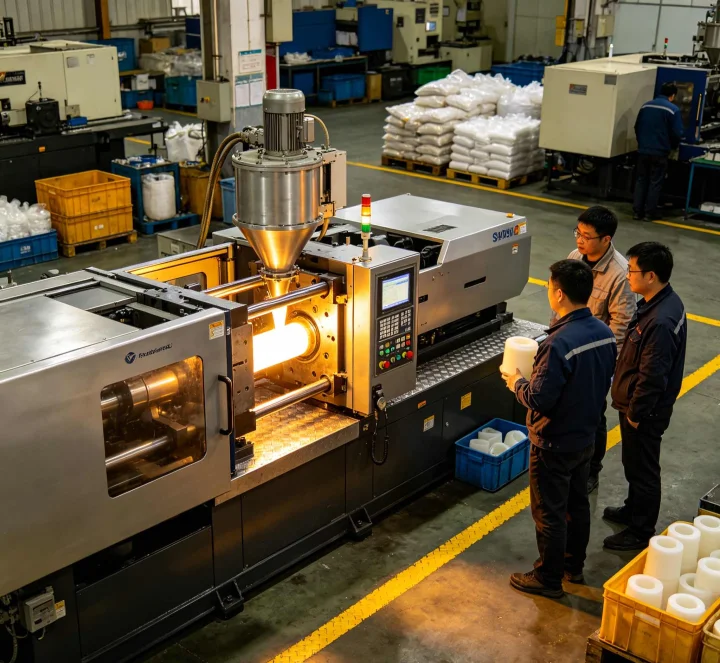
Many buyers ask how many machines a factory has. That is useful, but a better question is whether the machine range fits your product family. A factory with 50 machines is not automatically stronger than one with 18 machines if the second factory has the correct tonnage windows, automation, and process discipline.
| Capability Area | What to Verify | Typical Unit |
|---|---|---|
| Clamp force | Can the press prevent flash at required cavity pressure? | tons |
| Shot capacity | Is the part plus runner weight within an efficient operating range? | grams |
| Platen size | Can the mold fit without limiting water, ejection, or maintenance access? | millimeters |
| Screw diameter | Does plasticizing performance match resin and part geometry? | millimeters |
| Automation | Robot take-out, insert loading, and vision check support repeatability | seconds per cycle |
Ask for a machine list showing clamp force from, for example, 80 tons to 1,200 tons. Then map your product family to that list. If your part weighs 220 grams and your mold needs a press around 350 tons, but the factory mainly runs 90-ton and 800-ton machines, your job may be a poor fit. Because a mismatch creates inefficient utilization, so your project may receive unstable scheduling and a weaker cost structure.
3. Tooling capability is where long-term performance begins
A mold is not just a cavity; it is a production system. Buyers should review mold-flow thinking, steel selection, cooling channel layout, venting strategy, gate design, ejection balance, wear parts, and maintainability. Strong tooling capability often separates factories that can scale smoothly from factories that spend 6 weeks chasing recurring defects.
Ask the supplier what steel grades they use, what mold life they expect in cycles, and how they handle mold trials. If a factory claims a tool life of 500,000 cycles but offers no preventive maintenance schedule every 50,000 cycles or 100,000 cycles, that claim is incomplete. Because cooling design controls heat removal, so poor cooling usually means longer cycle times, higher warpage, and less stable dimensions.
Useful tooling questions include:
- What was the last similar mold size in millimeters?
- How many cavities were used?
- What cycle time in seconds was achieved?
- What resin shrinkage rate in % was assumed?
- How many engineering changes occurred before mass production?
4. Material handling reveals process maturity
Resin management is a major indicator of factory discipline. Hygroscopic materials such as PA, PC, PET, and some blends require controlled drying in specific degrees Celsius for defined hours. If a supplier cannot explain drying temperature, dew point, regrind ratio, and lot traceability, quality risk rises immediately.
Ask to see material storage, drying logs, mixing procedures, and line-side identification. For example, if nylon resin needs drying at 80 degrees Celsius to 90 degrees Celsius for 4 hours to 6 hours, but the plant treats every resin the same, you should expect inconsistency. Because moisture changes viscosity and final properties, so uncontrolled drying can lead to splay, brittleness, and dimensional drift.
Helpful references on plastics, safety, and manufacturing practices include NIST, OSHA, EPA, FDA, and U.S. Department of Energy.
5. Quality systems should produce evidence, not promises
When evaluating Injection molding capability, ask for sample evidence from real production. That includes first article inspection, in-process check sheets, control plans, gauge calibration records, material certificates, and nonconformance procedures. A quality system is useful only if it turns problems into data and corrective action.
Look for measurable indicators such as:
- Incoming material verification frequency per lot
- Dimensional inspection intervals every 1 hour or 2 hours
- Scrap rate below 2 % or 3 % for mature programs
- Cpk above 1.33 for critical dimensions
- Gauge repeatability and reproducibility studies in %
A supplier may say they perform 100 % inspection, but that statement can hide weak process capability. If the process itself is unstable, sorting simply increases labor cost in USD per hour. Because stable processes reduce variation at the source, so they are usually more reliable than heavy manual sorting.
For general standards and manufacturing research, you can also review NASA, NSF, MIT, and Stanford Engineering.
6. Evaluate engineering support and problem-solving speed
A factory’s technical team should be able to discuss gate location, sink mark risk, weld line position, wall thickness variation in millimeters, and possible resin substitutions. Ask how they manage DFM feedback, trial reports, and design revisions. Engineering responsiveness matters because many projects succeed or fail in the first 30 days to 60 days.
Request a sample DFM report. It should highlight draft angle in degrees, rib-to-wall ratio in %, gate suggestions, expected sink risk, and likely warpage zones. If the report is generic and does not reference your actual geometry, treat that as a warning sign.
7. Capacity planning: can the factory support your volume in 2026?
For 2026 programs, capacity planning deserves extra attention. Ask for available machine hours per month, utilization rate in %, maintenance downtime in hours per month, and backup machine options. A supplier with a good technical team can still miss delivery if the schedule is overloaded.
Check whether the factory can support pilot runs of 500 pieces, ramp-up to 10,000 pieces per month, or mass production of 1,000,000 pieces per year. Also verify raw material safety stock in days and packaging stock in weeks. Because capacity constraints reduce flexibility, so engineering changes and urgent orders become much harder to absorb.
For broader supply-chain and industrial data, buyers often monitor U.S. Census Bureau and U.S. Bureau of Labor Statistics.
8. Cost analysis: compare total cost, not just quoted price
The quoted piece price in USD per unit is only one layer. Buyers should compare tooling cost in USD, expected mold life in cycles, cycle time in seconds, cavity count, scrap rate in %, packing method, freight in USD per shipment, and payment terms in days. Total cost thinking usually prevents surprises.
For example, Supplier A may quote USD 0.42 per piece while Supplier B quotes USD 0.46 per piece. But if Supplier B reduces scrap by 4 %, shortens cycle time by 3 seconds, and extends tool life by 200,000 cycles, the overall economics may favor Supplier B over the full program life.
9. Red flags buyers should not ignore
Some warning signs appear early and should not be dismissed:
- No clear machine list with tons and shot size
- No mold maintenance records in cycles
- No resin drying standards in degrees Celsius and hours
- No dimensional reports in millimeters
- Very short quotes with many assumptions omitted
- Lead times that look unusually fast by 20 days or 30 days
- Inability to explain corrective action on past defects
A factory does not need to be perfect, but it should be transparent. Because open data exposes real capability, so transparency is often a better predictor of future performance than polished marketing language.
10. A practical factory evaluation scorecard
Use a weighted scorecard when comparing suppliers. One example is below:
| Category | Weight | What Good Looks Like |
|---|---|---|
| Machine fit | 20 % | Correct tonnage, shot range, platen size, and backup press availability |
| Tooling capability | 20 % | Strong DFM, cooling, venting, maintenance, and mold trial process |
| Quality control | 20 % | Measured results, traceability, calibrated gauges, and low scrap % |
| Material management | 10 % | Drying logs, lot control, regrind policy, and storage discipline |
| Engineering support | 10 % | Fast DFM feedback and effective root-cause analysis |
| Delivery capacity | 10 % | Reliable lead times, machine hours, and contingency planning |
| Total cost | 10 % | Competitive cost across tooling, scrap, packaging, and logistics |
This approach helps buyers avoid overweighting unit price. It also makes supplier selection easier to defend internally when procurement, engineering, and operations have different priorities.
FAQ
1. What is the first thing to check in an injection molding factory?
The first thing to check is whether the factory can repeatedly make your exact part within the required tolerance in millimeters, volume in pieces per year, and cosmetic standard. Start with machine fit, mold experience, resin handling, and actual quality records. If those four areas are weak, a low quote in USD per unit will not protect your program from delays or defects.
2. How important is machine tonnage?
Machine tonnage is essential because clamp force in tons must resist cavity pressure during fill and pack. If tonnage is too low, flash and instability can appear; if it is too high for the application, energy use and scheduling efficiency may suffer. Buyers should look at projected area, material behavior, shot size in grams, and mold dimensions in millimeters, not just one headline number.
3. Should buyers audit tooling capability separately from molding capability?
Yes, they should. Tooling capability determines cooling efficiency, venting quality, ejection balance, and long-term maintenance frequency in cycles. A factory may own capable presses but still run poorly designed molds that create warpage, sink, or short shots. Separating the two reviews gives you a clearer picture of production risk.
4. What documents should a supplier provide?
A reliable supplier should provide DFM feedback, mold trial reports, first article inspection, control plans, material certificates, dimensional data in millimeters, and maintenance records. If available, ask for process windows with melt temperature in degrees Celsius, cycle time in seconds, and inspection intervals in hours. These records show whether the factory works from evidence instead of memory.
5. How can I judge lead time reliability?
Do not accept a promised lead time in days at face value. Ask the supplier to show historical performance over at least 12 months, including tooling launch, sample approval, and mass production delivery. Compare quoted timing with actual timing and ask what happened during machine breakdowns, material shortages, or engineering changes. Reliable suppliers can explain both success and misses.
6. Is the lowest quote usually the best option?
Not usually. A low quote may leave out mold steel grade, spare inserts, texture approval, packaging quality, or inspection frequency. If scrap rises by 5 % or the tool requires repair after 100,000 cycles, the initial savings can disappear quickly. Buyers should compare total delivered cost in USD across the full life of the program.
7. What role does material expertise play?
Material expertise plays a major role because resin drying, shrinkage, flow length, and regrind policy influence final part performance. A factory familiar with engineering plastics can better control moisture, dimensional variation, and visual defects. That matters even more when tolerances are tight in millimeters or when parts face heat, impact, or chemical exposure.
8. Why is capacity planning important for 2026 sourcing?
Capacity planning matters in 2026 because demand patterns, labor availability, and logistics variability can shift quickly. Buyers should verify machine utilization in %, available production hours per month, backup press options, and safety stock in days. A technically good supplier can still fail if it has no room to absorb urgent orders or schedule changes.
Final thoughts
Choosing the right Injection molding partner is not about finding the cheapest quote or the largest factory. It is about finding the supplier whose machines, tooling, process control, material discipline, engineering support, and delivery capacity match your product and growth plan. When buyers ask for evidence in tons, grams, millimeters, seconds, days, and %, factory capability becomes much easier to evaluate objectively.
If you want a quick screening method, begin with machine fit, review real quality data, examine mold maintenance, verify resin control, and then compare total cost. That sequence will save time, reduce sourcing risk, and help you select a factory that can support stable production beyond the first sample shipment.
Post time: Apr-21-2026