Why Injection Molding Trends Matter for OEM Production
As we look toward 2026, the manufacturing landscape is being squeezed by tighter margins and a relentless demand for faster scale-up. Staying ahead of High-volume molding trends can make or break procurement budgets. For those managing global supply chains, saving just a few pennies on a multi-million unit run translates to a massive bottom-line impact.
Shifting economics in high-volume molding
The economics of high-volume production are shifting rapidly. Global tooling costs have risen by roughly 12% to 15% due to raw material and labor inflation. To offset these increases, procurement teams are pushing for higher amortization thresholds. Instead of calculating ROI over 250,000 units, buyers now demand tooling capable of withstanding 1,000,000+ shots with zero degradation. The focus has shifted entirely to total cost of ownership (TCO) rather than just the initial mold fee.
Market signals and keywords to watch
Procurement professionals should monitor key market signals, particularly concepts like conformal cooling, reshoring versus China-plus-one strategies, and bio-blended resins. Recent vendor audits reveal a 30% uptick in inquiries for sustainable materials that do not compromise mechanical strength. Buyers who ignore these developments risk being trapped in outdated, inefficient contracts by 2026.
Technical Trends Shaping High-Volume Injection Molding
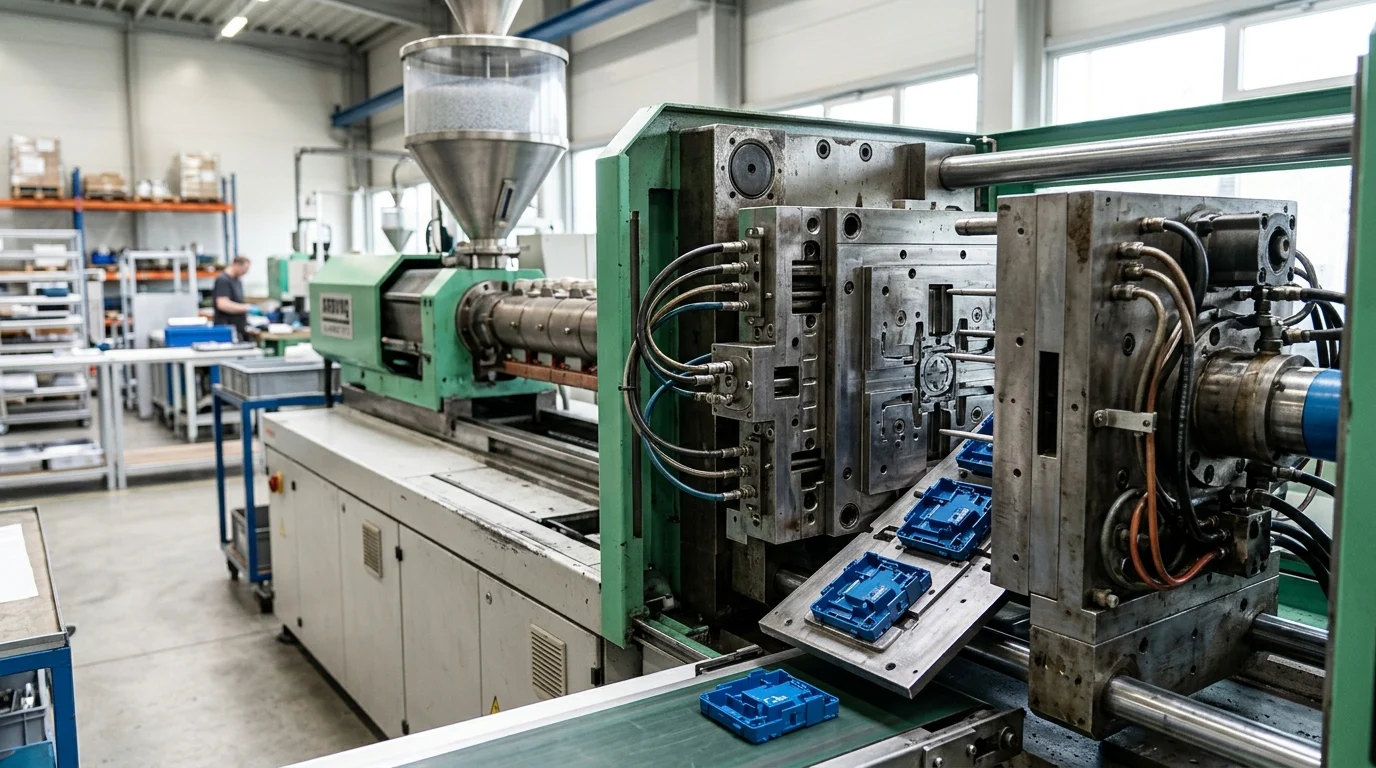
The manufacturing shop floor in 2026 will look vastly different from just a few years ago. Smarter technologies are being integrated to achieve tighter tolerances, driving impressive technical leaps across the industry.
Materials, tooling, and cycle-time priorities
When evaluating materials and tooling, cycle time remains paramount. Upgrading from standard P20 steel to hardened H13 or S136 allows for aggressive conformal cooling channels. Optimizing the cooling layout can drop cycle times from an average of 24 seconds down to 16 seconds. Over a 500,000-part run, shaving eight seconds per cycle saves hundreds of machine hours, which drastically reduces the piece price.
Automation, multi-cavity molds, and hot runners
Automation and advanced runner systems are no longer optional for achieving serious scale. Multi-cavity molds—ranging from 32 to 128 cavities—paired with fully automated robotic part-picking are becoming the industry baseline. Hot runner systems lead this charge by virtually eliminating sprue waste.
| Feature | Cold Runner System | Hot Runner System |
|---|---|---|
| Material Waste | High (10-25%) | Near Zero (<1%) |
| Cycle Time Impact | Adds 2-5 seconds | Optimized/Faster |
| Tooling Cost | Baseline ($) | Premium ($$$) |
| Best For | Low-to-mid volume | High-volume (500k+ shots) |
Resin selection criteria for OEM programs
Selecting the right resin for Industrial plastics requires balancing the Melt Flow Index (MFI), shrinkage rates, and end-use environments. Specifying standard ABS is no longer sufficient for complex applications. There is a massive shift toward glass-filled nylons (PA66 GF30) for structural components, as they offer tensile strength exceeding 130 MPa while maintaining excellent dimensional stability.
How to Evaluate Injection Molding Suppliers
Vetting a partner for Custom injection molding requires looking beyond the lowest quoted piece price. A rigorous evaluation process ensures suppliers can reliably deliver under pressure.
Core supplier capabilities and commercial terms
Evaluation must start with core capabilities and commercial terms. Assess the press tonnage range; a robust supplier should offer everything from 50T micro-molding up to 1,500T+ presses for large appliance panels. Furthermore, expect a documented defect rate of sub-500 PPM (Parts Per Million) and ISO 9001:2015 certification at a bare minimum. Favorable commercial terms typically involve a 30/40/30 payment split on tooling (tied to sample approval) and Net 45 to Net 60 days on production parts.
Offshore vs regional sourcing
The debate between offshore and regional sourcing is intensifying for 2026. While regional sourcing offers shorter transit times, offshore manufacturing maintains a massive advantage in tooling costs and scaled infrastructure.
| Metric | Offshore (Asia) | Regional (US/EU) |
|---|---|---|
| Average Tooling Cost | $15,000 – $40,000 | $45,000 – $120,000 |
| Tooling Lead Time | 4 – 6 Weeks | 8 – 14 Weeks |
| Piece Price (High Vol) | Lowest | Medium to High |
| Freight Transit | 25 – 35 Days (Ocean) | 2 – 5 Days (Truck) |
Engineering support and value-added services
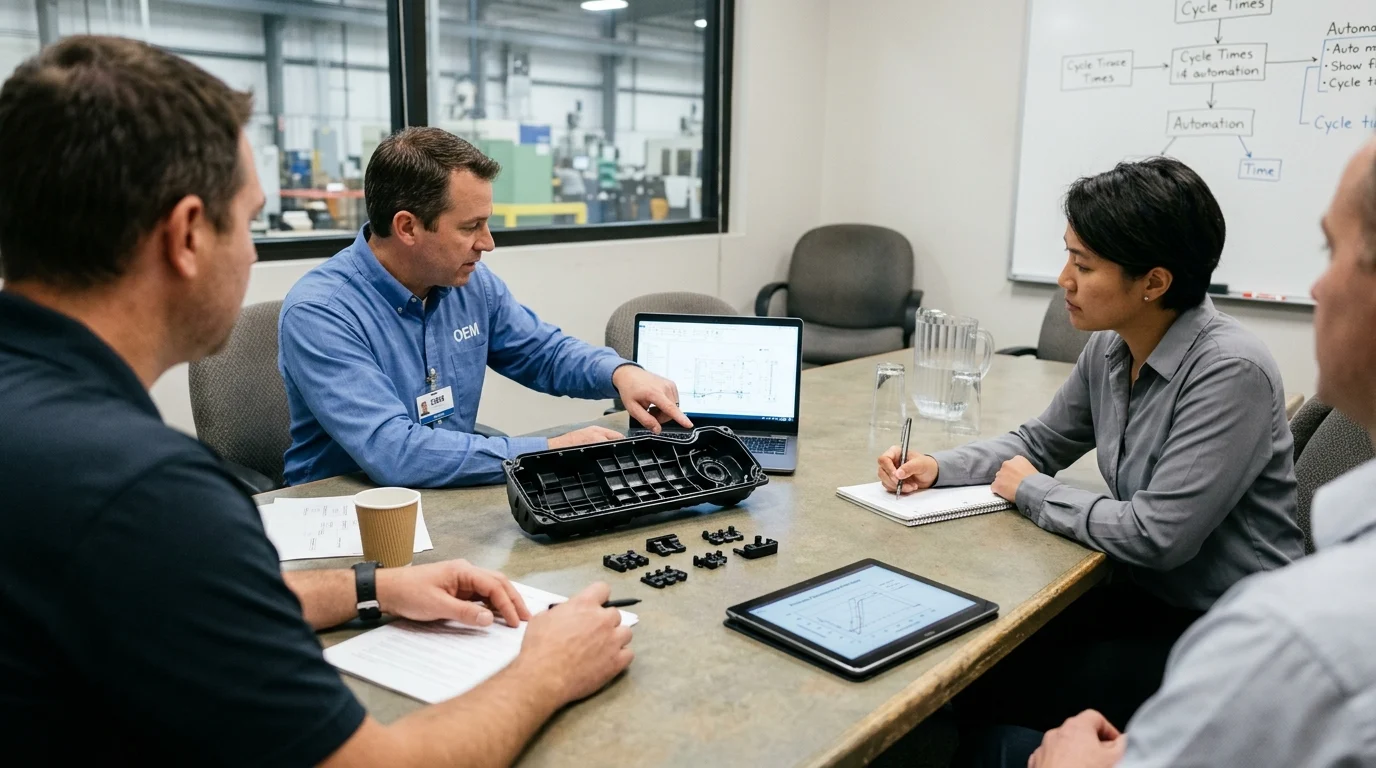
Engineering support is where a Plastic parts manufacturer truly proves its worth. Value-added services like in-house Design for Manufacturing (DFM) and mold flow analysis are critical. By keeping DFM and tooling design under one roof, mold revision times can routinely be cut by 30%. Furthermore, when a supplier can handle ultrasonic welding, pad printing, and final assembly in the same facility, it eliminates costly secondary logistics.
Compliance, Packaging, and Logistics for OEM Programs
Even perfectly molded parts lose their value if they get stuck in customs or arrive at the assembly line damaged. Logistics and compliance require just as much strategic attention as the molding process itself.
Compliance and documentation requirements
Compliance is not just a box to check; it is a legal barrier to entry. For electronics and consumer goods, resin data sheets must prove RoHS and REACH compliance. When dealing with enclosures, achieving a UL94 V-0 flammability rating is often non-negotiable. Procurement teams should demand material certificates of analysis (COA) with every batch, as a missing COA can hold up a $100,000 shipment at the border for weeks.
Packaging, labeling, and pallet configuration
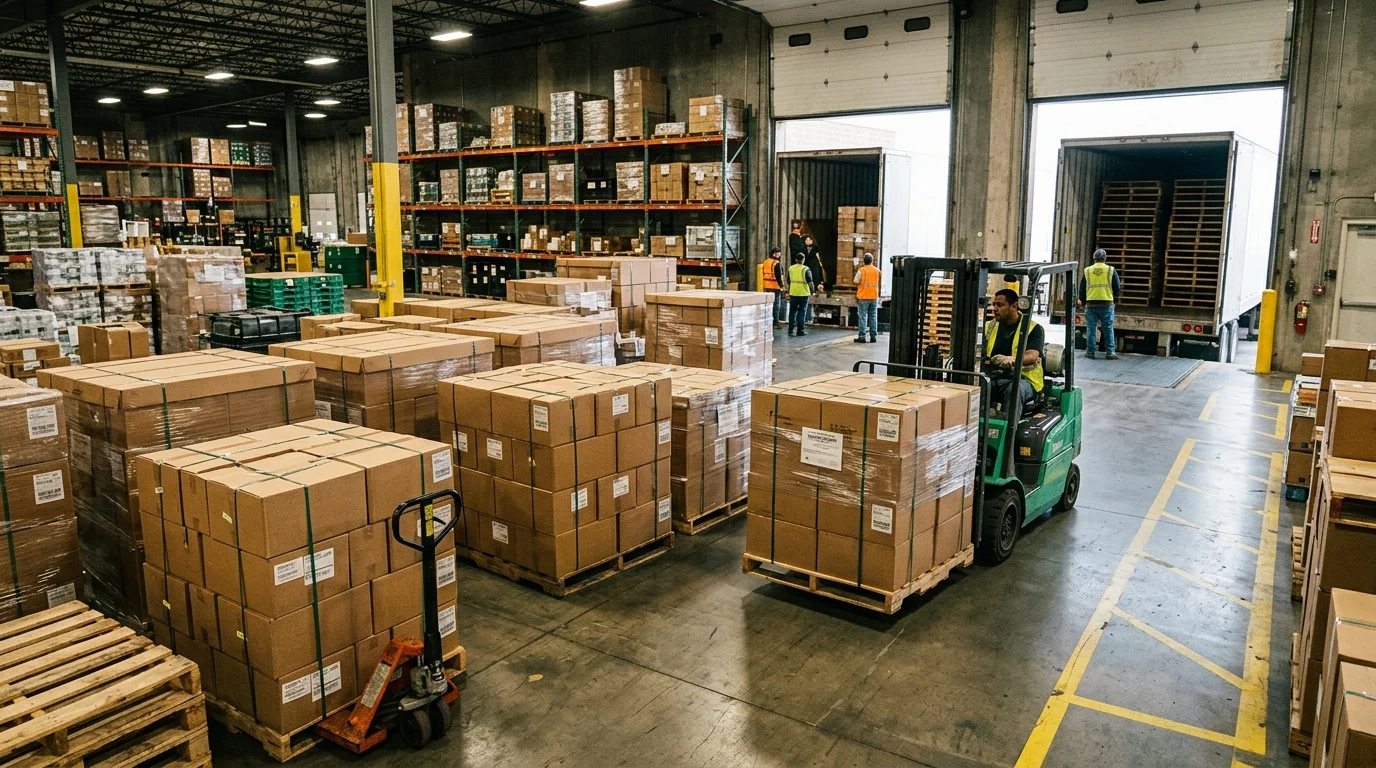
Inefficient packaging configurations can quickly erode profit margins. Shipping “air” is a common and costly mistake. Pack-out density can be optimized by moving away from generic, jumble-packed Gaylord boxes and utilizing custom thermoformed trays for class-A surface parts. Pallet configuration is equally vital; standardizing on 48×40-inch pallets with a maximum height of 50 inches maximizes container space, pushing utilization rates above 85%.
Sourcing steps to reduce supply risk
To mitigate supply risk, buffers must be built into the sourcing process. Maintaining a minimum safety stock of four to six weeks is recommended for offshore programs reliant on ocean freight. Additionally, dual-sourcing critical tools—or partnering with a supplier that operates multiple identical presses—ensures that a single machine breakdown does not halt the entire production line.
Building a Smarter Injection Molding Strategy for 2026
Finding success in OEM production requires a highly proactive approach. The procurement teams that succeed in 2026 will be those who treat their molders as strategic partners rather than transactional vendors.
Supplier shortlist and decision framework
Building a supplier shortlist requires a rigid, data-driven decision framework. A weighted scorecard is highly effective: 40% for TCO (including tooling, piece price, and freight), 30% for historical quality metrics (PPM and scrap rates), 20% for engineering capabilities (such as in-house DFM), and 10% for financial stability. Suppliers failing to score above 85 on this matrix should be disqualified from high-volume programs.
Aligning partner selection with business goals
Ultimately, aligning partner selection with long-term business goals drives profitability. If the goal is rapid product iteration, prioritize a supplier with an agile tooling shop. If the focus is absolute cost reduction on mature products, look for a partner with heavily automated, lights-out manufacturing capabilities. Leveraging comprehensive end-to-end solutions—from initial resin selection through to final packaged logistics—ensures that a procurement strategy remains bulletproof for 2026 and beyond.
Key Takeaways
- Wholesale sourcing and supply-chain implications for Injection molding
- Specifications, compliance, and commercial terms buyers should validate
- Actionable recommendations for distributors and procurement teams
Frequently Asked Questions
What mold life should OEM buyers expect in 2026?
For high-volume programs, target tooling validated for 1,000,000+ shots with stable dimensions and no meaningful degradation.
When does a hot runner usually make sense for OEM production?
It typically pays off at 500,000+ parts, where lower material waste and faster cycles offset the higher tooling cost.
How can cn-nbt.com support faster high-volume injection molding?
Look for multi-cavity tooling, robotic part-picking, and optimized cooling to cut cycle time and improve output consistency.
Which resin is increasingly preferred for structural molded parts?
PA66 GF30 is a common choice because it offers high strength, good dimensional stability, and suits demanding OEM applications.
What should buyers check when qualifying an injection molding supplier?
Verify press range, ISO 9001:2015 certification, documented defect rates below 500 PPM, and clear tooling and production payment terms.
Post time: Apr-16-2026